Saturday, 5 January 2013

Belfast: Borough of Barriers and Boats


Happy New Year everyone! To celebrate the turning of the years I thought I’d do pot-luck with my local airport – I went off to Belfast for 48 hours. It was a good time, although the weather didn’t really allow for much wild adventuring; I spent a lot of time contemplating barriers and boats.

Barriers

I first became aware of the ‘Troubles’ in 1996; I was 7, my Dad was going to London and the IRA had just bombed Canary Wharf. All I understood was, ‘the Irish are angry with us; and that’s why there are no bins’ but still a fairly nuanced understanding for a 7 year old. Then in Year 7 I read a book about a Romeo-and-Juliet-style couple split by the Trouble  centred around the Falls Road. I remember being struck by the story and storing it away somewhere for later use.

Shankhill Road

Later I studied ‘Archaeology of Modern Conflict’ at UCL;  we thought about wall murals and how these can be expressions of identity in civil war contexts. I decided I’d get a closer look and, much to my parents consternation, made a b-line for the Shankhill Estate. Shankhill is a protestant estate with much evidence of said on display. Union flags festoon the streets and there are lots of murals celebrating the centenary of the ‘Covenant’ (when the government in Belfast voted to stay with the UK in 1912). The established ‘Shankhill murals’ are  in the middle of a normal housing estate where normal people live. I saw no trouble while I was there, the only other people around were Shoreditch archetypes, all woollens and digi-SLRs; taking great interest in the repaint peace project and arty photos of the murals; apparently in summer the place is awash with tourists and the bus tours make good money. I walked down Cupar Way which reminded me of the Berlin wall, all arty and ‘give peace a chance’ but still rather substantial; and then onto Falls Road – the Catholic equivalent of Shankhill – Bobby Sands took a fairly central role here and I saw no tourists. 


Cupar Way

On both sides of the wall there was a roaring trade in memorials and a rhetoric of martyrdom. One mural in Shankhill represented nicely some of the thoughts I was having, ‘nothing about us, without us, is for us’; it was painted by someone who lives in Shankhill, for whom that landscape isn’t a fascinating museum dedicated to a dark and mysterious past. The murals are painted on the walls of homes in a living district, I bought a pasty from the sandwich shop, I sent a parcel from a post office in a queue of people waiting for their pensions. No-one wants to live in a goldfish bowl and be gawked at by tourists. Do we have any right to heritage-ise people’s living environment, and if so for what cause? And is it ethical to paint over memorials in the name of peace?

Shankhill Road
Cupar Way

Boats

On my second day I ventured to the ‘Titanic Quarter’; a modernised dock which took my head straight to Dusseldorf and Hamburg where similar regeneration projects have taken place. It’s really modern and features a shopping centre, museums, cafes and art works. On the way I stopped at the Belfast Barge – a thoroughly impressive, although poorly advertised museum. It’s free and it’s on board a boat – what’s not to love! Ok, what I really appreciated about the barge was how many ways it made its point – dressing up clothes, more information in drawers, DVD and touch screen features, testimonials and models – and the clever use it made of the limited space available. I even had a go at hammering in a rivet!

Belfast Barge

I decided to give the newly opened ‘Titanic Experience’ a miss on the advice of a fellow hostel user; ‘you pay £13 and then you can’t touch anything, it’s all lights and sounds and stuff’. Instead I walked an extra half a mile to the ‘authentic Titanic experience’ at the Pump House and Finishing Dock complete with real life tour guide AKA an actor seeking employment. I spent an hour being told many interesting tales of the Titanic’s creation and thought the physical impact of standing inside a giant concrete dry-dock was quite substantial. All the advertising for the Pump House was around it being the ‘authentic’ museum, what did that mean? Authentic because the boat actually rested there for 2 days, authentic because you can actually see and touch things that touched the Titanic? All the time conveniently ignoring the reality that some 2,000 other ships also passed through the same dock. Not sure, but there is something about being able to physically ‘touch’ the past which registers in a different part of my brain and is expected by the audience when they visit a ‘museum’,  that the ‘entertainment experience’ of ultra-modern museums doesn’t touch…plus it was half the price of the other one!

Authentic?

My holiday wasn’t a constant sociology exercise; honourable mentions also go to Ulster Museum (an amazingly in-depth history of Belfast and a lovely collection of butterflies), Maggie May’s cafĂ© (cheap milkshakes bigger than tankards) and Belfast YHA (which was my accommodation for the trip). Looks like I got back just on time too. See you soon for some foreign film reviews.

Sunday, 16 December 2012

Listening to Lord Farquaad (or Lithgow Talks!)


I love my National Theatre Entry Pass – it provides opportunities for young people to access groundbreaking theatre at discounted rates. When they told me John Lithgow – the voice of Lord Farquaad – was not only starring in a show but also doing a Q & A, and I could see both for £8, I booked it straight away.
(Dinner at the National Theatre)

Lithgow was interviewed by Nick Hytner, Director of the NT. The first thing I noticed when he stepped on stage was how tall he was!  It was a memorable opening as Lithgow described being born in a prop box. Born into a thoroughly theatrical family, Lithgow spent his childhood summers with his Dad’s Shakespeare troop in Ohio, starting with the small bit parts and graduating up to the young leads.

Lithgow was no fool and secured a scholarship at Harvard. He describes himself as the ‘best actor in Harvard by osmosis’ only a small underestimation of his evident dramatic talent (!) and a time of prolific output – he featured in some 8 or 9 plays per term and his repertoire had by this time expanded from Shakespeare to encompass several Russian playwrights among others . On some kind of Erasmus swap Lithgow made it to LAMDA which conferred on him a love of London and a convincing English accent, he describes it as like ‘swallowing a horsepill of Englishness’.

Lithgow also passed comment on his lifelong profession of acting deeming it a reckless and stupid career path. He has done numerous other things on top of acting to fill the quiet season from writing children’s books to conducting orchestras. He does this he says to avoid the actor’s agony of ‘waiting to be wanted’.

With this backdrop I ran off to speed munch my dinner and then returned to the front row to see Lithgow perform the lead role in Pintero’s  Victorian farce, The Magistrate. Damien Lewis loved it - he was sat about 6 rows behind me, desperately trying to keep a low profile. The play was everything I’ve come to expect from comedy at the NT, riotous, professional, splendid and slightly mad. The script set the action firmly in London and with my local interests that really pleased me! As ever the staging was central to the success of the play, this time it both rotated and rose on expensive mechanical, silent sets. Lithgow provided some hilariously comic moments particularly when acting out being attacked by a dog who obviously wasn’t there! And I loved the song about trying to guess the age of a lady; it was suggested you might chop her leg off and count the rings!

The Magistrate is on until March, there are plenty of discounted seats available and I can’t recommend it high enough!

Wednesday, 5 December 2012

Merry Christmas Racist Santa!


As you will know from previous posts I’m a bit obsessed with Continental Christmas traditions. A couchsurfer from Holland visited me a few months ago, and I requested native foodstuffs as my gift. She brought a bag of Kruidnoten ‘gingerbread’ biscuits and the story of the racist Santa which I now present.

December 5th is the day that good little Dutch children get their presents from the benevolent St Nik. Whilst the commercial kids now leave stockings and bags for Santa, traditionally the children always left out their shoes. If the child had been good Santa would fill those shoes with sweeties; if they had been bad they would start a whole new adventure, in Spain.


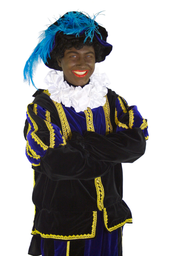
Unlike other Santas, St Nik, patron saint of Amsterdam, has a time-share in Spain; he likes to stay warm whilst he’s making all those sweets and toys. He has a team of helpers, who look like Moors. The story I heard was that the naughty children had been engaged in slave labour for Santa, climbing up and down chimneys and acquiring black faces, as it turns out in bygone centuries Santa had a black servant called, imaginatively, Black Pete and it was he who adorned my pack of Kruidnoten, like the most unashamed, Gollywogg I’ve ever seen!

 Just so racist.

And because Santa has been living all year in Spain how is he supposed to get to Holland – by steamboat of course! None of this sleigh and reindeer business, Santa is a civilised chap, who rides a steamboat to Holland and then a white and noble steed! This being a tradition he probably borrowed from pre-Christian times when his name was Odin.


I am fascinated by all these borrowings from different times Santa from one culture has gained to form his fully-fledged expression in the 21st century. I wonder how Dutch Santa will translate again in another 100 years, will he catch up with modern transport and fly from Spain perhaps? Will he be less racist? Only time will tell.

Merry early Christmas everyone!

Saturday, 10 November 2012

Offa's Dyke Walk: brought to you by the letter 'C'

Last month I went on a wonderfully reflective walking holiday along the Offa's Dyke Trail. Herewith some ruminations.

Context
Offa's Dyke is an incomplete earthwork running the length of Wales on the border between England and Wales. It is attributed to the eighth century, Anglo-Saxon king, Offa and was turned into a National Trail in 1971. Both before and since Offa this land has been contested between the Welsh and other opposing groups. The landscape en route is varied; from mountain ranges to rivers, plains and forest. I walked from Kington to Sedbury, with the company of my Mum between Hay and Monmouth, it required walking boots and walking poles.

(The weather was er, interesting - Llanthony)

Conquerors and Chieftains
As previously mentioned the path follows the borderlands between England and Wales, an area that has been contested for millennia. As such there is lots to interest the budding archaeologist from Norman castles to Iron Age hillforts and the remains of Roman settlements. I frequently marched off piste towards mapped inclines in the hope of finding settlements.

Much of the route is rural and there were frequent occasions where the vista could have been Saxon, sheep, forest, stone walls and mountains. No cars, no houses, no tarmac. This meant that the path was not always easy, frequently muddy and occasionally impassable. I was only trying to walk 15 miles on any given day but progress up inclines and through mud was often slow. When I wasn't feeling like Bear Grylls I had increasing sympathy for the Roman soldiers based in this landscape (they had a settlement at Abergavenny they called, 'Gobannium' - great name!). Agricola's comment, 'Britain is cold, wet and difficult to traverse! Take me back to Tunisia, now!' (I paraphrase) seemed rather fitting. There were times a spa would have been very nice.

Castles and Churches as Community
Not only is the trail a beautiful natural path it also brings you into contact with lots of gorgeous old buildings. Some of these buildings are ruins (Llanthony and Tintern Abbeys, Abergavenny Castle, Monmouth Castle) others less so (Chepstow castle) and some still in one piece (St David's Church -1108, Abergavenny Tithe Barn, Hergest Hall).

The more complete buildings and the illustrations at ruins really helped me to think about churches and castles with their attendant communities. The castles and priory communities had gardens, storehouses and fireplaces in evidence for supporting real people doing real life. These were homes for communities of people; places tradesmen created wares, politicians made decisions, women infiltrated and caused scandals. For once the ruins weren't just romantic photo opps, they were also representations of communities passed.

(Llanthony Castle)
Cultural Conquest
The Dyke is in a liminal place, somewhere between England and Wales. It was interesting to compare towns culturally in modern day life.

Kington screamed rural English village. I went to a pub where people spoke like they were the cast of Hot Fuzz, there were roasts a plenty of cosy fires.

Hay on Wye on the other hand was 'just inside Wales' as declared by a deliciously comic partnering between the 'Welcome to Wales' sign and the 'Beware Children. Beware Old People' signpost.

Llanthony was Welsh and very rural, Pandy was still Wales, Abergavenny had a strong Welsh identity. The Welsh dragon was everywhere, even in the priory choir stalls; they had a cwtch coffee shop and all signs were billingual. We heard a lot of Welsh spoken here too.

(Dragon carving, St Mary's Priory, Abergavenny)

Monmouth our next stop by contrast was adamantly English. There was clear overtones of Norman settlement and monied English inhabitants, even the shops Fatface, Joules etc. testified that English culture was truly settled here. This emphasis was further supported by the Habs boarding school also based in the town.

Abergavenny v. Monmouth was an interesting experience.

Chepstow castle was a study in this influence of nationality and fashion on communities in the borderlands. The castle is a very early Norman castle. See downright Mediterranean designs on the oldest part of the castle, reminiscent of the Tower of London and other early Norman fortifications. As design developed so did the castle, accruing round turrets and other architectural design. One room is decked out in Tudor design; it was gaudy to say the least. Other parts of the castle have been left without roofing. The buildings were used as a fortification for some 500 years and developed different emphases as the years passed. But always they had thick walls, doors and barred entry. As I walked the walls of Chepstow castle I realised that thick walls are about more than protecting one king, or magnate, its about the defence of a whole community. It must be a nightmare to preserve a space like this, which has developed over several centuries, in a way that pleases and educates all interests.


(Chepstow Castle, Tudor Room)

(Early Norman Chepstow Castle)

The Tithe Barn at Abergavenny is also worthy of note. Originally built in the 12th century to house tithe from the local community, it still stands today and has seen a number of uses including 17th century theatre and a disco in the 1970's! Each population used the space as seemed best to them. Today the tithe barn is a museum encouraging story-telling and Anglo-Welsh history. Each generation has put its stamp on the building, adding to it and taking away. I wonder what people will think of what we've done in 300 years time to our historical and current buildings.

Part of the path is preserved by English Heritage. Here the bank seemed at its steepest and the paths were well maintained as if the very trees were under control. Given that the purpose of Offa's Dyke is unclear, but one hypothesis is it was a military defence (to keep the Welsh out) created by Welsh slave labour, its interesting it is preserved by 'English heritage'. Given another 1,200 years I wonder what else will be deemed suitable preservation material?

Can-do!
As well as providing lots of pretty historical spaces this holiday gifted me a can-do attitude. Away from the computer screens and phone signal, the challenges were different - how do I outwit a crowd of angry looking cows, how do I climb up this muddy incline with no hand-grips? How do I get to the end of this path when there are gates and tree trunks in the way? It required a different skill set and ingenuity in often unused areas but I really enjoyed my trip in the time machine.

Sunday, 28 October 2012

Skyfall: Bond of 2012

I recognise I break the tradition of varied comment but please find herewith my analysis of Skyfall, the latest Bond film. Anxious as ever to avoid plotline, essentially my argument is that Skyfall is tightly a product of 2012.


Bond: The Patriot

Although Bond films have often been about tradition in Skyfall unlike many of the previous films England is a real focus. M has a Doulton British bulldog on her desk, most of the action happens in London or rural Scotland. When Bond plays word association, in reply to 'country' he says 'England'. The strong sense of patriotism laced throughout the film can only have been released in the positive patriotism atmosphere of 2012. It has taken a royal wedding, a jubilee and the Olympics to make the English recognise their latent patriotism and it seems these events have enabled English film makers to join other artists (like Cath Kidston) to recognise their 'English' or 'London'ness (although these are very different concepts, not to be conflated!).

 Royal Doulton's British Bulldog


Bond: The Healthy

When you watch a Bond film you expect to see gratuitous violence, sex, Martinis and lots of gambling. Never was this more true than in Casino Royale (2006) which was mainly set in a casino (clue's in the name!). But Skyfall is quite different; there is some sex but it is limited and quite veiled. Whilst Bond does enter a casino he never actually places any bets. He does drink, and occasionally to excess, but this is viewed as part of his demise that requires rectifying rather than something to be idolised. Bond does kill in this film (and equates 'murder' with 'employment' in the aforementioned word association game); but violence is portrayed as the last resort, something that only bad guys do, the 'good' prefer detention. This reflects the health agenda particularly in entertainment; the idols must have healthy gym routines, may in fact be t-total and leave behind their complicated pasts. Being 'zen' is in, being ostentatious is out.


Bond meets Q at the National Gallery      Bond surfing the tube (neither are my images)

Bond: The Advertiser

There has been plenty of discussion about product placement in this film. The products advertised include: Sony (its a sony film though!), Range Rover, Heineken, Jaguar and Austin Martin. Some of the advertising is actually quite subtle, take Jaguar for example, its just the logo stitched into the headrest of Bond's car. There has been some upset that Bond drinks Heineken and not a Martini, I have to admit I missed this placement and I was looking for it! For what its worth, I think that product placement has always been a part of Bond films, in fact a work colleague told me just this last week that his watch was 'the same as Bond's'. Although the products, and the number needed to sponsor a film, may have changed the necessity of sponsorship is the same as ever - big explosions, wrecking cars and ensuring quality casting all cost money. And sponsors are really helpful in a recession.

Q: The youthful computer nerd

More and more the content of spy entertainment revolves around the impact of e-terror. During Skyfall I was much reminded of the last series of Spooks in which Tariq Masood the techno-geek played an increasingly important role in spy activity. This Bond's Q is the frankly gorgeous, Ben Whishaw, and he plays it modern geeky, he's got the cardigan and dark frames look going down, he is essentially an ethical hacker. His approach is quite different from Micheal Caine's, much younger and less about the gadgets, more focussed on the brain; 'Were you expected an exploding pen? We don't really go in for that anymore'. This shift away from the stuff, and towards the way in which we can use technology to help us achieve our aims seems reminiscent of the 2000+ world.

Ben Wishaw as Q (not my picture!)

As ever this Bond was high-octane, featured a surreal trailer, the words, 'Bond, James Bond', and a reference to Moneypenny. I really liked this Bond because of its focus on Bond as relational human as well as nation's superhero. Definitely one of my favourite Bonds; but then only the third I've seen at the cinema; possibly the last with Craig? See it!

Thursday, 18 October 2012

the perks of being a wallflower


I wrote this post on my phone: 2 weeks ago. Then I went on holiday. More on that in subsequent posts.

Last night I did that weird thing I sometimes do, I went to the cinema on my own to see a feel-good coming of age film, 'the perks of being a wallflower'. I was in for a bit of a shock.

The film is about a boy, Charlie (Logan Lerman) going to middle school for the first time and coming of age. Charlie doesn't fit in right away, but he's the most gorgeous misfit I've ever seen (Lerman is 20; that's almost not pervy!). Over time Charlie meets all the common characters of the high school drama, the jock (who is secretly gay), the design tech class noone can take seriously, the kooky oddball friends who turn out to be cool, and the teacher who 'like made your life'. Charlie also does coming of age things - he goes to parties, accidentally takes drugs, kisses girls, kisses boys and obviously, performs in rocky horror (!). But this story has some cruel twists which begin about half way in when his flashbacks start coming thicker and faster; what is wrong with Charlie?

(you fancy a girl so you help her with her homework - very 10 things I hate about you!)

So in an attempt to not give too much of the plot away I have decided as ever to talk about form (this is inspired by my good friend Dan Curtis). TPOBAW has good form. Set in the early 90's the cinematography has that bold colour with hints of fuzz which I remember from shows like 'Fresh Prince of Bel Air'. There was lots of echoes of other American teen films in it; in fact the dialogue that ends with Sam, 'I love the smiths' seems almost verbatim from '500 days of summer'. What does a love for the Smiths, Simon & Garfunkel signify for American teenagers of the 90's? - they'd fit right in on a Shoreditch night out!

Charlie is supposed to be an avid reader and one of the books his teacher recommends is 'The Great Gatsby'. Nick Carroway in Gatsby is often accused of being a helpless wallflower, perhaps Charlie too is a naive child initiated into adulthood. The visual scenes of party going and drug abuse in the film were reminiscent of the chaotic excesses in Fitzgerald's 'Tender is the Night' ('perverted as a breakfast of oatmeal and hashish' always being a memorable line).

 (Mad nights out - can't find any photos without old Watson in!)

So what was good? I really enjoyed watching Charlie find his freedom and the way he overcame his past and I really invested in him as a character; when sad things happen to him I felt sad. You can tell a writer of actual books has also been involved in the screen writing as the lines are poetic in places.

What was naff? Watson tries to play an American; I failed to disassociate her with harry potter and her accent was fleeting at best. Also the thing I really can't believe is that its a 12a. This certification may be because the references to sexual abuse, drug abuse and nudity are at least veiled but I will admit the film left me panicky and wanting my mum! Perhaps I've just lived a sheltered life although there was a point where I hid behind my hoody so this never will be a complete review.


All in all faithful cinematography, slightly scary plotline, generally good acting, won't change the world but a good thinking, reminiscing kinda film. I will give it 3/5.

Sunday, 23 September 2012

B road to Brighton

Last Sunday I cycled 54 miles, for charity from London to Brighton. It took me a long time – more than twice as long as my grandpa in 1939 who was on a single speed bike.

Grandpa's cycling medal - 50 miles in 2hrs 32mins

It all really began the night before, when my thighs were feeling chafed from too much fun; I was at my other grandfather’s house. No one had any moisturiser and it was 11.30 on a Saturday night. I would reiterate, my legs were really sore. So I traipsed downstairs, like a ninja, trying not to disturb my sleeping grandpa to apply my deceased grandma’s face cream to my thighs. I hope you will understand this as a funny story and not think I am a horrible human being.

The next day the alarm went off at 5.45, and after a bowl of Frosties and half a grapefruit we set off for Streatham Common in the car – as the sun rose over Sainsbury’s from whence we would depart, I was really starting to wonder whether this was a good idea. Thankfully it was at this point I met Melvin; encouraged by his smiley grin I set off.

Me and Melvin in Streatham at 7 in the morning! So chirpy!

Despite the pain in my knee which started pretty much immediately, the first 10 miles were actually alright. I cycled through Lambeth and noticed how quickly a city felt like country. As usual my obsession with London was reminding me of what a recent phenomenon the urbanisation of South London is. It was also very much a ride through my ancestry – starting with Purley and Croydon. I was peddling along quite happily, remembering that I needed to conserve energy, when I hit Chipstead – and the hills leaving London. Its not that the hills were high its just that they required energy and quite early on. I got peddling and soon reached the Dog and Duck – 20 miles. Feeling good I headed towards lunch – primarily uphill; and on one occasion nearly vomited from the effort of propulsion on those gradients.

Lunch at The Ark, 28 miles in and at just 10 am was delicious. They had put on a veritable feast and I enjoyed haloumi salads, ham, olives, tea and a massive piece of carrot cake. Back on the bike the next 6 miles were very conducive to digestion as they were all downhill – encompassing both my maternal and paternal history, through East Grinstead, past the Bluebell Railway, and through Guildford. From about the 30 mile mark the nemesis was visible; rising like the edge of a pudding bowl was Ditchley Beacon (830ft above sea level), it did not inspire great faith in my ability to finish. By this time I had added an achy lower back, painful ribs and an inability to breathe to my painful knee.

Lunch at The Ark

35-42 miles was killer. Despite taking numerous pauses for breath, imagine your alveoli have been put in a washing machine, I did keep pedalling. During one of my rest breaks a guy half got off half fell off his bike towards me yelling as he fell – turns out he only had cramp but we had a great conversation and its all part of the camaraderie. Later in the trip, when I was struggling he encouraged me too.

On the other side of the Beacon, which I admit I walked, the descent to Brighton was thrilling, the end so visible and the path so easy. The final miles along the pier victorious. The resting on the beach afterwards glorious and chip-filled. The whole trip a bit emotive.

Brighton - I made it!

I think I learn by doing and the first thing I learned was that I can overcome. It might take time, it might take me longer than other people, but I can complete things even when they are tough. I hope to take this life lesson into the rest of life - even when it looks like other people are taking short-cuts to where the fun is!

Secondly, I learned that success is defined in different ways. For some people their aim was to finish first, for other people it was to cycle the beacon, or to simply cycle as much as possible. For me my aim was to finish - which I did. As in life people will have different goals and different definitions of success. Your definition of success will define what sort of ride you have.

Thirdly, I learned about motivation. Being a charity cycle people had all sorts of different motivating factors for doing their cycle - some had lost family members, others had been affected by other kinds of loss of sense, of dear pets, of rights. At the top of the Beacon I saw one lady with 'for my little angel' and her deceased daughter on her t-shirt. I nearly cried. The whole thing was so emotive. What makes humans push to their last? Experience, the opinions of others, needing to prove themselves, boredom? I was also fascinated by how doing spin for 2 years has conditioned me and helped me reach the finish line. During a spin class one cycles to the RPM of the track in question not to one's energy levels. That is what pulled me through the 35-42; music with a fairly fast RPM; that and knowing that was the only way of getting back home, plus the threat of you lot being disappointed.

I imagine you're wondering how I'm getting on now - actually OK. It seems cycling sustainably, eating two portions of chips and hanging out with a good friend afterwards is a recipe for health and satisfaction. Thank you for your sponsorship and encouragement! See you soon!