Showing posts with label review. Show all posts

Monday, 14 August 2017

DUNKIRK: A review

I recognise I'm pretty late to this party but last week I saw Dunkirk and regardless of anything else it was a lesson in cinematography.

WARNING: MANY SPOILERS

I'll admit I was affected by location and circumstance. The day before I had made that same journey, to Dunkirk and then on to Paris with my 10 year old godson, albeit we went under, not over the ocean. Travelling on the metro we saw signs for the film with its French spelling (Dunkerque) and I thought about how a French director or screenwriter might have written a slightly different film.

I went to see the film when I was staying with my parents, at a budget friendly, no frills cinema on Canvey Island. Driving to and from the cinema I drove along that same coastline that had sent the little fishing boats from Leigh on Sea to their heroic adventure; the story of the Dunkirk flotilla is written into our local story. Both the French and Essex experiences helped a long-distant event feel very present to me.

And that's to say nothing of the cinematography. There are some political aspects to this film which I will come around to, but first I want to tell you about the incredible creativity that was poured out on this highly stylised film quite so effectively.

Blue and Grey

Colour and musical tone were used to great effect. Everything was different shades of blue and grey for a long time; despair was played out in monochrome monotony - the sea and sky became indistinguishable at the horizon and I really believed like the men at sea that maybe help was never coming. This was echoed in Hans Zimmer's score - all minor chords and constant suspense. Christopher Nolan is well known for his use of the Shepard tone - its a corkscrew effect that makes you feel as if the music is constantly climbing and it sets your teeth on edge - he uses it to good effect in this film.


But when the fleet of ships arrive all of this changes the little boat is full of colour - the sailor's jumper, the hull of the boat, the women on the other ships - warm reds and oranges explode onto the screen in this triumph of hope. This glory is reflected in the music which changes to major and we get this brief reprieve from the Shepard Tone. This is epitomised in the final flight of Farrier to Elgar's Nimrod - all major chords and full colour; hope for the soldiers and for us.


Our glorious past?

Whilst the majority of the film feels hopeless and disastrous and not at all glamorous I would define it as a patriotic film. Through thoroughly limited dialogue a large emphasis is put on the role of 'home', and putting Churchill's words into the mouth of an ordinary soldier was very effective at underlining the sacrifice of 'the few'. It did make every body out to be heroes - Nolan shows some awareness of this in the heroic write up of George, killed by his own side but declared a war hero in the paper, but the rest of the film argues against this. Commander Bolton chooses to 'wait for the French' at the end of the film instead of getting the boat home, he chooses certain death; although Dad pointed out to me this is a charming nod to the 50's films I felt it was a bit dramatic.

The issue I take with this film is the effect it had on me, I left the cinema thinking, 'you know what we need? A jolly good war!'. And that scares me because I am by nature a fairly peaceful soul; somebody more prone to conflict would be easily fired up by the narrative.

Like any story you do have to simplify the facts for the sake of a good story, but I agree with Sharmal that there was significant white-washing in this film - and the featured token person of colour was tokenism exemplified. Although the stance taken by Nolan on this was inline with the narrative we are told in schools there was a real opportunity here to tell less known stories; it is a shame that opportunity was missed.

In summary this is a powerful piece of cinema, expertly composed, that will rightly win many awards; entertainment does not always have to be educational - and it certainly was an education in cinematography - but I do wish we had been told a story of somebody new that recognised the complexity of war, rather than glorification of the armed forces.


Friday, 26 September 2014

James III: National Theatre Scotland

This week I had an extra special theatre experience at the National, watching the National Theatre of Scotland's James III - from the stage.

Jamie Sives (Game of Thrones) and Sofie Gråbøl (The Killing). 
King James III and Queen Margaret of Denmark.
Photo Credit: National Theatre.

Click here to see trailer.


Theatre in the round

James III is one of a trio of plays by Rona Munro charting the history of the first 3 James kings of Scotland. It was originally performed at Edinburgh International Festival in the round and they've copied this format for the performance in the Olivier Theatre. This meant I got to go back stage. It was so magical to see the engine rooms of the National Theatre, the backstage props and the perspective of performers looking out on an audience from the stage.

The play itself is a contemporary rendering of the history of James III of Scotland by Rona Munro. Both acts commence with a ceilidh band playing 'Born this way' and other modern classics which subtly allude to the plot. The characters wear modern dress with the odd nod to the fifteenth century (a la Robin Hood circa 2006).

Jester King

James' court is portrayed rather like that of King Henry VIII's in The Other Boleyn Girl, pretty poor girls, poor economic decisions and banishment of the privy council. I particularly enjoyed the moment where James III sacrifices the funds for a pilgrimage to Avignon to instead employ a choir to follow him round at all times to make life more 'beautiful'.

This play is all about the girls; the mistresses, the mothers and the formidable Danish queen, Margaret, who might be a bit past her best but has one hell of a head on her shoulders. Beyond the privy council, the nobles, Lord John and sibling rivalries the real power is held by the girls. There was a particularly strong performance from Sofie Gråbøl showing depth of character and progression.

Poignancy of timing

I watched this play one week after Scotland's referendum. There are plenty of references to the relationship between England and Scotland as James III constantly suffered the threat of English invasion and coercion. Munro illustrates the links between the historical political circumstance and that of today very well, so  little has changed in 500 years. A contemporary play, James III gave me an insight into how Shakespeare's history plays must have been received by the audience of the day; the parallels to their modern day circumstances must have been clear.


The show was a sensation, taught me loads of Scottish history and provided a unique backstage tour as part of the bargain. I'm really looking forward to seeing the first of the trio, James I, in a few weeks time.

King James is played by Game of Thrones star, Jamie Sives, and Margaret of Denmark by Sofie Gråbøl from The Killing. James III features full nudity and is not appropriate for those under 14 years old. The three James plays run daily in rotation, you can still get tickets for £15 until 29th October.

Thursday, 2 January 2014

Janvier

As ever I've been up to loads of stuff and not spending very long typing. I did so many things in December that I actually spent a whole week in my pjs not moving just to recover!

Exciting changes include: turning 25 (I went to a salsa bar and drank so many tequilas that my basic step was a sight to behold!), leaving one job (sob!sob!), but starting a new one (hurrah!) and all the wine and books I got for Christmas. I also attended a charming wedding and squeezed in time to visit Germany one last time this year (might tell you about that soon). Yeah I know! I'm obsessed!


(zumba parties, avignon, berlin and my 25th!)

Before moving on to a review of one of the many books I've come into contact with this season I thought I'd just pause and reflect on the last year. By my blog-posts alone I have been incredibly fortunate; look at all those holidays, books and plays. And they are only the experiences that have made the cut. That is to say nothing of the long-weekends, the weddings, the private views and the DMCs enveloped under a blanket of stars! 2013 has been pretty decent, here's to an equally solid 2014!

(Little Face by Sophie Hannah, oh wow!)


Little Face - Sophie Hannah
Little Face was one of the world book night titles of 2013 and was handed to me box-fresh by a friend in October. I have to say I remained unmoved by the cover for quite some time so didn't discover it until a wintery morning under the covers when I devoured the opening 50 pages in one sitting. This book is so gripping I stayed up to finish reading it last night, I admit I paused for Sherlock, but I am human! Its a sensational page-turner about a child abduction. Something terrible in the context of somewhere very luxurious. I liked the way she plays with time, unafraid to jump between weeks as the chapters progress. I was amazed at the way she sort of grabbed me by the jugular and kept me involved, the suspense was incredible. It would make a great two-parter BBC drama. Its a little bit dark and has so many last minute twists but I loved it! Plus she mentioned ASNAC for extra geek points!

Hoping to be back later in the week to talk you through my observations from Aachen but many other things to do first! So we'll see!


Sunday, 10 March 2013

Good things come in threes

It seems I am doing everything in threes at the moment from ideas to hobbies. After watching People I watched two more live shows in 24 hours this week. Herewith an introduction to Cardboard Citizens Forum Theatre Piece, Glasshouse.

Cardboard Citizens are a travelling theatre troupe, set up in the early 1990’s as a proactive response to homelessness in London. The troupe are primarily made up of people with experience of homelessness and that focuses the content of their work. The shows they run tours both in schools and hostels, and also in mainstream theatres. Despite serving social aims this troupe does not run on pity, but on excellence and professionalism.

Glasshouse - Copyright: Cardboard Citizens

Cardboard Citizens are pioneers of forum theatre. A style Shakespeare would have recognised. During Glasshouse the players present one story through the eyes of three different characters and it doesn’t end well. The audience’s job is first to watch and listen and then to suggest how different decisions and actions could change the outcome for the character of their choice. Your words of course are not enough; to change it for the character you literally step into their shoes, taking their place and experiencing what the scenario  feels like from their perspective. Some of the tactics work, and some of them just seem to make it worse.

This forum-style was really effective for me as an audience member. It made me reflect on the way that I respond to conflict and to difficult life circumstances more generally. It was a style I remembered from Sex-Ed and Crime-Stoppers at school; but that doesn’t stop it being an effective way to challenge people and make them think. More than that, it didn’t feel like school because these guys were professionals, they were highly polished entertainers as well as educators. And the work of Cardboard Citizens clearly goes beyond teaching drama, to getting people back on their feet in really practical, humanising ways!

Glasshouse is touring, its in Southend tomorrow and then in East London, at Richmix on Saturday, as well as numerous venues in between. See it if you get the chance!

Sunday, 28 October 2012

Skyfall: Bond of 2012

I recognise I break the tradition of varied comment but please find herewith my analysis of Skyfall, the latest Bond film. Anxious as ever to avoid plotline, essentially my argument is that Skyfall is tightly a product of 2012.


Bond: The Patriot

Although Bond films have often been about tradition in Skyfall unlike many of the previous films England is a real focus. M has a Doulton British bulldog on her desk, most of the action happens in London or rural Scotland. When Bond plays word association, in reply to 'country' he says 'England'. The strong sense of patriotism laced throughout the film can only have been released in the positive patriotism atmosphere of 2012. It has taken a royal wedding, a jubilee and the Olympics to make the English recognise their latent patriotism and it seems these events have enabled English film makers to join other artists (like Cath Kidston) to recognise their 'English' or 'London'ness (although these are very different concepts, not to be conflated!).

 Royal Doulton's British Bulldog


Bond: The Healthy

When you watch a Bond film you expect to see gratuitous violence, sex, Martinis and lots of gambling. Never was this more true than in Casino Royale (2006) which was mainly set in a casino (clue's in the name!). But Skyfall is quite different; there is some sex but it is limited and quite veiled. Whilst Bond does enter a casino he never actually places any bets. He does drink, and occasionally to excess, but this is viewed as part of his demise that requires rectifying rather than something to be idolised. Bond does kill in this film (and equates 'murder' with 'employment' in the aforementioned word association game); but violence is portrayed as the last resort, something that only bad guys do, the 'good' prefer detention. This reflects the health agenda particularly in entertainment; the idols must have healthy gym routines, may in fact be t-total and leave behind their complicated pasts. Being 'zen' is in, being ostentatious is out.


Bond meets Q at the National Gallery      Bond surfing the tube (neither are my images)

Bond: The Advertiser

There has been plenty of discussion about product placement in this film. The products advertised include: Sony (its a sony film though!), Range Rover, Heineken, Jaguar and Austin Martin. Some of the advertising is actually quite subtle, take Jaguar for example, its just the logo stitched into the headrest of Bond's car. There has been some upset that Bond drinks Heineken and not a Martini, I have to admit I missed this placement and I was looking for it! For what its worth, I think that product placement has always been a part of Bond films, in fact a work colleague told me just this last week that his watch was 'the same as Bond's'. Although the products, and the number needed to sponsor a film, may have changed the necessity of sponsorship is the same as ever - big explosions, wrecking cars and ensuring quality casting all cost money. And sponsors are really helpful in a recession.

Q: The youthful computer nerd

More and more the content of spy entertainment revolves around the impact of e-terror. During Skyfall I was much reminded of the last series of Spooks in which Tariq Masood the techno-geek played an increasingly important role in spy activity. This Bond's Q is the frankly gorgeous, Ben Whishaw, and he plays it modern geeky, he's got the cardigan and dark frames look going down, he is essentially an ethical hacker. His approach is quite different from Micheal Caine's, much younger and less about the gadgets, more focussed on the brain; 'Were you expected an exploding pen? We don't really go in for that anymore'. This shift away from the stuff, and towards the way in which we can use technology to help us achieve our aims seems reminiscent of the 2000+ world.

Ben Wishaw as Q (not my picture!)

As ever this Bond was high-octane, featured a surreal trailer, the words, 'Bond, James Bond', and a reference to Moneypenny. I really liked this Bond because of its focus on Bond as relational human as well as nation's superhero. Definitely one of my favourite Bonds; but then only the third I've seen at the cinema; possibly the last with Craig? See it!

Monday, 2 April 2012

Hampton and Hunger


Today’s blogs brought to you by the letter, ‘h’.

Hampton Court Palace
 
On Friday I had the great pleasure of visiting Hampton Court Palace and its beautiful gardens. Hampton is an English royal palace, built first by Cardinal Wolsey, an adviser to Henry VIII. The building subsequently left ecclesiastical hands when Henry VIII took the palace over, built additions to it and had his family based there. A century and a half later William III bulldozed half the Tudor Palace and created a grand baroque country home. 

 (Tudor Hampton Court on a sunny day)

Although entry cost £16 for an adult it was well worth the money. Entry included access to both parts of the palace, all the gardens, Henry’s chapel royal and a handset which gave different tours of all parts of the palace. I was immediately struck by how like a Cambridge college the whole thing was; the clock and base court of Henry’ s palace being reminiscent of St John’s and William’s palace and gardens more like Clare.

The palace itself is laid out in several different styles, Williams’s apartments were laid out in the traditional style of a country house, showcasing the royal collection of paintings. Whereas Henry VIII’s apartments and kitchens on the other hand were laid out as Henry VIII would have had them at the time, with a strong emphasis on experimental archaeology; reinforced by the constant referral to the archaeologists on the handset. Henry’s royal chapel is really worth a look.

One of the strongest exhibitions was about Henry’s early life and first marriage. I liked the fact that although it was sited in the traditional structure of the palace, it was a blank canvas onto which new ideas were painted. There were videos projected onto the walls, speakers hidden in seats and interactive screens. In each room the relationship between Woolsey, Henry and Catherine of Aragon was represented by three thrones; which like chess pieces, took different formation depending on their relationship at the time. This effect got round the excessive ‘political history’ boards whilst still conveying the essential information.

Although I only had three hours at Hampton I could easily have spent longer. The handsets went into great detail and featured, archaeologists, art historians, curators and actors to give you as full a picture as possible; I admittedly skipped lots of them. Similarly there are amazing gardens ranging from English wildernesses of daffodils and bluebells, to a maze, and walled gardens which serve as more than a background to your picnic lunch. Although I think the weather contributed to such a lovely visit (I’m not sure all the gardens would have been so pleasant in the pouring rain!) I would highly recommend a visit to Hampton Court.

The Hunger Games
 
Yesterday I went to see the Hunger Games at the cinema. Yes, I went on my own. No that’s not weird. The film is about a dystopia where in the wake of a peasant uprising there is a yearly memorial ‘games’; its a fight to the death. 

It was a strongly emotive film; from the start people are making sacrifices for oneanother and the constant threat of death makes lines from the actors all the more poignant. Although I think I was supposed to be drawn to the love-triangle in this film (see media image below) I was actually more affected by the narrative of sisterhood in the film. At the start the children go through a selection process and both the lead, Katniss, and her little sister are in the mix. Katniss’ sister is scared and she does her best to reassure her, even giving her a Morning Jay pin-badge for luck. Against all odds Katniss’ sister is chosen and confronted with such an awful reality Katniss volunteers herself. I don’t know what was going through Katniss’ head at the time but her desire to fix that terrible situation was something I could relate to; as a big sister my gut-reaction is to jump between my little sister and any things that frighten or threaten her, even when I don’t feel that brave myself. 


Later in the film Katniss forms an alliance in the game with a little girl called Rue. Together they make a great team and achieve things neither of them could have done on their own. Without Rue’s communication ideas and fire-lighting they would not have achieved their aims. Although this relationship was quickly forged it was deep and true; much deeper in fact than any of Katniss’ romantic attachments. Rue stood for hope in Katniss’ game. This sisterhood, forged in a time of crisis, where each has their own skills and strengths but both work as a team towards a common goal reminded me of my relationship with my sister, on a good day.

There were definitely some quotes to take away. I particularly liked, ‘Hope...it is the only thing stronger than fear. A little hope is effective, a lot of hope is dangerous’. That line was spoken by a dictator a man trying to keep morale high but contained, I’m not the only one who likes it (Clawson). If I were the sort that went in for tattoos I think I might have this one. In general it was a more hopeful dystopia than some of the films I’ve seen (Children of Men, for example).

Finally I liked this film because it had a heroine at the centre; she was doing strong things from firing arrows to burying the dead. Often action heroes are men and if they are women they can often feel one-dimensional, e.g. Lara Croft. Katniss was very real, she had strengths but also weaknesses. The way her romantic narrative played out was also interesting, no where near as cut and dried as Hollywood often tried to make it. I don’t think I spoil the plot in saying there is a romantic tension which Katniss lives with that is also reminiscent of real life.

Yes, the plot was a little unreal some times but it was a great way to spend a Sunday evening.

Thanks for making it through a double-blog. I’m off to Germany now so see you in two weeks time!

Tuesday, 6 March 2012

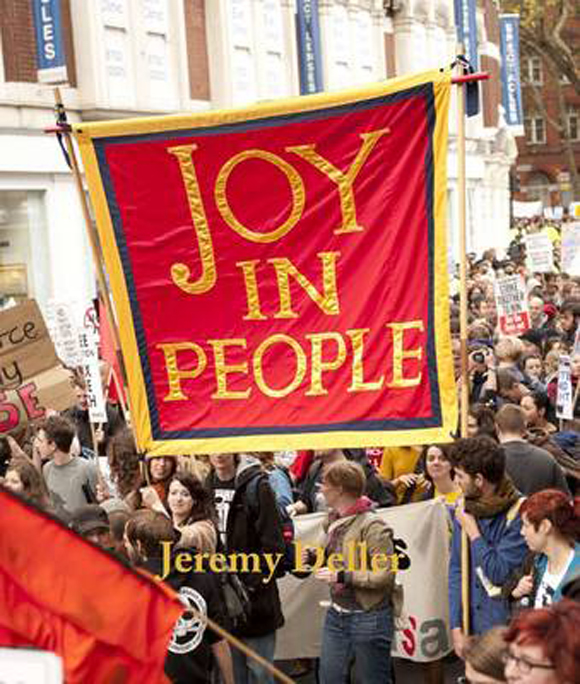
Joy in People: Jeremy Deller


I have recently been developing an obsession with the Southbank. Last week I went twice, once to see Comedy of Errors, starring Lenny Henry, review to follow – we saw it for a fiver! - and once to see Jeremy Deller’s exhibition at the Hayward Gallery.


Jeremy Who?
Admittedly not a traditional artist of the high form I would forgive you for not knowing the name. I first encountered Deller whilst working on a piece for my MA on the archaeology of sites of former protest. I was really fascinated by the ‘Battle of Orgreave’, so much so I jumped on a train to look at the site, got into all sorts of scrapes and met nice northern ladies in bun shops.

Anyway, Deller was also pulled into the orbit of Orgreave and produced a re-enactment of the battle, with former miners playing policemen and former policemen playing miners.  ‘Its going to take more than an art project to heal wounds. But was definitely about confronting something; to look at it again and discuss it’. I thought this sounded like a man I could get on with and when his name appeared on the Hayward list I paid it a visit.

‘To look at it again and discuss it’
This is the thread that runs through all of Deller’s work. The Joy in People exhibition included some of his earliest works (illicitly exhibited originally in his bedroom whilst his parents were on holiday), to It is what it is (2009), a discussion on terrorism and UK involvement in Iraq. He looks at the domestic proximity of cafes (2009) and bedrooms (1993) to big open landscapes , Exodus and Beyond the Walls (both 2012). Working with a number of mediums; including paper, photography, music, film and in fact people, Deller provokes discussion on a number of issues from war and peace, Britain’s heritage, to ageism and the plight of a transvestite wrestler.


His methods are arresting. 
They take you by surprise and they encourage discussion. 
Only Deller would build a life-size operational 1970’s style cafe for a carnival float; and encourage visitors to sit, drink tea together and contemplate what is worth saving, and protesting about.


By the people for the people
Deller uses a number of actors to people his exhibitions. One part of the gallery was a big black wall with ‘I <3 Melancholia’ written on the wall and a youth dressed in black just sat reading for hours. The people in Deller’s exhibitions often don’t say much, or directly interact with you. Rather they are there as sign posts and discussion points. I must say I totally missed the real person who had experienced war-torn Iraq sat in ‘It is What it Is’. In sum, ‘Deller makes art by the people for the people –and it is often fun and uplifting as a result’ (Sooke).


Common-Culture
I went to visit this exhibition with a dear friend who ‘appreciates art’. I think going on my own to this exhibition would have been an altogether different experience; the discussion would have been decidedly one-way. In its ability to provoke discussion Deller’s work is communal and it encourages community cohesion. At another level this is ‘common-culture’ in that it makes art from the common every-day world. I think it has taken me quite some time to see Deller’s work as ‘art’; a few years ago I would not have recognised scruffy t-shirts and quirky placards as art. I credit my MA, Dan Curtis, Elle McAllister and Caz Challis as well as the numerous artists at TAP for teaching me that ‘art’ doesn’t have to be ‘pretty’.

I loved this exhibition so much so I bought the pinbadge. Its on til 13th May and is a steal at only £10. It truly celebrates ‘Joy in People’.

Monday, 3 October 2011

Luke Leighfield and Jose Vanders: Live at The Borderline


The astute amongst you will notice that I haven’t got any better at blogging weekly. I am really sorry. All I can say is that London is full of lots of bright lights and I am easily distracted...oh look shiny thing! One of the wonderful distractions of the big smoke is gig venues. Last Tuesday I went to The Borderline to watch Luke Leighfield and Jose Vanders; here’s what I thought.

I first saw Jose play at Jesus College May Ball in Summer 2008. My feet had been really hurting from wearing stupidly high heels for an all-night party; and come midnight I was resting my feet in the bar. In the bar a petite singer with a much larger voice was playing her original tunes about waiting at railway stations and going to the fair with a boy she loved. The combination of beautiful melody and silly lyrics about ordinary events reminded me of the songs my best friend Lizzie used to write when we were teenagers. Although the most memorable part of Jose's gig was her begging for a pint before the end of her set, I enjoyed it enough to buy her EP (Transactional Language) several days later.

So three years later she offered her fans cheap tickets to see her at a London venue, on a day I could do and I was there! The Borderline is a basement venue in Soho that is well suited to bands with few performers (the stage is quite small) and for intimate gigs (I reckon there were 150 -200 of us there). Playing a small venue was actually really beneficial for the audience as we could see all the facial expressions and the little details Leighfield and Vanders throw in. It provided quite a different atmosphere to other gigs that I've attended.

I actually went to this gig on my own but it really wasn’t a problem. They’re a nice crowd at The Borderline and Vanders’ voice quickly picks you up and wheels you away far beyond the venue. She played a great set with a combination of the old greats, ‘Puppets’ and ‘Faces Going Places’; the latter, where she played piano and provided the ‘clap’ percussion simultaneously, being very impressive. She also played the playlist from her Blue Notes EP and ‘Man on Wire’. It was really interesting to see how Vanders’ music has developed; she still writes about break ups, romance and other frivolity, but she’s also developing a more mature edge to her lyrics which deal with big issues; I liked that. The poetic language is still there too, ‘I’m like the sun without the shine, a long road without any signs’ (Me Without a You) and you know how I enjoy unusual similes! (cf my post on Mornings in Jenin). She also owned the night really well; the personal touch of understanding the context of her lyrics gave them a new depth of meaning.

Jose was the reason I went to the gig but she was well complemented by both Luke Leighfield and Marcel Legan. Jose and Luke have just released a split EP which is the basis for their tour. I’ll admit I had not researched either of the other artists before I went; but Luke’s music was really uplifting. He played the set preceding Jose’s which I caught almost by accident. He sounds a bit like Get Cape Wear Cape Fly crossed with the Rend Collective (make up your own mind here) both in his love for brass to complement more traditional instruments and big chorus lines; all used to address everything from romance to loneliness, hope and despair.

I bought Luke's latest album and the EP of Marcel Legan. On the night Marcel provided backing vocals and guitar for both artists but he is also an artist in his own right. I bought his EP because his vocal on the other artists’ tracks (such as Metal Detector) was sensational. His voice sent shivers down my spine; and I was unsurprised to find that several of my friends, of both genders, had serious crushes on him; that voice is magic! Real Gone reviewed his EP and said ‘those great moments only really present themselves after two or three listens’. I agree that the EP is not ‘instant gratification’ but as it has played on my MP3 this last week it has grown exponentially on me.

All three artists write about lying in bed, amongst other things, anyone would think they were students (!). They also do a good line in quirky videos (see: http://www.youtube.com/watch?v=slBDsoQH9kM and http://www.youtube.com/watch?v=USUhT1sDvJs for reference). Their coming together for the split EP has definitely been good for the UK music scene. If you remain unconvinced can I encourage you to check out their cover of Bon Iver, Blindsided. It is hauntingly beautiful, and has a gorgeous backdrop of London at night; a very fitting tribute to another great band. Jose and Luke are currently touring Europe with their split EP but you can still check ‘em out online!http://www.youtube.com/watch?v=PCN5yxFI7wc

Tuesday, 19 July 2011

The Old Man and the Sea

This weekend I had the great fortune to attend ‘Shorelines’; the first literary festival celebrating the sea. The press eagerly anticipated the event and weren’t to be disappointed. The programme was varied including public readings of works old and new, literary discussions and some memorable theatre (who could forget an open air production of ‘The Tempest’ actually in a tempest!). It was good just to get people talking about the rich inheritance of being ‘people of the sea’; even if visitors weren’t from Southend, we all share this little island.

For me, the most memorable experience was watching a three-man performance of Hemmingway’s ‘Old Man and the Sea’. I like Hemingway and enjoyed reading ‘The Sun Also Rises’ and ‘For Whom the Bell Tolls’ but I have to say, with ‘Old Man and the Sea’ I never got past page three. For some reason a story of one man fishing didn’t capture my imagination in quite the same way as some of his other tales. That was, until Rob Young adapted the story for stage and Laura Casey directed his show; injecting the story of an old man’s delusions with life and vigour.

At base this is a story of one old man, on a boat at sea; not much to write home about. But Young has made it come alive; building a dynamism between the Old Man and his wife, or is it the sea? Either way he builds an exciting, playful tension between the two players. Young has made the story more accessible by introducing two characters alongside the old man who represent temptation and good, in the shape of the wife and fisherman’s boy. We’ve all been confused, tempted and uncertain in decision making. But it was more than a sympathetic plotline that drew us in; there was magic.

The concept for the show is quite simple; three actors, one stage, simple lighting and human percussion; but the effect is impressive. The sounds of water slopping against the boat, created by a boy with a partly filled water-cooler; or the skimming of stones recreated in a bucket of water with a few rocks. The plot weighs in on the psychological and the Old Man’s hallucinations, which recreate both his dead wife and fisherman’s boy; prime the imagination to fill in the other details of sea and sky. The actors also helped us to imagine other parts of the seascape sometimes taking on the role of say, birds in the distance. Special mention goes to Vernon Kizza Nxumalo for his portrayal of the fisherman’s boy, the Old Man’s conscience, a fish, the sounds of the sea and narrator extraordinaire. Such competency in being so versatile is an unusual skill in so young a man, he has the makings of a great storyteller; having the audience in stitches telling tales of the Old Man and his wife.


Old Man and the Sea, 04/09/10. Photo credit: K. Koziel


The location and circumstances within which this story was told also added to the sense of drama and seafaring. We were in a tent, in a storm. The roof of the tent was billowing in the wind and the performance was nearly hijacked by a failing generator which threatened the show with mere candlelight for lighting. Despite these distractions, the performance was impressive and a thoroughly memorable finale to a thought-provoking festival. As one guest said, ‘Technical difficulties? What technical difficulties?’.

Now I’m going to go and read Hemmingway’s novella; thank you Magpie Productions for the inspiration to give ‘Old Man and the Sea’ a second go!