Showing posts with label history. Show all posts

Tuesday, 30 January 2018

City: Almería

If history makes your heart happy you must visit Almería; regardless of when your favourite period is, this city has something for you. If you don't like history there's plenty to amuse too, beaches, bars, museums but being a bit of a history-nut this post features on places of historical interest.

Alcazaba and Arab baths
In the 10th century Almería was a thriving port city under the Caliph of Cordoba, Abd ar-Rahman III. They developed the relevant infrastructure to go with this and you can visit  - the old Arab cisterns have anachronistically been opened as a museum of traditional Spanish culture. If you want to experience Arab baths a hotel on the old market square has opened an arab-bath experience on the site of a historic bath. At 25E for 2 hours it is good value - you get to use all the facilities, including the flotation tank which was a personal favourite of mine and you can drink as much mint tea as you like!

The Alcazaba or castle also arrived in the 10th century, the distinctive ramparts still dominate the city's skyline although you will have to walk slightly beyond the modern city centre and climb a hill to get there. If you can climb all the steps before it closes the castle and its gardens are free to enter and offer great views of the surrounding city and coastline - aspects that were no doubt fundamental to its original creation.

(Alcazaba ramparts)
(Alcazaba gardens)

Cathedral
It would be easy to confuse this 16th century building with a castle, as it is so well fortified, but it is in fact a cathedral. You do have to pay to get in but it wasn't expensive, maybe 5E, and an audio-tour in English was included in the ticket price. It was quite ornate and pretty inside, a nice place to spend an hour or two but its not a 'day-visit' location.

(Cathedral)

Refugios de Almería
If you like your history a little more contemporary you can take a subterranean trip through the underground bunkers used by the residents of Almería during the Civil war. This was a really great way to spend an 1hr and a half or so and was not expensive. 3E for a video subtitled in English and then a guided tour in Spanish - with brief summaries given in English too - is really good value. Although it is essentially a series of concrete tunnels they have done a good job of bringing people's stories to life and I particularly enjoyed the underground hospital reconstruction.

(Refugio tour)

(Hospital in the bunker)

The Museum of Almería 
This is hands-down the best free museum I have ever been too; that is quite a claim as I have been to many museums, but its true. The museum covers the region's history spanning from Los Millares to the present day with a focus on the early history of the region. What was particularly striking about this museum was the way they fused audio visual with artistic installations by local artists and genuine artefacts, the integrity of presenting real objects wasn't compromised by experience but enhanced by it. I was particularly impressed with a map of the Los Millares site - you could see the geographical layout of the site but you could also learn about their attitude towards the economy and spirituality, for example, through symbolic objects such as beads, shells.

(Los Millares map with symbols)

With Morocco visible across the water, Almería as a town and as a wider region exists in this liminal space - with a foot in each camp of Europe and Africa - but definitely no-one's pet! Almería owns its ancient heritage; continuing ancient practical practices like building houses into the rocks and cave structures; since the Chalcolithic they have been artisans, creating copper from raw ingredients, firing pots in ingenious fashion whilst looking after the landscape around them.

Luckily for me Almería has been off the tourist track for a long time - as successive governments have ignored it and refused to invest in the area - this has caused real problems financially for the area and is part of the reason why we have the unsightly 'plastics' today, but is also the reason for incredible scenery and for that I am grateful.

Saturday, 11 November 2017

Fight fire with satire: Wipers Times and Savage Ink

In the run up to Remembrance Day I have been to the theatre and the People's History Museum. Both the play and the exhibition look at the role of satire in helping us face scary circumstances and to speak truth to power.

Wipers Times - Theatre Show

The Wipers Times was a newspaper created by Captain Fred Roberts and his battalion during the First World War produced in the trenches themselves. The 12th Battalion Sherwood Foresters faced some very serious scenes they were present at Ypres and the Somme with Captain Fred decorated with the military cross for bravery.  They were under no illusions about the awful nature of war, 'Most of us have been cured of any little illusions we may have had about the pomp and glory of war, and know it for the vilest disaster that can befall mankind'. This is echoed in their humour, one ad read, ‘Are you a victim to optimism?...do you sometimes think the war will end within the next twelve months?...do you consider or leaders are competent?'.

Copyright: The Wipers Times

There are many responses to war - fear it, glamorize it, or satirize it. Drawing on the traditions of both music hall - Hind and berg: sword swallowers and nail eaters at the Cloth Hall - 'the best ventilated hall in the town' (it was a ruin); and high-literature (Kipling, Shakespeare, Arthur Conan Doyle) they punned their way to hope right in the midst of battle.  They played close to the wire when it came to respected war correspondents both Hilaire Belloc and Beach Thomas's names are spoonerised and spoof articles written to illustrate just how far from reality their articles had departed. The bureaucrats of the war machine also do not get off lightly - Roberts took their regular request to 'up the offensive' as a rallying cry for the paper, 'Are we as offensive as we might be?'.

The stage show written by Ian Hislop and Nick Newman did a good job of translating a newspaper into a stage show; the show tunes and adverts translate particularly well. They also added extra context showing the war leaders, people at home and the impact of war on the veterans future careers all of which I thought was helpful. Although it was an entertaining show it was also a 'thinker'. I was very moved by the performance of 'To My Chum' a poem which featured in the print version of Wipers Times from the pen of a private in the trenches, reproduced in part here:

Confessions of an alcohol slave advert. Copyright: The Wipers Times


 'We’ve shared what shelter could be had
The same crump hole
when the whizz-bangs shrieked;
The same old billet that always leaked,
 And now – you’ve stopped one.'

It is precise, concise poetry that cuts to the heart of a man grieving his friend.


To face fear head on and to laugh seems such an appropriate response, and the show a great way to remember in all its complexity.

Savage Ink - A temporary exhibition at PHM

The Savage Ink exhibition illustrates the rich tradition that Wipers Times drew on; showcasing satirical cartoons from the 18th century onward including several works by Hogarth, Gillray and Fluck drawing right up to the present day cartoons criticising the Labour cabinet views on Trident.

Gillray, Substitutes for Bread

One of the most interesting cartoons is Gillray's, 'Substitutes for Bread' (1795) which shows Pitt, his Chancellor Loughborough and other ministers tucking into many lavish substitutes for bread; venison, turtle soup, champagne whilst the people outside starve. In 1795 the UK was at war with France and was running out of both money and commodities. The Board of Agriculture sent out pamphlets suggesting people substitute their expensive tastes for white bread with mixed grain loaves and eat more meat and fish instead, in a bid to help the war effort. This is all rather akin to Marie Antoinette's, 'Qu'ils mangent de la brioche' and the unrealistic expectations of those in power on those living with the reality of their decisions.

It seems if you had money in 1795 you could enjoy pretty much anything you liked, and the poor paid the price for war; nothing changes does it.

This remembrance day I pray, with Captain Fred and Gillray, never again.


Tuesday, 5 August 2014

Edinburgh 1

Hi everyone!

I recently went on holiday to Edinburgh on a mini-break with my photographer friend (all the photos in the post are hers!). We had a great time in both Edinburgh and the surrounding area. So today in the first of 2 posts, what to do in Edinburgh city centre - I'm thinking particularly of those of you chortling in the Scottish capital right about now.

Climb up high
If you know me by now you’ll know how much I love to climb high things; Edinburgh offers lots of chances to climb up high. Arthur’s Seat, the only remains of an old volcano, twisted on its side by Ice Age activity is a 822ft treat of an afternoon. There are many theories concerning the name, many people claim its to do with the mythical King Arthur but it might just be a corruption of Àrd-na-Said (Height of Arrows) or Àrd-thir Suidhe (Place on High Ground). Arthur’s Seat requires minimal input for maximum views– the experienced walkers who photo-bombed our victory photo were in brogues! 


Calton Hill offers similarly panoramic views of Edinburgh and features many historic curiosities from Nelson’s upturned telescope to the Portuguese cannon and the National Monument of Scotland, they've even got a little art gallery up there. We enjoyed studying the city and its happy brood of bird-life from these high points.


Into the very bowels of Edinburgh
We really enjoyed exploring Edinburgh on foot, down the winding closes, the Georgian promenades and poking our noses in interesting doorways. We got a real education at the People’s Story Museum. The PSM offers a rich and engaging narrative of the lives of Edinburgians since the 18th century. The museum isn't that high-tech but telling history through individual stories is very effective, ‘Meet Joan, on a warm afternoon in 1964 she is off to the wash-house to clean her clothes’.


Once upon a time, before the Royal Mile even existed, the people of Edinburgh lived cheek-by-jowl in tightly wound ‘closes’ or lanes and disease was rife. So in the early 18th century fresh investment arrived in Edinburgh, instead of demolishing the old town, they merely built over the top of it. The Continuum Group (Jorvik, Canterbury Tales) seized the opportunity to create an effective tourist-trap, 'The Real Mary King's Close' a tour of the deserted, underground Edinburgh. The tour provided enough genuine archaeology for me and entertainment for my pal who couldn’t care less about history. Just like the People’s Story of Edinburgh, a lot of MKC’s success is built around our getting to know a person, our guide ‘Walter King’ Foul Clenger, and his life on the close. Technological advances built the tour into a real experience!

Elephants and eating
Although we were camping outside Edinburgh we ate out a few times. The Elephant Café is the much celebrated birth-place of Harry Potter, where JK wrote the novels. The food was a good price, there were elephants aplenty and there is a unique memorial to Harry Potter, concealed in the loos. The other place we visited was SX café (Southern Cross, you dirty little whatsits!) they freely offered us their power supply for our ailing phones and tasty cakes. I even tried their haggis bites, they were gooooood.


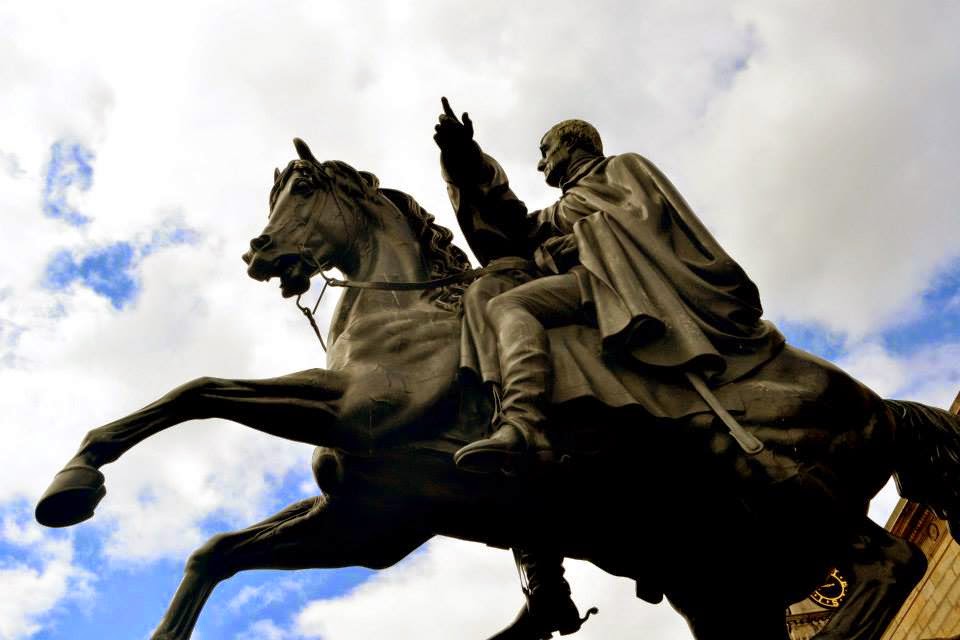
Honourable mentions...St Giles Cathedral, Canongate Kirk, Museum of Edinburgh (if you can stand the smell), and this guy (who is this guy?)


Tomorrow, Beyond the Walls of Edinburgh

Wednesday, 22 January 2014

The book that revived my love of London

Hi everyone!

How are you? I am loving getting to know London a little better from the inside. There are 2 reasons for this; one is my multi-branch gym pass (more to follow) and one  is Gillian Tindall's 'The House by the Thames'.
(photo taken by me, 16.01.14)

London - life-long love
My Dad has been taking me to London since I started Primary school. As a teenager I explored London from my cousin's well-placed London flat. And now as a grown-up I love walking across London; past all those places that have seen so many things, St Paul's (as in the photo above), the Bank of England, Trafalgar Square, the Southbank.

'The House by the Thames' 2006
This book is a potted history of one property, number 49 and its place in London as it has grown and changed over the past millennium. The Southbank sees a lot of change; it goes from fields, to industrial wharfs, and back again. It becomes the on-trend place to live, it is the place only the poorest of the poor would live. The landscape and thus number 49 reflect many of the changes that happen across the UK; the temperance movement, the introduction of sewers, the British Empire, electricity. Each of these changes had an impact on number 49; its structure, use and inhabitants - these varied from middle class gents, to crippled sweet makers and even a film star!

One of the things I really enjoyed about the book was the way she explains the frailty of memory and the strengths and weaknesses of different historical sources - it is so accessible. Anchoring the history of the whole area around one house was a really intelligent move; keeping me involved with the area's narrative right to the end! She's not just a historian, she's a confident historian, quite happy to share her methodology with us all, and provide photos and plans. This book was like all the best bits of my Cultural Heritage MA.

Seriously, this book is great; whether you are a novice or an expert give it a read!

Next time: The pools of London; and the adventures therein.

Saturday, 10 November 2012

Offa's Dyke Walk: brought to you by the letter 'C'

Last month I went on a wonderfully reflective walking holiday along the Offa's Dyke Trail. Herewith some ruminations.

Context
Offa's Dyke is an incomplete earthwork running the length of Wales on the border between England and Wales. It is attributed to the eighth century, Anglo-Saxon king, Offa and was turned into a National Trail in 1971. Both before and since Offa this land has been contested between the Welsh and other opposing groups. The landscape en route is varied; from mountain ranges to rivers, plains and forest. I walked from Kington to Sedbury, with the company of my Mum between Hay and Monmouth, it required walking boots and walking poles.

(The weather was er, interesting - Llanthony)

Conquerors and Chieftains
As previously mentioned the path follows the borderlands between England and Wales, an area that has been contested for millennia. As such there is lots to interest the budding archaeologist from Norman castles to Iron Age hillforts and the remains of Roman settlements. I frequently marched off piste towards mapped inclines in the hope of finding settlements.

Much of the route is rural and there were frequent occasions where the vista could have been Saxon, sheep, forest, stone walls and mountains. No cars, no houses, no tarmac. This meant that the path was not always easy, frequently muddy and occasionally impassable. I was only trying to walk 15 miles on any given day but progress up inclines and through mud was often slow. When I wasn't feeling like Bear Grylls I had increasing sympathy for the Roman soldiers based in this landscape (they had a settlement at Abergavenny they called, 'Gobannium' - great name!). Agricola's comment, 'Britain is cold, wet and difficult to traverse! Take me back to Tunisia, now!' (I paraphrase) seemed rather fitting. There were times a spa would have been very nice.

Castles and Churches as Community
Not only is the trail a beautiful natural path it also brings you into contact with lots of gorgeous old buildings. Some of these buildings are ruins (Llanthony and Tintern Abbeys, Abergavenny Castle, Monmouth Castle) others less so (Chepstow castle) and some still in one piece (St David's Church -1108, Abergavenny Tithe Barn, Hergest Hall).

The more complete buildings and the illustrations at ruins really helped me to think about churches and castles with their attendant communities. The castles and priory communities had gardens, storehouses and fireplaces in evidence for supporting real people doing real life. These were homes for communities of people; places tradesmen created wares, politicians made decisions, women infiltrated and caused scandals. For once the ruins weren't just romantic photo opps, they were also representations of communities passed.

(Llanthony Castle)
Cultural Conquest
The Dyke is in a liminal place, somewhere between England and Wales. It was interesting to compare towns culturally in modern day life.

Kington screamed rural English village. I went to a pub where people spoke like they were the cast of Hot Fuzz, there were roasts a plenty of cosy fires.

Hay on Wye on the other hand was 'just inside Wales' as declared by a deliciously comic partnering between the 'Welcome to Wales' sign and the 'Beware Children. Beware Old People' signpost.

Llanthony was Welsh and very rural, Pandy was still Wales, Abergavenny had a strong Welsh identity. The Welsh dragon was everywhere, even in the priory choir stalls; they had a cwtch coffee shop and all signs were billingual. We heard a lot of Welsh spoken here too.

(Dragon carving, St Mary's Priory, Abergavenny)

Monmouth our next stop by contrast was adamantly English. There was clear overtones of Norman settlement and monied English inhabitants, even the shops Fatface, Joules etc. testified that English culture was truly settled here. This emphasis was further supported by the Habs boarding school also based in the town.

Abergavenny v. Monmouth was an interesting experience.

Chepstow castle was a study in this influence of nationality and fashion on communities in the borderlands. The castle is a very early Norman castle. See downright Mediterranean designs on the oldest part of the castle, reminiscent of the Tower of London and other early Norman fortifications. As design developed so did the castle, accruing round turrets and other architectural design. One room is decked out in Tudor design; it was gaudy to say the least. Other parts of the castle have been left without roofing. The buildings were used as a fortification for some 500 years and developed different emphases as the years passed. But always they had thick walls, doors and barred entry. As I walked the walls of Chepstow castle I realised that thick walls are about more than protecting one king, or magnate, its about the defence of a whole community. It must be a nightmare to preserve a space like this, which has developed over several centuries, in a way that pleases and educates all interests.


(Chepstow Castle, Tudor Room)

(Early Norman Chepstow Castle)

The Tithe Barn at Abergavenny is also worthy of note. Originally built in the 12th century to house tithe from the local community, it still stands today and has seen a number of uses including 17th century theatre and a disco in the 1970's! Each population used the space as seemed best to them. Today the tithe barn is a museum encouraging story-telling and Anglo-Welsh history. Each generation has put its stamp on the building, adding to it and taking away. I wonder what people will think of what we've done in 300 years time to our historical and current buildings.

Part of the path is preserved by English Heritage. Here the bank seemed at its steepest and the paths were well maintained as if the very trees were under control. Given that the purpose of Offa's Dyke is unclear, but one hypothesis is it was a military defence (to keep the Welsh out) created by Welsh slave labour, its interesting it is preserved by 'English heritage'. Given another 1,200 years I wonder what else will be deemed suitable preservation material?

Can-do!
As well as providing lots of pretty historical spaces this holiday gifted me a can-do attitude. Away from the computer screens and phone signal, the challenges were different - how do I outwit a crowd of angry looking cows, how do I climb up this muddy incline with no hand-grips? How do I get to the end of this path when there are gates and tree trunks in the way? It required a different skill set and ingenuity in often unused areas but I really enjoyed my trip in the time machine.

Wednesday, 28 March 2012

London - architecturally speaking


Ever since I was a child I have been in regular contact with London. My Dad took my sister and I every half term in a bid to get us to know the City (impelled by a profound fear that we would be left on our own whilst out clubbing with friends and not know our way home), I came to love W1 as a teenager visiting family, got to know Bloomsbury as a student, Holborn and the Strand as a jeweller’s assistant (when I first noticed the Griffins of the City of London and the architecture of the Royal Courts of Justice) and now east of Tower Gateway working with young people. (This post would have been accompanied by my own photos but my phone got nicked!)

(Griffin, thanks to DT model at picture nation)


When I’m meeting friends ‘in town’ I often choose to walk rather than take the tube. It is good to see the city pass, walk along the banks of the Thames and take in the cool air of the city at leisure. On these many walks I have noticed what a hotchpotch of architectures we have in London. What follows is an attempt to catalogue the history of London, architecturally.

Londinium – London of brick part I

The first bit of London I was ever met was Roman. It is a piece of the London wall, now comfortably nestled, and only slightly oppressed by The Grange Hotel. Although now crumbling, the wall that used to encompass the Roman city was a formidable structure that used to run along London wall up to the Barbican (where there was a Roman fort) and down to the waterfront. You can see a statue of Trajan at Tower Hill; not often you put up a monument to someone who invaded your city (!). Encompassed within the wall Roman London had a forum, an amphitheatre and a mint; politics, entertainment and money ran the city even then!

(thanks Wikipedia!)

Ludenwic – London of wood

London was not abandoned after the Romans left, but the archaeology often looks like that. So much so that until the 1980s archaeologists and historians were at loggerheads as to whether a Saxon London even existed! Saxon London was wooden and it was western. As usual the Saxons were really into their recycling and choosing alternative locations for building; they built their London in Covent Garden. Other outlying towns and villages, now part of Greater London, have retained their Saxon names, Paddington, Lambeth and Fulham, sound familiar? The Saxons left other imprints on the City, the irregular shape of Park Lane follows the Saxon farming patterns for a start (thanks Pete Ackroyd for that gem!)
Beyond the Saxon period London continued to be a city of wood and recycling with the odd incursion of stone e.g. Tower of London built in stone by the Normans to make a point (they all had small willies!). The lack of fire-retardant structures was a frequent problem for the people of London. Fires and pestilences plagued the city on frequent occasions, often raising the city to the ground. But the occupations of older Londoners still lives on in present day toponyms; Milk Street, Wood Street, Cooper’s Row, Lime Street (think limestone rather than citrus fruits), Poultry and Vintry for example.

But London is a regenerative city, like the Phoenix that rises from the ashes, London rises again. After the great fire of London came a new age; London in the age of stone.

London of Stone

After the Great Fire and right on through the Regency period London was expanding. Life expectancies were still short but rumours like Dick Whittington’s were rife, so immigration to the city was high. The wealthy saw money to be made in the City and started building. Although Smithfields, Moorfields and Farringdon were still rural fields; the centre of the City of London was exploding.  Roads around Holborn and the Strand, heading west from St Pauls are dominated by this architecture. Big limestone-fronted buildings that announced wealth, the Bank of England built by John Soanes in this period illustrates the point precisely. Some buildings have stayed on site and retained their usage since this period. Take for instance, Twinings tea shop on the Strand; classic 18th century architecture and still serving tea since 1706. There are other rare gems to find too, the Guildhall Library with its Hundustani Gothic entrances (1788) and the College of Arms (1670s) features amongst many guild buildings from this period.


(Bank of England, thanks to itraveluk)

Although the Royal Courts of Justice just miss the Regency period, being designed in the 1860’s and not actually opened until the Victorian Gothic period, the building shares many similarities with eighteenth century construction. The courts are a dazzling white in a city perceived as morally and literally dirtied; the edifice is elaborately decorated with perfect archways and minute shapes. Even now it makes an impression on the area around it. I did have a lovely picture of the RCJ from behind but my phone got nicked, sorry everyone. The photo showed that at the heart of RCJ is warm wood and soft lighting, hidden under the blinding brightness. Just like many of the churches in the city of London built at the time; forbiddingly holy (and stone) on the outside, soft and wooden on the inside.

London Metropolis – London of brick part II.

Thanks to transport links, better sanitation and continuing immigration pressure the London of the Victorian period saw huge expansion. Rail travel particularly saw the construction of great high ceilinged stations and commuter satellites. It was during the Victorian period that ‘Moorgate’ was no longer the gate to a ‘moor’ but a metropolis. It is the time of markets, Covent Garden, Shoreditch and of great overcrowding.  Slums, particularly in East London were popping up in great numbers trying to accommodate the vast numbers of people in the city. Building south of the river also began in earnest being served by railway lines and an increasing number of bridges to ‘the City’ (Battersea, Blackfriars, Putney, Westminster and Tower Bridge being perhaps the most famous). This is also the age that brought us the Houses of Parliament (1840) and other buildings like the RCJ, and Adelphi and Theatre Royal theatres. Evidently since the Roman times those key strands of parliament, economy and entertainment remain.

(Tower Bridge, thanks to destination360)

London of Concrete – Why would anyone want to talk about that?!

London of Glass

Today  I would call London the city of glass. Most of its new buildings are typified by the Gherkin and the Shard, or perhaps less famously the Lloyds building on Lime Street, or 88 Wood Street. Glossy, glassy, comedy shaped office blocks. All traditional forms are inverted, the glass and infrastructure is on the outside, you are supposed to be able to see in. One construction in Bishopsgate actually claims to invert the traditional building shape of biggest at the bottom...it will actually by bigger at the top! Without the dirt and dust of previous centuries Londoners are confronted with a mirror into which they themselves may indeed be perceived. I think that also says something about the generation which built the buildings, designed to give you what you want to see.

(88 Wood Street, note the lifts are on the outside! Thanks to urban75.org for image)


London of tomorrow? I wonder what that will be? I wonder what design constraints it will need to meet and what materials it will be built from? Flood proofed perhaps?


I hope you have enjoyed what was potentially my most wordy blog yet! Well done if you got this far!
 I didn’t think of all these ideas myself, please find below a list of people who helped me:

Peter Ackroyd’s London: The Biography (I’m only 200 pages into the 850 page epic but I’m getting biceps on my biceps reading it on the way to work).
http://www.victorianweb.org/mt/theaters/pva234.html – Victorian Theatres in London