Showing posts with label remember. Show all posts

Tuesday, 11 November 2014

Remembering and representing: World War I

Every museum worth its salt has a World War I exhibition this Autumn. I’ve almost lost count of the exhibitions I’ve visited.

Imperial War: through an imperial lens

The IWM have just reopened their First World War galleries, when I visited a mere fortnight ago the museum was rammed with grandparents and grandchildren making the most of this new, free, interactive exhibition. For an imperial war museum they’ve done a good job.  Technology has been used to good effect to create interactive games, and a reconstruction of a trench.  Subject wise there was plenty on the war as class conflict, a section dedicated to conscientious objectors, as well as an informative area on the world war beyond Europe particularly in the Middle East. There was some effort to represent the home front, but I felt women were under-represented in the exhibition particularly with reference to activity on the Front – but then I suppose I did buy the book which brought women to my attention at the IWM so maybe its not all bad!


('The Din', Imperial War Museum Gallery)

Upstairs at the IWM they have a collection of paintings from the First World War which cover the gender angle much better – featuring several paintings by women from the conflict as well as several paintings by the Nash brothers.

The Passing Bells

Another commemorative TV series on the BBC this Autumn – borrowing its title from Wilfred Owen’s ‘Anthem for Doomed Youth’. TPB jumps a major hurdle to remembrance from the first scene in genuinely representing 3 different nationalities experience; German, English and Polish. The producers have worked hard to show the shared experiences and get some comment on most of the major events –  1914 Christmas peace, the Somme etc. I felt the role of women in TPC was well covered and nothing was over romanticised. That said, unlike Our World War the show is designed to feel like a period piece. War is not glamorised, the character of Derek (Brian Fletcher) is used to mirror some of the questions we are asking today ‘in a hundred years’ time, I wonder what they will make of this?’. You can catch The Passing Bells on iPlayer til Dec 3rd.

(Enemies side by side. Photo credit: BBC Media Centre)

Burgh House: bringing the war home

To bring the conflict back to a very local scale I visited the free exhibition at Burgh House, Hampstead. Hampstead Heath played host to training troops during the conflict and artists famous from the era – including the Nash brothers and Richard Carline. The exhibition featured a copy of the Vorticist magazine, Blast and an original World War I nurses uniform as well as several photos of people using the hospital and the nearby heath during war-time. The curators had made good use of poetry on the walls to set the scene, and helped to set an international crisis into a local perspective – the personal drawn into stark relief through the smaller objects – a Princess Mary tin, a postcard home. The exhibition is open until 14th December. They also do great food!
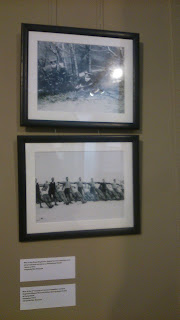
(Troops work out on the Heath)

(The doorstep of Burgh House)

Tuesday, 18 February 2014

Pere Lachaise: On not kissing Oscar Wilde

I’d heard a lot about Pere Lachaise cemetery whilst on my Cultural Heritage Course: talk of memory, forgetting, commemoration and how even famous people get forgotten.

Pere Lachaise is Paris’ largest cemetery within the city of Paris; it stands at a massive 110 acres with more than a million internments. Accompanied by my oldest friend walking round Pere Lachaise provided many interesting conversations.

View from within.

The first person to be buried at Pere Lachaise in 1804 was a five-year old called Adélaïde Paillard de Villeneuve. Her grave isn’t there anymore; it was a temporary concession. There are a wide range of famous people commemorated in the cemetery all labelled with a number on a neat little billboard; philosophers, artists, singers, politicians. But finding them is less easy amongst the city of the dead, interspersed by people from all the nations of the world some famous and some not. 

Finding Edith Piaf was particularly difficult because her inscription was a little note on the side of a family tomb, not a massive monument. I still found myself wanting to sing ‘Non, je ne regrette rien’. Do you think that was appropriate? 

'Non, de rien de rien'

Oscar Wilde’s tomb is covered in a massive Egyptian motive created by Epstein. And the world and his wife have kissed the sphinx. With lips bright red, and the block next to the face is also covered in kisses of every hue. A big plastic box has been put in place to try to prevent any more amorous advances from visitors as the bill for cleaning goes to the family. So again, kissing and leaving your mark, acceptable?  We talked about the Diana memorial and the recent Judd-gate scandal. What constitutes appropriate memorialisation, especially when you can climb inside the memorial?

Oscar Wilde's sphinx
City of the dead
The style of memorial at Pere Lachaise might be a little unfamiliar to British audiences. Whilst some tombs were small and enclosed the majority looked like little houses varying in size from port-a-loo to full on chapel complete with pews and crypt. You can enter these memorials, and spend time there. Some memorials seemed to be glorified sheds and others were well maintained. The famous graves have been numbered, all have an address with many different street names. Although these are navigation systems the rows of doors with street signs and neighbouring properties really felt like streets.

The living and the dead

Streets of Pere Lachaise

Freezing a passing moment in time

We visited a strange quasi temple come crypt under this golden dome. I was attracted to one little corner by a flickering light that I assumed was one of those plastic tea lights. I was wrong. It was a real candle; and watching it flicker and then extinguish was a poetic moment full of metaphor. The candle was at the heart of a wider ephemeral memorial surrounding a well varnished plaque and we talked about how even the hardest rock is still temporary and memorials are for the living. 


Guttering flame