Saturday, 16 February 2013

Deutsch-Kino-Love 2


OK, I admit you have waited a long time for this blog post. I have been exploring some real life big issues, like why are all the poor people in the Les Mis film Northern? And is the body under the car park King Richard III? (no!), and what about the Gay Marriage bill or Women Bishops?! So herewith part two of my German cinema series; today featuring Das Wunder von Bern (HMV buy) and Barfuss (Birthday/Christmas gift) both good, quite different films.

Das Wunder von Bern (2003)
This Wortmann film is set in 1950’s Essen and is the story of a football-mad boy (Matthias) and his trip to the 1950’s World Cup in Bern, Switzerland. When we first meet Matthias he is growing up a world without male role-models. His dad is still in a Soviet prisoner of war camp and his brother dreams of revolution; Matthias turns to footballers for inspiration. This film, whilst ostensibly being about the downright miraculous victory of the Germans in the 1954 World Cup at Bern is also about family. About the adjustments of Matthias’ family with and without his dad, the loyalties of a husband when greeted by fame and fortune, the duties of a father and a son to the family and making it work. And it is also about the experience of war and recovery through the eyes of a child; thoroughly reminiscent of the photos I saw on my Archaeology of Modern Conflict course.
Das Wunder von Bern was a beautiful story to watch. The set design and the location shooting take you back in time, not a simpler time, but a different world to ours; where women wore pretty dresses and the men called the shots (intentional pun!). Like Goodbye Lenin! some of the footage is interspersed with real historic footage which adds an extra glorious dimension. And my own father, who isn’t generally that interested in Foreign Language Cinema lapped it up too!

If you like football, World War II or beautifully crafted films you will love this! I’d give it a secure 4/5.


Barfuss (2005)
Nick is a bachelor who has trouble holding down a job. On one such job, working as a cleaner in an asylum he meets Leila who he interrupts trying to commit suicide. Leila becomes Nick’s shadow following him all the way from Munich to Hamburg, seeing the world through the naïve eyes of a child and emboldening Nick to make good life decisions. This rom-com is apparently loved by people who also loved 500 days of summer and Love Actually; I can see the resemblances with an extra psychological twist. There was the occasional painfully slapstick scene but I liked the fact that even Leila was treated like a complex  character despite her fragility. And I think I recognised the party location as Benrath Castle but I could be wrong…

Great rom-com, a little long in places, but feel-good and a great sofa comfort… 7/10.


Tuesday, 15 January 2013

Deutsch-Kino-Love 1


Dear Blogosphere,

Happy New Year! You know I really love German cinema. My obsession really peaked over the Christmas holidays when I packed 4 classics in (I've legally downloaded number 5). Herewith Review 1 of 2 featuring the famous Berlin films, Das Leben der Anderen (2006) and Goodbye Lenin (2003)

Das Leben der Anderen (2006)

This film was given to me as a birthday present and is the most poetic cinematically of the German films I’ve seen to date. Watching it encouraged a conversation as to the definition of ‘Arthouse Cinema’ – the conclusions: ‘Arthouse’ often has negative connotations of plotlessness but beauty in the form & cinematography.

DLDA, however, had plenty of plot. It is the story of a young writer/ director in Berlin in the 1980’s and the man who spies on him for the government, their interrelationship and how it changes them both. Both characters go through a gentle but eventually radical development shaped by their circumstances and experiences. I was impressed by Florian Henckel von Donnersmarck's handling of such a recent political issue, avoiding overdramatisation or too bold a line between 'goody' and 'bady'. The story made me think about identity, the role of art in subversion, love and the strength of an individual. Cinematically Florian Henckel von Donnersmarck, was quite radical in his casting decisions; choosing Ulrich Mühe to play a Stasi informant when he himself had been monitored in the 1980’s. Life since 1980 has obviously moved on in Berlin, the producers commented that finding a place to film in Berlin, without cars was really difficult. 

The brilliance of DLDA was recognised by several awarding bodies, and not kooky ones either! The film made €814,337 in its opening weekend in Germany alone. It secured 7 Lolas (German film awards), was nominated for a Golden Globe and won an Oscar in 2006. Plus did I mention it is beautifully shot.
 See it.
The English subtitles are plenty good enough.

Good Bye Lenin! (2003)

When I mentioned I was surveying German cinema one comment was recurrent, ‘Watch Good Bye Lenin!’. So I did. I ordered it online and dutifully waited for the disk. It’s a comedy about a young guy, Alex, whose mother is very sensitive to shocks (it seems to send her into a coma) and very devoted to socialism. When Alex gets into political trouble his Mum goes into a coma, whilst she's out of the picture the Berlin wall and all that she stands for falls. When she recovers Alex tries to recreate socialist East Berlin in her bedroom, believing it will save her from death, with hilarious consequences.

Compared to the intricate beauty of DLDA, Good Bye Lenin! is a heavy-footed romp of hilarity. It did make me laugh and I enjoyed the developing romance between the male lead and his mother’s nurse. I thought adding actual footage from the collapse of the wall was also a nice touch and it did bring home what a world changing year 1990 must have been. My ears also pricked up when I heard an identical music sample to that from French film Amelie (turns out the soundtracks share a composer). 

Other than that it left me fairly unmoved. Sorry. Luckily for those who do love it I’ve been outvoted; it won 8 Lolas, a César and a Goya, and was even nominated for a BAFTA. Maybe I just let my funny bone at home…

So in conclusion, 2 deservedly good films, for 2 different moods, set in 2 different decades. Take your pick! I'll be back with a review of Miracle of Bern and Barefoot next time!

Wednesday, 9 January 2013

10 things I learned from Pocahontas


I've been reliving my youth watching Pocahontas. Here are my top 10 tips...

1.       If you think a tree is talking to you; you’re not hallucinating, its probably your hilarious Grandma.

2.       You can definitely trust the man who stops you leaving when you say you feel uncomfortable, he probably ‘has a good soul’.

3.       You can also trust the man who says your house needs improving, your society civilising and calls you a savage to your face.

4.       If his hair isn’t shoulder length he’s not even up for consideration.

5.       Men don’t really have nipples. In real life they’re just drawn on!

6.       Kissing always leads to trouble.

7.       The only thing stronger than weapons is anger. Or you know guns.

8.       Even your best friend will try to blackmail you, and will probably dob you in. Your friendly neighbourhood hummingbird on the other hand is a keeper.

9.       You can use a compass to find your destiny. And there’s no magnetic North in Native America.

10.    A pretty necklace makes everything alright.

Saturday, 5 January 2013

Belfast: Borough of Barriers and Boats


Happy New Year everyone! To celebrate the turning of the years I thought I’d do pot-luck with my local airport – I went off to Belfast for 48 hours. It was a good time, although the weather didn’t really allow for much wild adventuring; I spent a lot of time contemplating barriers and boats.

Barriers

I first became aware of the ‘Troubles’ in 1996; I was 7, my Dad was going to London and the IRA had just bombed Canary Wharf. All I understood was, ‘the Irish are angry with us; and that’s why there are no bins’ but still a fairly nuanced understanding for a 7 year old. Then in Year 7 I read a book about a Romeo-and-Juliet-style couple split by the Trouble  centred around the Falls Road. I remember being struck by the story and storing it away somewhere for later use.

Shankhill Road

Later I studied ‘Archaeology of Modern Conflict’ at UCL;  we thought about wall murals and how these can be expressions of identity in civil war contexts. I decided I’d get a closer look and, much to my parents consternation, made a b-line for the Shankhill Estate. Shankhill is a protestant estate with much evidence of said on display. Union flags festoon the streets and there are lots of murals celebrating the centenary of the ‘Covenant’ (when the government in Belfast voted to stay with the UK in 1912). The established ‘Shankhill murals’ are  in the middle of a normal housing estate where normal people live. I saw no trouble while I was there, the only other people around were Shoreditch archetypes, all woollens and digi-SLRs; taking great interest in the repaint peace project and arty photos of the murals; apparently in summer the place is awash with tourists and the bus tours make good money. I walked down Cupar Way which reminded me of the Berlin wall, all arty and ‘give peace a chance’ but still rather substantial; and then onto Falls Road – the Catholic equivalent of Shankhill – Bobby Sands took a fairly central role here and I saw no tourists. 


Cupar Way

On both sides of the wall there was a roaring trade in memorials and a rhetoric of martyrdom. One mural in Shankhill represented nicely some of the thoughts I was having, ‘nothing about us, without us, is for us’; it was painted by someone who lives in Shankhill, for whom that landscape isn’t a fascinating museum dedicated to a dark and mysterious past. The murals are painted on the walls of homes in a living district, I bought a pasty from the sandwich shop, I sent a parcel from a post office in a queue of people waiting for their pensions. No-one wants to live in a goldfish bowl and be gawked at by tourists. Do we have any right to heritage-ise people’s living environment, and if so for what cause? And is it ethical to paint over memorials in the name of peace?

Shankhill Road
Cupar Way

Boats

On my second day I ventured to the ‘Titanic Quarter’; a modernised dock which took my head straight to Dusseldorf and Hamburg where similar regeneration projects have taken place. It’s really modern and features a shopping centre, museums, cafes and art works. On the way I stopped at the Belfast Barge – a thoroughly impressive, although poorly advertised museum. It’s free and it’s on board a boat – what’s not to love! Ok, what I really appreciated about the barge was how many ways it made its point – dressing up clothes, more information in drawers, DVD and touch screen features, testimonials and models – and the clever use it made of the limited space available. I even had a go at hammering in a rivet!

Belfast Barge

I decided to give the newly opened ‘Titanic Experience’ a miss on the advice of a fellow hostel user; ‘you pay £13 and then you can’t touch anything, it’s all lights and sounds and stuff’. Instead I walked an extra half a mile to the ‘authentic Titanic experience’ at the Pump House and Finishing Dock complete with real life tour guide AKA an actor seeking employment. I spent an hour being told many interesting tales of the Titanic’s creation and thought the physical impact of standing inside a giant concrete dry-dock was quite substantial. All the advertising for the Pump House was around it being the ‘authentic’ museum, what did that mean? Authentic because the boat actually rested there for 2 days, authentic because you can actually see and touch things that touched the Titanic? All the time conveniently ignoring the reality that some 2,000 other ships also passed through the same dock. Not sure, but there is something about being able to physically ‘touch’ the past which registers in a different part of my brain and is expected by the audience when they visit a ‘museum’,  that the ‘entertainment experience’ of ultra-modern museums doesn’t touch…plus it was half the price of the other one!

Authentic?

My holiday wasn’t a constant sociology exercise; honourable mentions also go to Ulster Museum (an amazingly in-depth history of Belfast and a lovely collection of butterflies), Maggie May’s café (cheap milkshakes bigger than tankards) and Belfast YHA (which was my accommodation for the trip). Looks like I got back just on time too. See you soon for some foreign film reviews.

Sunday, 16 December 2012

Listening to Lord Farquaad (or Lithgow Talks!)


I love my National Theatre Entry Pass – it provides opportunities for young people to access groundbreaking theatre at discounted rates. When they told me John Lithgow – the voice of Lord Farquaad – was not only starring in a show but also doing a Q & A, and I could see both for £8, I booked it straight away.
(Dinner at the National Theatre)

Lithgow was interviewed by Nick Hytner, Director of the NT. The first thing I noticed when he stepped on stage was how tall he was!  It was a memorable opening as Lithgow described being born in a prop box. Born into a thoroughly theatrical family, Lithgow spent his childhood summers with his Dad’s Shakespeare troop in Ohio, starting with the small bit parts and graduating up to the young leads.

Lithgow was no fool and secured a scholarship at Harvard. He describes himself as the ‘best actor in Harvard by osmosis’ only a small underestimation of his evident dramatic talent (!) and a time of prolific output – he featured in some 8 or 9 plays per term and his repertoire had by this time expanded from Shakespeare to encompass several Russian playwrights among others . On some kind of Erasmus swap Lithgow made it to LAMDA which conferred on him a love of London and a convincing English accent, he describes it as like ‘swallowing a horsepill of Englishness’.

Lithgow also passed comment on his lifelong profession of acting deeming it a reckless and stupid career path. He has done numerous other things on top of acting to fill the quiet season from writing children’s books to conducting orchestras. He does this he says to avoid the actor’s agony of ‘waiting to be wanted’.

With this backdrop I ran off to speed munch my dinner and then returned to the front row to see Lithgow perform the lead role in Pintero’s  Victorian farce, The Magistrate. Damien Lewis loved it - he was sat about 6 rows behind me, desperately trying to keep a low profile. The play was everything I’ve come to expect from comedy at the NT, riotous, professional, splendid and slightly mad. The script set the action firmly in London and with my local interests that really pleased me! As ever the staging was central to the success of the play, this time it both rotated and rose on expensive mechanical, silent sets. Lithgow provided some hilariously comic moments particularly when acting out being attacked by a dog who obviously wasn’t there! And I loved the song about trying to guess the age of a lady; it was suggested you might chop her leg off and count the rings!

The Magistrate is on until March, there are plenty of discounted seats available and I can’t recommend it high enough!

Wednesday, 5 December 2012

Merry Christmas Racist Santa!


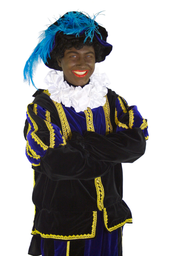
As you will know from previous posts I’m a bit obsessed with Continental Christmas traditions. A couchsurfer from Holland visited me a few months ago, and I requested native foodstuffs as my gift. She brought a bag of Kruidnoten ‘gingerbread’ biscuits and the story of the racist Santa which I now present.

December 5th is the day that good little Dutch children get their presents from the benevolent St Nik. Whilst the commercial kids now leave stockings and bags for Santa, traditionally the children always left out their shoes. If the child had been good Santa would fill those shoes with sweeties; if they had been bad they would start a whole new adventure, in Spain.


Unlike other Santas, St Nik, patron saint of Amsterdam, has a time-share in Spain; he likes to stay warm whilst he’s making all those sweets and toys. He has a team of helpers, who look like Moors. The story I heard was that the naughty children had been engaged in slave labour for Santa, climbing up and down chimneys and acquiring black faces, as it turns out in bygone centuries Santa had a black servant called, imaginatively, Black Pete and it was he who adorned my pack of Kruidnoten, like the most unashamed, Gollywogg I’ve ever seen!

 Just so racist.

And because Santa has been living all year in Spain how is he supposed to get to Holland – by steamboat of course! None of this sleigh and reindeer business, Santa is a civilised chap, who rides a steamboat to Holland and then a white and noble steed! This being a tradition he probably borrowed from pre-Christian times when his name was Odin.


I am fascinated by all these borrowings from different times Santa from one culture has gained to form his fully-fledged expression in the 21st century. I wonder how Dutch Santa will translate again in another 100 years, will he catch up with modern transport and fly from Spain perhaps? Will he be less racist? Only time will tell.

Merry early Christmas everyone!

Saturday, 10 November 2012

Offa's Dyke Walk: brought to you by the letter 'C'

Last month I went on a wonderfully reflective walking holiday along the Offa's Dyke Trail. Herewith some ruminations.

Context
Offa's Dyke is an incomplete earthwork running the length of Wales on the border between England and Wales. It is attributed to the eighth century, Anglo-Saxon king, Offa and was turned into a National Trail in 1971. Both before and since Offa this land has been contested between the Welsh and other opposing groups. The landscape en route is varied; from mountain ranges to rivers, plains and forest. I walked from Kington to Sedbury, with the company of my Mum between Hay and Monmouth, it required walking boots and walking poles.

(The weather was er, interesting - Llanthony)

Conquerors and Chieftains
As previously mentioned the path follows the borderlands between England and Wales, an area that has been contested for millennia. As such there is lots to interest the budding archaeologist from Norman castles to Iron Age hillforts and the remains of Roman settlements. I frequently marched off piste towards mapped inclines in the hope of finding settlements.

Much of the route is rural and there were frequent occasions where the vista could have been Saxon, sheep, forest, stone walls and mountains. No cars, no houses, no tarmac. This meant that the path was not always easy, frequently muddy and occasionally impassable. I was only trying to walk 15 miles on any given day but progress up inclines and through mud was often slow. When I wasn't feeling like Bear Grylls I had increasing sympathy for the Roman soldiers based in this landscape (they had a settlement at Abergavenny they called, 'Gobannium' - great name!). Agricola's comment, 'Britain is cold, wet and difficult to traverse! Take me back to Tunisia, now!' (I paraphrase) seemed rather fitting. There were times a spa would have been very nice.

Castles and Churches as Community
Not only is the trail a beautiful natural path it also brings you into contact with lots of gorgeous old buildings. Some of these buildings are ruins (Llanthony and Tintern Abbeys, Abergavenny Castle, Monmouth Castle) others less so (Chepstow castle) and some still in one piece (St David's Church -1108, Abergavenny Tithe Barn, Hergest Hall).

The more complete buildings and the illustrations at ruins really helped me to think about churches and castles with their attendant communities. The castles and priory communities had gardens, storehouses and fireplaces in evidence for supporting real people doing real life. These were homes for communities of people; places tradesmen created wares, politicians made decisions, women infiltrated and caused scandals. For once the ruins weren't just romantic photo opps, they were also representations of communities passed.

(Llanthony Castle)
Cultural Conquest
The Dyke is in a liminal place, somewhere between England and Wales. It was interesting to compare towns culturally in modern day life.

Kington screamed rural English village. I went to a pub where people spoke like they were the cast of Hot Fuzz, there were roasts a plenty of cosy fires.

Hay on Wye on the other hand was 'just inside Wales' as declared by a deliciously comic partnering between the 'Welcome to Wales' sign and the 'Beware Children. Beware Old People' signpost.

Llanthony was Welsh and very rural, Pandy was still Wales, Abergavenny had a strong Welsh identity. The Welsh dragon was everywhere, even in the priory choir stalls; they had a cwtch coffee shop and all signs were billingual. We heard a lot of Welsh spoken here too.

(Dragon carving, St Mary's Priory, Abergavenny)

Monmouth our next stop by contrast was adamantly English. There was clear overtones of Norman settlement and monied English inhabitants, even the shops Fatface, Joules etc. testified that English culture was truly settled here. This emphasis was further supported by the Habs boarding school also based in the town.

Abergavenny v. Monmouth was an interesting experience.

Chepstow castle was a study in this influence of nationality and fashion on communities in the borderlands. The castle is a very early Norman castle. See downright Mediterranean designs on the oldest part of the castle, reminiscent of the Tower of London and other early Norman fortifications. As design developed so did the castle, accruing round turrets and other architectural design. One room is decked out in Tudor design; it was gaudy to say the least. Other parts of the castle have been left without roofing. The buildings were used as a fortification for some 500 years and developed different emphases as the years passed. But always they had thick walls, doors and barred entry. As I walked the walls of Chepstow castle I realised that thick walls are about more than protecting one king, or magnate, its about the defence of a whole community. It must be a nightmare to preserve a space like this, which has developed over several centuries, in a way that pleases and educates all interests.


(Chepstow Castle, Tudor Room)

(Early Norman Chepstow Castle)

The Tithe Barn at Abergavenny is also worthy of note. Originally built in the 12th century to house tithe from the local community, it still stands today and has seen a number of uses including 17th century theatre and a disco in the 1970's! Each population used the space as seemed best to them. Today the tithe barn is a museum encouraging story-telling and Anglo-Welsh history. Each generation has put its stamp on the building, adding to it and taking away. I wonder what people will think of what we've done in 300 years time to our historical and current buildings.

Part of the path is preserved by English Heritage. Here the bank seemed at its steepest and the paths were well maintained as if the very trees were under control. Given that the purpose of Offa's Dyke is unclear, but one hypothesis is it was a military defence (to keep the Welsh out) created by Welsh slave labour, its interesting it is preserved by 'English heritage'. Given another 1,200 years I wonder what else will be deemed suitable preservation material?

Can-do!
As well as providing lots of pretty historical spaces this holiday gifted me a can-do attitude. Away from the computer screens and phone signal, the challenges were different - how do I outwit a crowd of angry looking cows, how do I climb up this muddy incline with no hand-grips? How do I get to the end of this path when there are gates and tree trunks in the way? It required a different skill set and ingenuity in often unused areas but I really enjoyed my trip in the time machine.