Showing posts with label culture. Show all posts

Tuesday, 16 December 2014

Remembering and Representing: Germany Part II

Yes, I've been away, Christmas is coming and I have been crafting some beautiful things. Anyway...

Regular readers will know all about my obsession with Germany, today I even have Wir Sind Helden in the background. You will also know about my love for the British Museum. This Winter they made my dreams come true in producing Germany, Memories of a Nation.

https://www.youtube.com/watch?v=M0-VDKTY0ok
(Memories of a Nation Trailer. Click  here to watch video. Copyright: British Museum)


Different Germanys
The exhibition showcases 600 years of German history starting by illustrating the many different Germanys that have existed over time and the uniqueness of the regions. This section sort of works, it certainly gives good context for newcomers, with quality maps, but the coin display was a bit lifeless and more akin to a bronze age exhibition.

Vorsprung durch technik
Germany's technical prowess is well documented from printing, to the Bauhaus movement, the incredible work in ceramics, the Meissen rhino really is quite impressively large. And its famous people are also well celebrated, both Hans Holbein's Erasmus and Tischbein's Goethe make an appearance, as does Napoleon's hat.
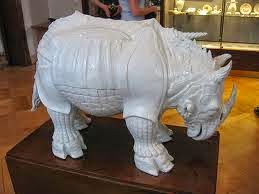
(Meissen Rhino)

New Learnings
Even for a massive Deutschophile there were things to learn. I learned that hidden in the Buchenwald Concentration camp gates was the hidden rebellion of a prisoner in the form of Art Deco script. I learnt the significance of Barlach's Hovering Angel, and the relevance of the face being modelled on the mourning mother and artist, Kathe Kollwitz.

(Buchenwald Gate)


One Nation?
One of the central events commemorated in the exhibition is the anniversary of the fall of the Berlin wall. There is a great chunk of the wall outside the main exhibition space but this its relevance is mainly lost in the grand surroundings of the hall; unlike its counterpart the VW Beetle which holds its own in the glass temple. The more effective image is the protest poster, 'Wir sind ein Volk', indicative of many Germanys coming under one banner. I remain, however, unconvinced of this idea as a reality on the ground.

(Wir Sind Ein Volk)

Come and see the exhibition in real life and tell me what you think! The exhibition is open until 25th January. Or listen to the insightful radio series by Museum Director, Neil MacGregor, taking one object at a time and discussing its role in German history for 15 mins.

Further Reading
I've been to a couple of panels at the British Museum and they have introduced me to Philip Olterman  (amongst others) who writes hilarious tweets and also wrote a great book in 2012, 'Keeping up with the Germans' - both informative and funny, I now finally understand why Germans love 'Dinner for One'; an English farce that I had never heard of!


Saturday, 3 May 2014

The land of sea, sails and bicycles: Denmark

Hello You!
Its a pleasure to see you! Yes, I am looking a little peaky. Its been a rough week for me with a fever and vomiting bug which I've only just about recovered from. So its time to share with you all of the exciting adventures I got up to whilst I was away in the land of sea, sails and bicycles; the place where there are 5 pigs to every person and about as many bicycles! The place where there are holes in your money and people genuinely enjoy being in the gym at 5am! I had a great time away full of variety, a lot of Vikings and one or two brushes with Harald Bluetooth (did you know the symbol for bluetooth is Harald's initials in runic?!)


So as a brief introduction to the uninitiated Denmark consists of three main parts, the islands of Fyn and Zealand, and the Jutland peninsula. Denmark has many other islands (407!) and territories including the constituent countries, Greenland and the Faroe Islands. As you can see from the map I travelled across the Danish regions heading mainly east to west with a brief u-turn near the end to head north and home; I flew in to Copenhagen, had a stop-over in Odense, travelled to Ribe and then up to Aarhus. I took a week to do this but it was Easter - you could definitely do it quicker! More to follow with regard to transport.

What follows is a diary of the trip; complete with local stories and adventures - details of accommodation and things to see and do.

But firstly some sweeping generalisations in a big list:

1. Denmark is really expensive - accommodation, food, even public transport is at the pricey-er end. I never thought I'd go somewhere more expensive than London!

(Danish coins in my hand. Image: my own)

2. You don't need Danish to do well here - everything from bars and restaurants to museum panels and even local bus drivers is in English (and Danish).

3. People are so polite - I wasn't harassed once. I know that doesn't sound like much, but usually on my own people always ask me for money, think they can offer me money for sex, generally make statements about me. This was really refreshing.

4. Being a woman in Denmark doesn't seem to be a problem!

(Cinnamon rolls. Image: my own)

5. There is a strong emphasis on sustainability of food supplies and sustainable living.

6. Its flat (except not THAT flat) so people bike everywhere.

7. You are never more than 30km from the sea.

8. The museums are ace. And their education system is really good!

(Aarhus Viking Museum. Image: my own)

9. Eating out - high quality, but high prices. I paid £28 for a piece of lamb one night, I know! But it was good lamb. 

10. There will be Danish flags everywhere. 

(Ribe Harbour. Image: my own)

Next installment: Copenhagen.


Wednesday, 16 April 2014

The Vikings: a British Museum Exhibition

Hello you lovely lot!

First off I am writing this on my phone en route to Stansted because I am flying to Denmark, hurray for technology!

In preparation for my hanging out with many Danes I recently visited the new Viking exhibition at the British Museum.

I had seen the trailer, which as you will note makes quite the claim in suggesting it will revolutionise the way you see the Vikings. Determined not to be put off by the £16 price tag I gave it a go.

watch the trailer

Treasure trove
What a collection! All the famous things are here; the Hunterston Brooch, the Cuerdale hoard and my personal favourites, the Lewis chessmen. There are literally hundreds of objects telling 'the Viking story' from beads to spears, coins and pots. The aim of the exhibition was to widen the public perspective on who the Vikings were; I'm not entirely convinced this worked.

(Lewis chessmen. Photo credit: theisleoflewischessmen.com)

Roskilde 6
The central artefact for this exhibition was the remains of an astounding 37-metre long ship known as Roskilde 6. I was really impressed with this boat; and the way it was presented. So often when we work with medieval ships we're left looking at a handful of rivets, or even just the rivet holes! To see remaining planks and their position in the wider structure was amazing. I also felt the presentation of the ship; complete with videos on the building materials and the opportunity to touch modern examples of fur and wood really made a living, breathing exhibit out of something that would otherwise have been a relatively opaque artefact to the initiated.

(Roskilde 6. Photo credit: The Independent)


Packed out
In some ways this exhibition is a victim of its own success. Despite booking several weeks in advance and being allocated a booking time you really couldn't move in there! I think this might have been due to the queue jump facility allocated to BM members, but having paid my £16 I hadn't expected to queue for each cabinet.

Vikings
The curators had been clear that they wanted us to come away with a broader understanding of who 'the Vikings' were. Sure, there were representations of work and leisure, faith and travel. Yet all 'the Vikings' were clubbed together without a framework of chronology or geographic locality and I felt that led the public more towards generalisation of 500yrs of history rather than less. Also I'd have liked more on the process of interpretation, something more experiential and a few less saga quotes. But perhaps most of those are satisfied in the audio guide (which cost extra) and the supporting programme of seminars.

BM at its best
In 2011 I compared the duration of 2 BM exhibits for an essay and noted then, as I do now that the BM is best at bringing us the monumental and the foreign, as opposed to the domestic and familiar. I felt the Viking exhibition was the same, showcasing the large monumental objects well but perhaps the smaller objects could have been better presented.

Coming to a cinema near you
I was encouraged to see that the BM is taking the exhibition to other museums across the country that share Viking heritage. This willingness to share resources will only win it friends moving forward. I also was pleased to see the BM take a leaf out of the National Theatre's book in taking its exhibition and seminar stream to cinema broadcasts which massively opens up the reach of these exhibitions.

Must see collection, but choose your  time carefully
It is not often that you see so many famous Viking pieces all in one place; this has been an incredibly collaborative project. It is also an amazing opportunity to see Roskilde 6, which on its own is worth the £16. But pick your visit time carefully to avoid crowds and to spend time with the precious artefacts.

Privilege
I want to conclude by recognising I have experienced great privilege. I have touched several of the treasures on display first hand and studied the Vikings in great depth. I reckon my luck and privilege will have shaped my view.

TTFN
They're calling my flight I better go. See you for more 'viking' and specifically Danish things soon!

Tuesday, 25 February 2014

The Book Thief: a magical homage to the power of books

The weekend before last I made the pilgrimage to Leicester Square cinema. I was on a quest, a quest to watch The Book Thief nearly 2 weeks before it hit cinemas in the UK. My quest was not unrewarded, The Book Thief is an amazing film. But I must admit early on, in an ironic move, I haven't read the book.

The Book Thief tells the story of Liesel Meminger; a little girl growing up with her adoptive parents in the fictitious south-western German town of Molching. Liesel hates Hitler because she believes he took her communist mother away. Liesel loves; her adoptive father, the jewish boy Max they are hiding in their basement, and her friend Rudy who spends the whole film oscillating between love for Liesel and wanting to belong in the Hitler Youth. That and books, Liesel has a lot of time for books.


The film is book-ended (ha!) by narration from a third party and the whole film has a sort-of unreal, ethereal feel. Shrouded in cloud, kept distant by time. The town of Molching has fairytale architecture despite the goings-on being decidedly more nightmare. The Book Thief has come under criticism for being too soft on the Nazi regime and the realities of war; Abele calls it 'a convenient backdrop for a wishful narrative rather than the springboard for an honest one.' I think the problem here is partly stylistic; in reflection of a book which I've heard is highly descriptive, the film's vignette style might not be to everyone's taste. Similarly there is limited reference to the suffering of the Jews on a daily basis. But, I would argue it very much does engage with the real problems facing teenagers and young people during the Second World War. Liesel and Rudi join the Hitler Youth but still feel conflicted. There is a great moment where Rudi paints himself to look like Jesse Owens, his favourite, black, athlete. The pain of his father in trying to explain why this is not an OK thing to do in public in Nazi Germany was realistic and credits the German people with more grace than perhaps other films have done.

Abele also claims that The Book Thief will leave audiences unmoved. I don't think that's fair, it is highly emotive. During a sequence portraying Kristallnacht in all its barbaric cruelty; Liesel and Rudi are part of a children's choir singing the Deutschlandlied. The contrast of childhood innocence and the reign of terror is stark and really effective at portraying the level of brainwashing imposed on young people in Germany. 

(Source: www.hypable.com)

Credit is definitely due to the actors, in their teens, who play Liesel (Sophie Nélisse) and Rudi (Nico Liersch). Neither of them speak English as a first language, coming from French Canada and Germany respectively, and neither have been cast as major roles in films before. The beauty of picking novices is that there is no fakery. Nélisse and Liersch show genuine emotion, it doesn't look staged when Liesel cries or laughs. Their acting is alive and believable, such a rarity in child-actors. Honourable mentions must also go to Geoffrey Rush, him off of the King's Speech, for playing his now almost type-cast quasi-magician, kind natured, adoptive father. And similarly Emily Watson playing Liesel's severe-yet-soft adopted mother. Final mention must go to John Williams who wrote the score for the film, the first time he's written for anyone but Spielburg in nearly a decade! The music is haunting yet magical and reminiscent of some of his other soundtracks, particularly Schindlers List, Harry Potter and E.T. I bought it when I got home from the cinema in the hope that my life will seem more magical to Williams' soundtrack.


(Source: www.pagetopremiere.com/2013/08/first-six-stills-from-the-book-thief-starring-sophie-nelisse/)

Written by an Australian (Petroni) and directed by the director of Downton Abbey (Percival), I can see why The Book Thief has come under criticism for being distant from the subject matter but this film is pure escapism to a simpler world. Its a coming of age movie, through a fairytale lens. Definitely worth watching when it comes out in UK cinemas on 27th February.

Tuesday, 17 September 2013

Four autumnal adventures

 The arrival of autumn has been hurried to say the least, as I type in my cardie and jeans I’m wondering how just last weekend I was in t-shirt and shorts! I have been having all sorts of adventures but I wanted to take the opportunity of reviewing a couple of them here.

Home Free – film premiere

My good friend Stephanie Hazel has joined force with the sensational Amber Bayley to produce the short-film Home Free which explores public attitudes to homelessness particularly in the Brighton and Hove area. Can a homeless person be a hero? Can love cross the housing divide? The show portrays a realistic view of homelessness which will challenge common misconceptions of homelessness; it does so with great gentleness and is accompanied by a lovely low-key soundtrack. It was my great pleasure to attend the premiere of Home Free in the atmospheric venue of West Street Loft – this film will hopefully become available to the public soon.

Marks Hall – heritage day

Marks Hall is a large estate in Coggeshall, handed over to the public in the 1930s. The extensive property has been filled with forests, walled gardens and meadows – it would be a brilliant place to take active children or pet! The hall itself was demolished in 1950 – the most recent incarnation of buildings on this site from at least the Tudor period. Archaeologists have been exploring the site over the last few months looking for outlines of the building and clues about the lives lived there, on Saturday they hosted an open day with tours of the site. Finds included a complete Neolithic axe-head, and the largest collection of Hedingham ware in the country. The pottery combined with several boars’ teeth in the nearby middens would suggest this site had been a high-status site for many centuries. More recent finds include the pulley systems for calling servants, a Victorian doll and a thimble. I was fascinated by the thought of doing archaeology on a site which had stood firm until so recently…proving you really can find out new information through archaeology from a site in use less than 100 years ago!


Orphan Black –TV series

Bad news guys, BBC iPlayer have started premiering series online before they hit our TV screens. One of the shows in this series, as well as guilty pleasure Bad Education, is Orphan Black – a dark tale of mistaken identity. Sarah witnesses the suicide of Beth and noticing a close resemblance to her own self decides to take on Beth’s identity of in order to escape some of life’s inconveniences. Unfortunately Beth’s life is hardly peachy either and Sarah gets more than she planned through the swap. The opening to this sci-fi thriller was unexpectedly gripping and I will be booking myself some iPlayer time very soon to see episode 2. Although I will be waiting some time, it doesn’t come out on telly til the end of the month!


Project Space: Word. Sound. Power – Tate Modern

What do you do when you have spare time in London? One of the things I like to do is visit free museums. Word. Sound.Power is the first exhibition you come to when approaching the Tate Modern. WSM is a multi-genre exhibition examining the strength and impact of words to influence new ideas, identity and even systems of power. There are rappers from inner-London estates, films of Indian orphans, and photos of roof-top gangs. It is a highly emotive exhibition directly illustrating that words and even sounds (where one is unfamiliar with the language) can indeed have great power. The message of the exhibition is clear – even those with minimal political agency have a voice and could do great things when they raise them.

Words. Sounds. Power is a collaborative curatorial exchange between the Tate Modern London and Khoj, International on at the Tate Modern until 3rd November and is free to visit. 

Friday, 23 August 2013

Review: The Secret Wives of Andy Williams

I have to admit I didn’t have a clue who the eponymous hero was. Apparently he's a crooner from yesteryear, recently deceased; despite not knowing who he was the show was still laugh out loud funny. 

(Andy Williams)

Caitlin is a naughty nun, she loves another man more than Jesus. In a bid for purity, and to escape her father, Caitlin becomes a novice at the craziest and kindest nunnery I have ever seen. Accompanied by a brood of crack-pot orphans and strict yet kind nuns, Caitlin battles with some deep issues; life, death, love, other people’s expectations (especially the dead ones) and the true adoration of Andy Williams. Whilst this play confronts serious topics Hasler’s excellent script accompanied by Mayhew’s direction, and the sterling efforts of the entire cast, meant the only time I cried it was with laughter! 

The show really is funny and this is partly down to style. A cast of four deliver at least 10 roles between them; Mitchell for example playing a Scottish nun, an orphan with imaginary siblings including a sister called Nietzsche, a cockney bloke, and a French romancer by turns was both impressive and simultaneously hilarious. I think the hair clips reinforced the reality of a bloke playing a nun in plain sight and enhanced the comedic effect. Similar contrasting roles such as Platt’s novice nun to drunken royal, and Hasler’s strict nun to west-country orphan, keep the play dynamic and entertaining. 

Being a show mainly concerned with death and comedy, black humour played its part; a bell-ringer with no hands, a deceased saint with her boobs on a platter, and a nun with a tv-signal clarifying brain tumour all feature. That said Hasler is also unafraid of confronting death, religion and love head-on. There are plenty of references to philosophy in the piece (come on, the imaginary sibling is called Nietzche!) but not in a way which is exclusive to the less academically minded. 

Hasler has rendered the religious characters in the play with great gentleness; the nuns are kind-hearted women, sheltered from the world by prayer times and a blanket of khaki Battenberg cake! Even God, or the ‘bugger upstairs’ as one character calls him, is depicted as a benevolent parent who just wants His children to have fun. The show was funny without being offensive, crude or irreverent – I was impressed that Hasler credits the audience with enough maturity not to go for the easy laughs about the frigidity of nuns! 

Not all the inhabitants of the nunnery are naive, and their reasons for being nuns are as varied as the counties they were reared in. Just like the average audience member the characters have true depth. One of the stand-out features of this show is the fact the characters are laugh out loud funny without being one-dimensional slap-stick comedy props.

Adults playing children and men playing women has been the recipe for laughter for centuries; but the way in which Hasler has used these methods to discuss philosophy make this an altogether different performance to the standard ‘comedy about nuns’ show you might be expecting. 

The show is part of the Camden Fringe Festival with a running time of 1 hour dead. It runs til Saturday 24th at the CamdenPeople’s Theatre. They are touring this Autumn, so catch them if you can!

Thursday, 13 June 2013

Freiburg and Guildford: Twinned Cities


Freiburg: City of faces
I went to Freiburg because my friend May was going there. I have to say I didn't really know about its history but I sure did enjoy it. Think cobbled streets, with gentle inclines in the towns, mountains in the background. I enjoyed visiting the Gothic minster (we didn't climb the tower as the weather was bad), eating würste, buying curiosities in the Minster Market and drinking cocktails in the evening. Whilst exploring we came across numerous anthropomorphic faces from mermaids, to gargoyles and lions.

Cocktails always aid creativity - my fruit boats

The Augustiner Museum; a modern museum considering the art and culture of Freiburg from the Baroque through to the modern-day is a real treasure. Their stock is vast with tapestries, the most representations of Jesus I've ever seen as well as an organ, stained glass windows and gargoyles to boot! Although the content was really old, the layout was very modern and designed to purpose. The gargoyles were positioned so you could see them from a distance as they would be in situ but also close-up from the gallery.

Secondly, I wanted to tell you about a bookshop I visited. I don't know how you feel about bookshops.  For me, the smell of antique bookshop is like catnip (to a cat!). I cannot resist.
I looked in the window and knew I had to go in.

I asked May to restrain me.

We went in. They had loads of books on Anthropology and Material Culture and several travel books arranged according to locality. One book we found was a Baedecker of the Rhine Land from 1939. It was geographically relevant and was full of references to the Glory of Hitler - quite an unusual discovery! Unfortunately the price was also outside the usual range for my trip - aka all my euros. So I left the shop, but not before I bought this postcode from 1906!

From Freiburg with love - the message is written in pencil round the outside!


Guildford: Heritage, public and private
I visited my friend Bec and spent several hours exploring. There are lots of historical buildings in Guildford centre from the Tudor Rose Restaurant to the Alms Houses, Holy Trinity church, and Abbots Hospital. I found something to climb, this time a Norman Castle tower! I paid £3 to view an exhibition, watch a video (from 1995!) and then climb the tower - this seemed a reasonable fee for the upkeep of such ancient heritage. I don't really know when, or why this obsession with climbing high ancient things came about. I can't help but wonder whether it has something to do with being so small and always looking up at things. There's something quite novel about observing cities from above.

Next I walked out to Guildford Cathedral, passing the road where my grandparents used to live. There were a few subtle changes. The road sign now featured a subtitle 'no access to university' and at the bottom of the road a shisha bar had opened. I wondered what my Grandpa would have made of those changes.

Guildford Cathedral itself is not like many of the other places of worship I visit. It was originally designed in 1930 and was finally completed in the 1960's. The angels on the entrance to the nave were strangely reminiscent of the angels at Coventry, turns out they are both designed by John Hutton. Usually when I visit a Cathedral it is for its Medieval history, the sanctity of ancient places of worship and of course a decent church tower. This time my visit was incredibly personal; my grandfather was a Cathedral Guide and it was a really special place for him. Sat in the Lady Chapel I found myself transported back to my own experiences some 12 years ago at my grandmother's funeral. That too is a history and a heritage, but a much more personal one; it is mine I have both ownership and authorship over it. Not everyone gets a museum or exhibition in honour of their history.


Finally, sorry for disappearing on you all! My weekends have been manic. There has been much to discuss: I've read 4 great books, done lots of thinking on social action and exploitation, experimented with poetry at the seaside and taken 2 people on exciting tours of London over the last 6 weeks. I am not sure there will be time to write on all of these. Especially as I am off to France in just over a week!


Saturday, 16 February 2013

Deutsch-Kino-Love 2


OK, I admit you have waited a long time for this blog post. I have been exploring some real life big issues, like why are all the poor people in the Les Mis film Northern? And is the body under the car park King Richard III? (no!), and what about the Gay Marriage bill or Women Bishops?! So herewith part two of my German cinema series; today featuring Das Wunder von Bern (HMV buy) and Barfuss (Birthday/Christmas gift) both good, quite different films.

Das Wunder von Bern (2003)
This Wortmann film is set in 1950’s Essen and is the story of a football-mad boy (Matthias) and his trip to the 1950’s World Cup in Bern, Switzerland. When we first meet Matthias he is growing up a world without male role-models. His dad is still in a Soviet prisoner of war camp and his brother dreams of revolution; Matthias turns to footballers for inspiration. This film, whilst ostensibly being about the downright miraculous victory of the Germans in the 1954 World Cup at Bern is also about family. About the adjustments of Matthias’ family with and without his dad, the loyalties of a husband when greeted by fame and fortune, the duties of a father and a son to the family and making it work. And it is also about the experience of war and recovery through the eyes of a child; thoroughly reminiscent of the photos I saw on my Archaeology of Modern Conflict course.
Das Wunder von Bern was a beautiful story to watch. The set design and the location shooting take you back in time, not a simpler time, but a different world to ours; where women wore pretty dresses and the men called the shots (intentional pun!). Like Goodbye Lenin! some of the footage is interspersed with real historic footage which adds an extra glorious dimension. And my own father, who isn’t generally that interested in Foreign Language Cinema lapped it up too!

If you like football, World War II or beautifully crafted films you will love this! I’d give it a secure 4/5.


Barfuss (2005)
Nick is a bachelor who has trouble holding down a job. On one such job, working as a cleaner in an asylum he meets Leila who he interrupts trying to commit suicide. Leila becomes Nick’s shadow following him all the way from Munich to Hamburg, seeing the world through the naïve eyes of a child and emboldening Nick to make good life decisions. This rom-com is apparently loved by people who also loved 500 days of summer and Love Actually; I can see the resemblances with an extra psychological twist. There was the occasional painfully slapstick scene but I liked the fact that even Leila was treated like a complex  character despite her fragility. And I think I recognised the party location as Benrath Castle but I could be wrong…

Great rom-com, a little long in places, but feel-good and a great sofa comfort… 7/10.


Tuesday, 15 January 2013

Deutsch-Kino-Love 1


Dear Blogosphere,

Happy New Year! You know I really love German cinema. My obsession really peaked over the Christmas holidays when I packed 4 classics in (I've legally downloaded number 5). Herewith Review 1 of 2 featuring the famous Berlin films, Das Leben der Anderen (2006) and Goodbye Lenin (2003)

Das Leben der Anderen (2006)

This film was given to me as a birthday present and is the most poetic cinematically of the German films I’ve seen to date. Watching it encouraged a conversation as to the definition of ‘Arthouse Cinema’ – the conclusions: ‘Arthouse’ often has negative connotations of plotlessness but beauty in the form & cinematography.

DLDA, however, had plenty of plot. It is the story of a young writer/ director in Berlin in the 1980’s and the man who spies on him for the government, their interrelationship and how it changes them both. Both characters go through a gentle but eventually radical development shaped by their circumstances and experiences. I was impressed by Florian Henckel von Donnersmarck's handling of such a recent political issue, avoiding overdramatisation or too bold a line between 'goody' and 'bady'. The story made me think about identity, the role of art in subversion, love and the strength of an individual. Cinematically Florian Henckel von Donnersmarck, was quite radical in his casting decisions; choosing Ulrich Mühe to play a Stasi informant when he himself had been monitored in the 1980’s. Life since 1980 has obviously moved on in Berlin, the producers commented that finding a place to film in Berlin, without cars was really difficult. 

The brilliance of DLDA was recognised by several awarding bodies, and not kooky ones either! The film made €814,337 in its opening weekend in Germany alone. It secured 7 Lolas (German film awards), was nominated for a Golden Globe and won an Oscar in 2006. Plus did I mention it is beautifully shot.
 See it.
The English subtitles are plenty good enough.

Good Bye Lenin! (2003)

When I mentioned I was surveying German cinema one comment was recurrent, ‘Watch Good Bye Lenin!’. So I did. I ordered it online and dutifully waited for the disk. It’s a comedy about a young guy, Alex, whose mother is very sensitive to shocks (it seems to send her into a coma) and very devoted to socialism. When Alex gets into political trouble his Mum goes into a coma, whilst she's out of the picture the Berlin wall and all that she stands for falls. When she recovers Alex tries to recreate socialist East Berlin in her bedroom, believing it will save her from death, with hilarious consequences.

Compared to the intricate beauty of DLDA, Good Bye Lenin! is a heavy-footed romp of hilarity. It did make me laugh and I enjoyed the developing romance between the male lead and his mother’s nurse. I thought adding actual footage from the collapse of the wall was also a nice touch and it did bring home what a world changing year 1990 must have been. My ears also pricked up when I heard an identical music sample to that from French film Amelie (turns out the soundtracks share a composer). 

Other than that it left me fairly unmoved. Sorry. Luckily for those who do love it I’ve been outvoted; it won 8 Lolas, a César and a Goya, and was even nominated for a BAFTA. Maybe I just let my funny bone at home…

So in conclusion, 2 deservedly good films, for 2 different moods, set in 2 different decades. Take your pick! I'll be back with a review of Miracle of Bern and Barefoot next time!