Tuesday, 5 August 2014

Edinburgh 1

Hi everyone!

I recently went on holiday to Edinburgh on a mini-break with my photographer friend (all the photos in the post are hers!). We had a great time in both Edinburgh and the surrounding area. So today in the first of 2 posts, what to do in Edinburgh city centre - I'm thinking particularly of those of you chortling in the Scottish capital right about now.

Climb up high
If you know me by now you’ll know how much I love to climb high things; Edinburgh offers lots of chances to climb up high. Arthur’s Seat, the only remains of an old volcano, twisted on its side by Ice Age activity is a 822ft treat of an afternoon. There are many theories concerning the name, many people claim its to do with the mythical King Arthur but it might just be a corruption of Àrd-na-Said (Height of Arrows) or Àrd-thir Suidhe (Place on High Ground). Arthur’s Seat requires minimal input for maximum views– the experienced walkers who photo-bombed our victory photo were in brogues! 


Calton Hill offers similarly panoramic views of Edinburgh and features many historic curiosities from Nelson’s upturned telescope to the Portuguese cannon and the National Monument of Scotland, they've even got a little art gallery up there. We enjoyed studying the city and its happy brood of bird-life from these high points.


Into the very bowels of Edinburgh
We really enjoyed exploring Edinburgh on foot, down the winding closes, the Georgian promenades and poking our noses in interesting doorways. We got a real education at the People’s Story Museum. The PSM offers a rich and engaging narrative of the lives of Edinburgians since the 18th century. The museum isn't that high-tech but telling history through individual stories is very effective, ‘Meet Joan, on a warm afternoon in 1964 she is off to the wash-house to clean her clothes’.


Once upon a time, before the Royal Mile even existed, the people of Edinburgh lived cheek-by-jowl in tightly wound ‘closes’ or lanes and disease was rife. So in the early 18th century fresh investment arrived in Edinburgh, instead of demolishing the old town, they merely built over the top of it. The Continuum Group (Jorvik, Canterbury Tales) seized the opportunity to create an effective tourist-trap, 'The Real Mary King's Close' a tour of the deserted, underground Edinburgh. The tour provided enough genuine archaeology for me and entertainment for my pal who couldn’t care less about history. Just like the People’s Story of Edinburgh, a lot of MKC’s success is built around our getting to know a person, our guide ‘Walter King’ Foul Clenger, and his life on the close. Technological advances built the tour into a real experience!

Elephants and eating
Although we were camping outside Edinburgh we ate out a few times. The Elephant Café is the much celebrated birth-place of Harry Potter, where JK wrote the novels. The food was a good price, there were elephants aplenty and there is a unique memorial to Harry Potter, concealed in the loos. The other place we visited was SX café (Southern Cross, you dirty little whatsits!) they freely offered us their power supply for our ailing phones and tasty cakes. I even tried their haggis bites, they were gooooood.
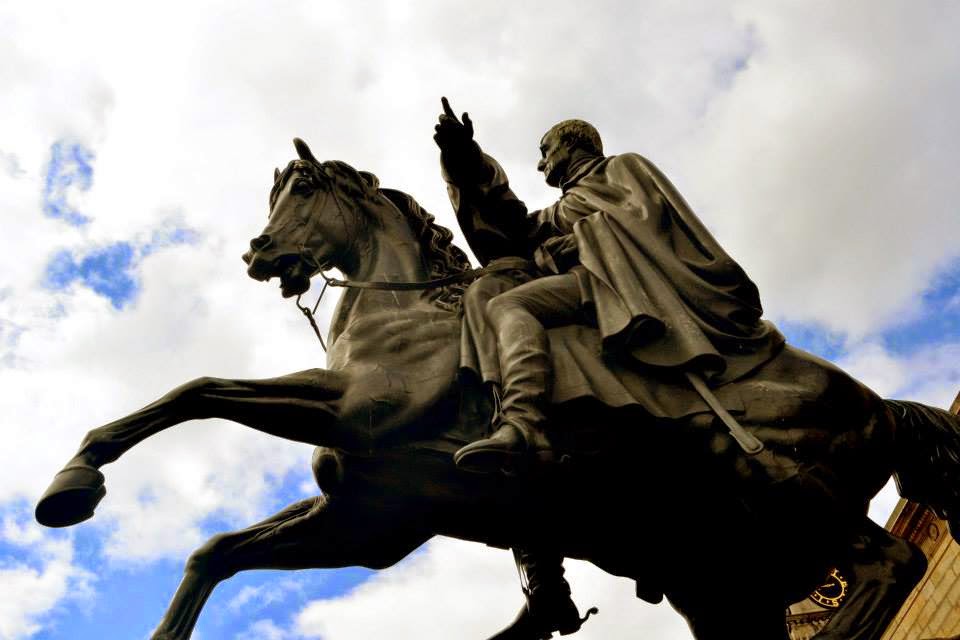

Honourable mentions...St Giles Cathedral, Canongate Kirk, Museum of Edinburgh (if you can stand the smell), and this guy (who is this guy?)


Tomorrow, Beyond the Walls of Edinburgh

Thursday, 24 July 2014

GIRL

Have you noticed there's a vogue at the moment to celebrate GIRL. People seem to have varying ideas of what this looks like and varying motivations behind celebrating it but here are a number of examples of focussing on GIRL.

'#LikeAGirl'

My social media feeds lit up with this gem of a video by sanitary towel maker, Always.


I always think the Marketers of the unglamorous brands have the toughest time and Always have done a good job here of talking about confidence and womanhood (both very marketable things right now) to carry their message. Although I saw many retweets of the video - I didn't see that many subsequent GIRL projects with the tag 'LikeAGirl' and hadn't even noticed that Always have a whole section of their website dedicated to the cause.

To Be A Girl

This is an awareness and fundraising initiative by WaterAid which considers the negative implications of being a woman in need of water worldwide. Whether that is the cultural expectation that women collect water, or being ostracised from community and fresh water during menstruation; there are many challenges affecting female access to water many of which I hadn't even thought of! All fundraising is matched by the government before Sept 9th 2014. Water Aid have been very keen that people publicise the issue through social media - off the back of my donation I received both an email and a letter in the post encouraging me to tweet about my donation. In the end I tweeted the cause but not the donating bit. An interesting angle for a charity who provide water to all, to focus on the current gender agenda.

In a similar vein Oxfam just released a GIRL infographic below:


How to Build a Girl

This is the title of Caitlin Moran's latest release, a novel about a teenager growing up in Wolverhampton. Trigger alert: This book features many of the joys and tribulations of coming of age in a working class house; if you don't like to hear about: masturbation, menstruation, alcoholic fathers or the Rolling Stones this book is not for you. 

However, I'm really enjoying the book. Almost certainly autobiographical in content, How to Build a Girl has made me laugh out loud on the tube, and cringe occasionally too. This is the pains of growing up without the Taylor Swift gloss and its jolly brilliant. But like I say, if you've a tendancy towards prudishness pick up another book. On a side note, she's got a wonderful range of merch out, and the profits go to 'Refuge' helping women escape domestic violence. 

Well, all this focus on GIRLS is a bit different innit, here's to hoping it prompts lasting change and isn't just the latest marketing ploy to sell sanitary towels!


Thursday, 10 July 2014

Haunch of Venison Yard: London's roads and pubs

I have been wandering the streets of London since I was six when accompanied by my Dad and little sister we would pick an area and walk it. Once home we would highlight the area covered and over several years of walking most of zone one was a veritable rainbow.

This education was furthered by studying in Bloomsbury, working near St Pauls, living in East London and now living in NW3. Every time I move to a new area I take great joy in getting lost, and then found with, or without, the assistance of the GPS or a local tube stop.

On foot the important things are the compass direction and the food outlets ('left at Sainsburys') to navigate by.

But I am discovering London from a completely different angle of late. Living as far west as I ever have done, and travelling primarily by bike and bus the key navigating points have changed and so I'm noticing other things. For example, did you know there's a road in Mayfair called Haunch of Venison Yard? Or that Mornington Crescent is actually still a crescent?


(Photo credit: 441K9 Flickr)

Cycling in London can be a bit nail-biting and as such I need all my concentration on the road, not on my phone GPS system. When I am going somewhere new I try to remember at least a 10-minute stretch and I do this using a combination of road names but also by the pubs. It amazes me that there are still enough pubs to navigate by. Its also got me thinking about pub signs. I always assumed they harked back to mass illiteracy, 'meet you at the Red Lion at 5'. But I wonder if those hanging pub signs also serve a greater purpose to people who are travelling too fast to read.


(Photo credit: camdenpubs.blogspot.com)

Now, I don't pretend to be a lightening fast cyclist but the signs outside both The Victoria and Edinboro' Castle reassured me that I was on the right track. By contrast the lack of signage outside the Queens Head and Artichoke on Albany Street nearly led to a small diversion. Being fair to the owners I'm not surprised they didn't feature a pictorial sign. In my head its looking like a head on a plate, with a stick of artichoke between her teeth. Apparently the name was given by Queen Elizabeth I's Head Gardener.


(Photo credit: www.beerintheevening.com)

Pub signage navigation comes particularly into its own when considering that postcodes are a relatively new invention. These days we take for granted our ability to type a code into our GPS but postcodes were only introduced first in the 1870s and then fully rolled out 1954 - 72. Before then points of interest would have been much more helpful for navigation.

Friday, 4 July 2014

Shakespearean Summer

I watched two Shakespeare plays in two days; there was a lot of blood!

King Lear – National Theatre - £5

Classic case of a king trying to divide his kingdom amongst heirs without causing World War III. Surprisingly all his heirs are women and the process drives him crazy. Lear is a long-old play, the first half alone is a hefty two hours complete with barbarism, butchery, and in this case, a full-sized deer carcass! King Lear considers issues of nature vs nurture, the all-consuming nature of power and the barbarous lengths people will go to in order to secure it.

Mendes has truly lent his Bond-style influence to Shakespeare’s text;  Lear’s retinue in monochrome berets and boots with every pocket knife was bloodied, and the women don’t go halves on the lace, or the butt kicking other. The staging as ever with the NT was imaginative and excellently executed complete with revolving staging, moving panels, AV and the mandatory trap door.  But the credit here really must go to the actors who  were very good; I’ve never seen King Lear nor read the play but they made it come alive in a real way that I could follow. There were several famous names in there, Adrian Scarborough is a witty fool and its pleasing to see Anna Maxwell Martin escape her Jane Austin costume and become this wild, powerful heiress.

I really enjoyed King Lear, although there's more violence and nudity than an average episode of Game of Thrones and is a mammoth 3-hours long (the first 2 of which take place without pause or break!). 

(Photo credit: Upstate Films)


Two world-leaders fall in love, what really reigns love or power? The play charts Antony's rise and fall in a strongly poetic style. Antony and Cleopatra will be your jam if you like innuendo, artistic depictions of warfare, suicide involving snakes. Having studied this play at school I at least knew what we going on, but my sister had to come to me for minute long synopses at the end of each scene.

(Clive Wood and Eve Best. Photo credit: The Guardian)

The joy of watching Shakespeare at the Globe is that sense of watching Shakespeare in its authentic style. As we arrived incense was pouring out, suffocating all the standing audience. We gratefully took our seats to one side of the stage on our rented cushions. On top of the incense there was plenty of impressive acrobatics and simple set changes that were very effective. My favourite part of the play was just before the interval when Antony and Cleopatra leave the auditorium in splendour. Something as simple as gold confetti created this amazing, glorious effect. The other great pleasure of this style of theatre is it allows the actors to be responsive to their environment. Eve Best (Cleopatra) did this really well, pausing before starting her big speech to allow planes to pass overhead, kissing an audience member on the lips when he played along. These little additions really knit the audience into the story and help you feel you have witnessed something unique.

Antony and Cleopatra was great, I think the lovely sunshine definitely helped, and the aeroplanes and pigeons stopped short of ruining the performance. My only criticisms would be the long political conversations between magnates were a little stagnant and tricky to follow. For a play in the Elizabethan style it was good. Fork out for a seat! It would be pretty long stood up!

Friday, 13 June 2014

Remembering World War I Artistically

Hello, yes I know, where have I been? All sorts of places, doing all sorts of things including learning how to successfully commute along the towpath without falling in the canal! One of the great things about living in London is that there is always something new and interesting to look at. This week I consider 2 of the ways WWI is being commemorated here in London.

War Horse - New London Theatre

This amazing stage play started life as Michael Morpurgo's children's book of the same name. Young Albert Narracott is born at the turn of the century on a farm he has a passion for horses but not a lot of money . He is astounded when his father, buys a thorough-bred colt at a show and decides he will ride and train it. even when that means subjugating this athletic horse to plough work. The show follows this close relationship from the farm to the war-fields of WWI. 

The play features all that I have come to expect from the National Theatre, revolving stages, lovely A/V, and a talented cast. For a show that is primarily about a boy and his horse, you may be surprised to hear that the show doesn't actually feature any live horses but puppets. The puppeteers are seriously talented at copying the attitudes of horses and making hydraulics, bamboo canes and reins come alive in this way complete with neighs and braying. 

By the interval I was in tears. Such was the success of the puppeteers in producing something so believable. Credit ought also be given to the young Jack Loxton who plays Albert. If you are under 25 you can see this show for £15, do it!

British Museum

As far as museums go the penchant for acquiring foreign objects is second to none at the British Museum.  So it should come as no surprise that the British Museum has a fair quantity of German WWI artefacts. The BM have got a whole year of memorialisation coming up; but exhibiting artefacts so closely linked to ethnic identity, at a museum where the nation is mentioned in the name is not without its difficulties! Anyway, what should you see?

Hidden away, just off the Citi Group sponsored room about money is the numismatist and medals department. It is hidden in a squat little metallic box far more akin to space than the BM’s typical spaces. But on display here they have a selection of German WWI medals. Unlike British medals made in their hundreds by the state to high quality, German medals are more like small artisan artefacts reflecting the heart of a nation. Amongst the medals death often features leading the both sides of the war in a merry dance of death, Japan and America are depicted as the real winners, and the controversial stockade of German ports after WWI by the allies is also shown. The medal series are a unique way to depict the German perspective – the exhibition is free to visit, take a look!


Whilst you’re at the BM go and look at the series of prints, ‘Germany Divided: Baselitz and his generation’. I ought to warn you early on that this exhibition is not for the faint-hearted; these are the drawings of men who grew up in post-WW2 East Germany, they knew the horrors of war and held out little hope for their nation; this is reflected in their work.

Like I say this is not the last we will hear of the BM and WWI. Keep your eyes peeled for an exhibition in the Autumn.

See you soon, perhaps for Shakespeare! 

Friday, 23 May 2014

Aarhus: the Danish concluding chapter

And so Easter Monday morning dawned and I left behind a sun-drenched weekend full of Vikings, fine wines and country walks. I was headed for for Aarhus which was wet and shut. It felt like the whole town was closed, except for the bars and coffee shops (expensive ones - £5 per coffee!) but once I boarded the right bus, on my 3rd attempt, things started to look up - I arrived at M and V's house.

In defence of couchsurfing
As I am sure you are all aware by now, I love couchsurfing. Most people are attracted to its being FREE but the benefits extend beyond the lack of a bill. I arrived at the house and immediately made two friends; we talked of  linguistics, education and culture in our 3 native lands as well as in Denmark, which was native to none of us. I had been yearning for company, and these guys were rapidly becoming my favourites.

Aarhus: Vikings and old stuff.
Aarhus is another of Bluetooth's towns with a rampart round it. I was up early to see the best of it, the rain had cleared and the shops opened. Unfortunately Aarhus' famous Viking exhibition was shut; but there is amazing Viking treasure if you know where to look. The free Vikingemuseet, Aarhus is hidden beneath a bank on the high street. Descending stairs so as to to be at 'Viking level', the museum catalogues Viking Aarhus and particularly the shops along the wharf that occupied that very space. Think reconstructed Viking houses, a clinker walkway and artefacts displayed in cases in the very space they were discovered. The exhibition is amazing quality for an unsupervised free museum in a bank basement!

 (Vikingemuseet, Aarhus. Image: author's own)

Aarhus Cathedral is breathtaking. Its a 13th century cathedral, said to be the longest and tallest in Denmark, and filled with gorgeous relics. The cathedral is covered in anchors, the symbol of St Clemens the patron saint, and these amazing comic strips. From a young age I was aware the illiteracy of the faithful led to a need for images in churches; but I always imagined these to be wall-murals rather than comic strips with speech bubbles as you see in the image below.

(Aarhus Cathedral comic strip. Image: author's own)

Aarhus: A harbour, palace, Bambi and sunset
Another benefit of couchsurfing is that where hosts are able they often become the most excellent tour guides. My host V was no exception. We met for lunch at Mikuna a new organic, vegan restaurant and I had sensational chilli. Hosts take you places you would never think to go without the knowledge of what is possible. V took me out south of Aarhus  to the harbour, Queen's Palace and an amazing deer park.

(Aarhus harbour. Photo: author's own)

(Chasing deer. Image: author's own)

 It was a sunny afternoon spent chasing deer and imagining I owned a yacht with the great pleasure of company; nothing beats having a companion, not least to take photos of you on your travels! Thoroughly bonded through our shared sunny afternoon we returned to the flat via a sushi bar which did tasty take away. Anxious to make the most of the trip I took up V's offer to visit the seaside after dinner. Although the sun had near enough set by the time we arrived, the beach was still wired with atmosphere. The roar of the sea, the shoreline peeling back to reveal endless sea, jetties ending in ocean, with no boats visible - the seashore at Akrogen seemed a fitting end to my Viking adventure.

(Akrogen Beach. Image: author's own)


Thursday, 15 May 2014

Drawing as sight and expression: experimental art

Those of you who follow my facebook will have seen this photograph, it shows my line drawing of Ribe Cathedral and its inspiration, drawn in-situ at the Field of Heads.


To say I don't draw that often is a massive understatement, I never draw. To be honest, I think its because I think I'm not very good at it. And I don't like doing things I'm bad at. But sitting there, for a few hours recording the buildings of historic Ribe in the Easter sun was magical; and I learned two key things about drawing that you probably already knew.

Background
I drew a bit as a child, but never really had the patience to finish things, less so to shade things in; the negative feedback in the school reports followed all the way until Year 9 when art became more about ideas than drawing and I started to succeed; but by then I'd found languages, human geography, politics and the work of T S Eliot.

Drawing escaped out of the art lesson confines and bled into some of my favourite lessons, history and geography. I always thought that the drawing activities were a bit of a waste of time, to help people whose primary mode of communication wasn't words, unlike me.

I was wrong. And I'm sorry.

Drawing as sight
As regular readers of this blog will know I love old buildings, particularly cathedrals with towers I can climb. I like to think I'm good at reading architecture to guess at age and influence, but drawing Ribe cathedral made me really look. I could see the different stages of construction with more clarity; two identical windows started to take on their own identities. Drawing Ribe cathedral as part of the surrounding landscape helped me to think about the city as a whole and how it had been shaped by this very physical influence. I can see with hindsight that drawing a cathedral could really help a young historian or geographer in their endeavours. Colour me humbled.

Drawing as expression
I understand that art doesn't always have to mean something, but I love it when it does (Wallinger's 'Where There's Muck' is my favourite of the Tate Britain collection). Whilst sketching the cathedral I became aware that as the artist I had great power over how you would perceive Ribe cathedral, especially if you have never seen it. I could accentuate certain facets, I could completely erase others! This editing process could be conscious or a mere result of my inaccuracy as an artist; but in the process of replication I was editing. That is some power!

The concluding post on Denmark is coming soon! And there's plenty of other things to tell you about, but those can wait for another time.