Showing posts with label heritage. Show all posts

Thursday, 10 September 2020

Summer 2020: County Durham and the North East

Well my friends, like most of you 2020 has not turned out like I planned. I did have quite an adventurous year plan encompassing Israel and Palestine and Vancouver. But then well 'the-changer-of-all-our-plans' broke in and turned everything upside down. Whilst travel abroad hasn't been possible for me this year I was determined to get in some adventures. So here is the first of my posts on travel in the UK 2020. Beginning with 7 weeks in County Durham and the surrounding areas.

Durham herself

Lending her name to the entire county, first up is Durham herself. I visited the city centre at least weekly during my 7 weeks in the North East and she has a lot to recommend her; but oh my goodness is she confusing to the unfamiliar driver! This was particularly the case when I visited as there have been a number of changes made to the local road network that Google hadn't caught up with yet. If you're going to travel by car I'd recommend the Prince Bishops car park, its a bit more expensive than the others but the directions to it are clear and you don't have to keep track of paper tickets etc. 

So, car rant over. What is there to do? Well, the cathedral is gorgeous and free to enter- you can still visit St Cuthbert's shrine and explore the nave, but NB the cafe and toilets remain closed. The covered market has also reopened with its full range of wares from watch straps to candles, fabrics to coffee. 

There are also a range of cafes to eat in. I particularly enjoyed my time at The Coffee House Durham and Leonard's. Cracking aero milkshake at the former, and fantastic sweet treats at the latter. 


Bamburgh

If you have the time and a sunny day I would heartily recommend a trip up the coastal road to Bamburgh. This small coastal town plays host to Bamburgh Castle - the inspiration for Cornwall's book (and now TV series), The Last Kingdom. The castle site has been occupied since ancient times, and you can see why when surveying the coast from the battlements. Having spent an enjoyable hour or two in the castle grounds you can make a day of it by, walking along the sand dunes, stopping for lunch in one of the many eateries along the high street, and paying a trip to St Aidan's church. St Aidan's is a 12th century church with a number of interesting features including the tomb of the unknown soldier. Unfortunately, the crypt - which contains the remains of 110 people from the 7th/8th centuries, was closed due to COVID. The coastal road to Bamburgh is a pleasure in and of itself, but if you happen to be heading that way from Durham I would also recommend a pause at Barter books or The Treehouse restaurant (sadly currently closed due to COVID), both in Alnwick.


Hartlepool, and Sunderland

I have snuck these two cities in amongst all the luxurious countryside and coastline because I feel they are much maligned in public culture. There are two faces to Hartlepool, and one of them is gorgeous - lots of Victorian architecture and the stunning exterior of Christ Church, built in 1854 but sadly now an art gallery. If you continue past the church to the marina you will spy a number of pretty boats and the majestic Royal Naval Museum. The museum was sadly closed at the time I visited but looked as if it would be a good experience. Hartlepool also has a drive-through Nandos. Need I say more.


Sunderland similarly has been unfairly dismissed as an ugly city. It is industrial and there is little to redeem the city centre, although have another look at The Elephant Tea Rooms as you go past. Beyond the city centre though there are some pretty spaces. Mowbray Park Gardens, for example, was created in the 1830's and won best park in Britain in 2008. Its a lovely place to spend some time. And the surrounding heritage areas make for a nice walk. 


Seaham and the Coast

Being in County Durham means proximity to a glorious coast line. There are beaches for every audience in County Durham. Roker has a beachside pub, Seaham has a sandy strand, but there are also several miles of quieter coastline. I really enjoyed an afternoon at Limekiln beach, and got quite lost exploring the coast at Hawthorne Dean. Seaham is a mere 15 miles from Durham city centre and has a Saxon church (sadly closed when I visited), many icecream parlours and a slightly strange WWI memorial. Seaham has several nice beaches and lots of free parking, its a strong recommend from me.


North Pennines and nature walks

Let's say for some inexplicable reason you are tired of County Durham's coast, what now? Well County Durham won't disappoint as there is plenty of natural beauty inland too. I did not visit Barnard castle (ahem!) but I did go to the North Pennines AONB and found it to be worthy of the name. As with the likes of Seaham there is lots of free parking in the area. There are walks to suit all types of walker. I did a little circular route of 7 miles, encountering cattle and horses, a river and the hill top. It was an enjoyable time but particularly facilitated by an afternoon tea in the nearby village of Quebec. 


So, that was County Durham and the North East - I found plenty to keep me busy in the seven weeks I was there. You would probably find more if you visit at a time the country is not plagued by pandemic. In my next instalment I'll tell you all about my fortnight in North Wales.

Friday, 23 May 2014

Aarhus: the Danish concluding chapter

And so Easter Monday morning dawned and I left behind a sun-drenched weekend full of Vikings, fine wines and country walks. I was headed for for Aarhus which was wet and shut. It felt like the whole town was closed, except for the bars and coffee shops (expensive ones - £5 per coffee!) but once I boarded the right bus, on my 3rd attempt, things started to look up - I arrived at M and V's house.

In defence of couchsurfing
As I am sure you are all aware by now, I love couchsurfing. Most people are attracted to its being FREE but the benefits extend beyond the lack of a bill. I arrived at the house and immediately made two friends; we talked of  linguistics, education and culture in our 3 native lands as well as in Denmark, which was native to none of us. I had been yearning for company, and these guys were rapidly becoming my favourites.

Aarhus: Vikings and old stuff.
Aarhus is another of Bluetooth's towns with a rampart round it. I was up early to see the best of it, the rain had cleared and the shops opened. Unfortunately Aarhus' famous Viking exhibition was shut; but there is amazing Viking treasure if you know where to look. The free Vikingemuseet, Aarhus is hidden beneath a bank on the high street. Descending stairs so as to to be at 'Viking level', the museum catalogues Viking Aarhus and particularly the shops along the wharf that occupied that very space. Think reconstructed Viking houses, a clinker walkway and artefacts displayed in cases in the very space they were discovered. The exhibition is amazing quality for an unsupervised free museum in a bank basement!

 (Vikingemuseet, Aarhus. Image: author's own)

Aarhus Cathedral is breathtaking. Its a 13th century cathedral, said to be the longest and tallest in Denmark, and filled with gorgeous relics. The cathedral is covered in anchors, the symbol of St Clemens the patron saint, and these amazing comic strips. From a young age I was aware the illiteracy of the faithful led to a need for images in churches; but I always imagined these to be wall-murals rather than comic strips with speech bubbles as you see in the image below.

(Aarhus Cathedral comic strip. Image: author's own)

Aarhus: A harbour, palace, Bambi and sunset
Another benefit of couchsurfing is that where hosts are able they often become the most excellent tour guides. My host V was no exception. We met for lunch at Mikuna a new organic, vegan restaurant and I had sensational chilli. Hosts take you places you would never think to go without the knowledge of what is possible. V took me out south of Aarhus  to the harbour, Queen's Palace and an amazing deer park.

(Aarhus harbour. Photo: author's own)

(Chasing deer. Image: author's own)

 It was a sunny afternoon spent chasing deer and imagining I owned a yacht with the great pleasure of company; nothing beats having a companion, not least to take photos of you on your travels! Thoroughly bonded through our shared sunny afternoon we returned to the flat via a sushi bar which did tasty take away. Anxious to make the most of the trip I took up V's offer to visit the seaside after dinner. Although the sun had near enough set by the time we arrived, the beach was still wired with atmosphere. The roar of the sea, the shoreline peeling back to reveal endless sea, jetties ending in ocean, with no boats visible - the seashore at Akrogen seemed a fitting end to my Viking adventure.

(Akrogen Beach. Image: author's own)


Thursday, 8 May 2014

Ribe: Local lamb, stars and 17th-century inns

Ribe is forever immortalised for me as Medieval, sun-drenched bliss. I hit a very good run of weather over the Easter weekend I spent there. I boarded a bus, then a train, and then a second, regional, battery-powered train from Vejle to Ribe crossing the width of Jutland East-West. I really enjoyed my stay here, I will wax-lyrical, its a long 'un.

What?
Ribe is a Medieval town on the west coast of Jutland. It started life as a seasonal trading post in 700 AD. It experienced a massive period of expansion when it became a Cathedral-town under our friend Harald Bluetooth (who enclosed the city in a wall) and instated a famous bishop, Ansgar, at the helm. Ribe grew and grew with a harbour, watermills, and a significant role in the Lutheran reformation. It is also very close to the Wadden Sea national park, home to 12 million migratory birds.

Ribe Viking Museum
Ribe has several museums including the excellent Viking museum, which for half the price of the BM exhibition knocked its competitor into the water! The museum has a trilingual introductory video, as many artefacts as you can shake a stick at, and an exploratory zone where you can try the helmets and swords out for size. That's to say nothing of their experiential spaces which channel that Jorvik vibe. I suspect when the Viking Village is open this museum gets less traffic. Ribe also has a town museum and art museum, but you can't see all the museums at once.


(Ribe Museum: Channelling Jorvik and selfies in masks. Images: author's own)

Ribe Cathedral and tower
You know how I am with cathedrals and their towers. I have to get inside and I have to climb the tower. I had two experiences of this cathedral; the first time I arrived it was Easter Saturday, 11pm. The town square was pitch black, you could see all the stars, there was a fire in the grate outside. Easter services are always magical, something about meeting Jesus in the middle of the night always draws me. But the Lutheran, Danish service left something wanting in comparison to its Catholic counterpart in Aachen.

(Ribe Cathedral, feat. 13th c painting. Image: author's own)


The second time I visited was Easter Day - and the cathedral museum was excellent. I learned that the cathedral tower fell and killed many parisioners in 1283, inspiration for Ken Follett perhaps? The climb to the top of the tower (52m) was well rewarded, with sunshine, a breeze and a stunning view.


(Ribe from Commoners' Tower. Image: author's own)

Eat
Your options to eat in Ribe are far from limited! I enjoyed eating the view on many occasions. Having Ribe-boller (a Danish with vanilla and chocolate) from a local bakery, eating ice-cream and waffles from the ice-bars, I had an amazing burger the size of my head at Quedens (a renovated haberdashery-come-eatery) and ate lamb reared on the nearby Wadden-sea island of Mandø at the illustrious Kolvig. I really wanted to get a meal in at Sælhunden but it was always too full. Most of the hotels also offer meals but the menus are quite traditional.

Sleep
There are lots of options here. I slept in real luxury at Weis Stue, a 17th-century inn which still has many original features from the wooden beams, and wonky floors, to 17th-century paintwork in the dining room. Staying here wasn't cheap (about £40 per night for a single room and shared bathroom) but for me was all about location - right on the Cathedral square, and character - they give you a big door key for late night escapades. Staying here was magical. There is a nearby youth hostel, much more central than others I have seen, I can't vouch for the interior but the cost sharing a 4-bed is £25.

(Weis Stue. Image: author's own)

Walk on the wildside
Much of Ribe is tightly knit together, you can see most of it within a half-hour walk. The Wadden Sea area offers lots for the nature lover but it seemed a bit distant without a bike. I did however walk the banks of the Ribe river, tour St Catherine's church, explore the old castle mound and chat to my mate, Dagmar. Lots of open space and sunshine.

 (Sunset at Ribe Harbour. Image: author's own)

One particular delight was sitting by the Medieval harbour in the 'field of heads'(!) sketching and enjoying the sunset.

So, if you like history, excellent food, sunshine and boats, Ribe is THE place to visit. Its a bit provincial, but if you fancy stepping back in time for a few days its hard to beat.

Promise next time I see you, I will be more concise!

(Signing out with Queen Dagmar. Image: author's own)


Wednesday, 7 May 2014

Jelling: Good Friday and an empty grave

The regional train dropped me ostensibly in the middle of nowhere. I had arrived at Jelling - a tiny, station (shut I might add!). This was a momentous pilgrimage for me. I was going to see the Jelling Runestones.

Sorry, what?
When I was a student I did a degree that frequently received a response of, 'sorry, what?'. It was a veritable casserole of early Medieval joy - which for me took an archaeological shape, in the main. Visiting Denmark has been motivated by my desire to get back in touch with all those ships and towns that I wrote about more than 5 years ago. I say 'back in touch' because whilst I was meeting the objects in the flesh for the first time I already felt like I knew them intimately. One such space is the Jelling Memorials.

(Over-excited much! Image: author's own)

Jelling Memorials
So once upon a time there was a king by the name of Harald Bluetooth; as previously mentioned (here) he was a bit of a big deal in Denmark. Whether a goodie or baddie in your opinion, he brought the country together, he converted a large part of Denmark and made it the state religion complete with bishops, cathedrals and town-ramparts. You will be hearing lots more about Bluetooth over the coming posts (he was quite involved with both Ribe and Aarhus).

A place he's really associated with is the Jelling Monuments, preserved by UNESCO in 1994 for being outstanding examples of Nordic culture.

What's there?
The Jelling Monuments consist of:

  • 2 mounds, 70 metres in diameter and some 11 metres high. 
  • 2 runestones - 1 dedicated to Harald's mum and one dedicated by Harald to, er, Harald.
  • A little stone church between the two
  • Perhaps a stone setting like a ship?
  • A large wooden pallisade confirmed just last year.


(Jelling church from a mound. Image: author's own)

Why is it interesting?
I can hear you ask why I'm bothered by any of this so lets see if I can explain...

  • 2 mounds - a pagan burial practice perhaps? One of them is over an oak burial chamber - which is empty...so where is the body? Was there ever a body in there? If there was, who moved it? And why? The momentousness of an empty grave at Easter was not lost on me!
  • 2 runestones - Both feature some of the first references to Denmark; and one an early depiction of Christ, still in immaculate condition. These stones mark a very particular point in time in a very physical way. They are the 'birth-certificates' or perhaps even 'baptismal certificates' of the Danes.
(Can you see Jesus? Image: author's own)
  • A little church - when Bluetooth erected the stones in the 10th century Denmark stood at a cross-roads between a pagan past and a Christian future. The current stone church was constructed in the 12th century but stands on the site of several older wooden churches perhaps built by Harald who 'christianised the Danes'. During excavation in the late 70's  Krogh found a body, re-buried in pomp and circumstance beneath the church. Could it be that Harald moved his father from the pagan past into the church and a Christian future? This question followed me during my third year, as I looked at similar situations in England. Seeing the mounds in the flesh produced quite profound emotions in me; I'll admit I nearly cried when I sat on those mounds, tempted to quote 'The Wife's Lament'.

I eventually climbed off the mound and boarded a bus that dropped me in the middle of nowhere...what was round the corner?
(Where's the hotel? Image: author's own)


Tuesday, 25 June 2013

My French Diary: Episode I


Nimes: who needs health and safety anyway!

So this is me, living the French dream, blogging from an apartment, croissant in hand. I thought by way of an apology for my lack of blogging I´d produce some daily updates for you complete with pictures.


One of the advantages to travelling light is that when you land at an out of town airport you can still explore. I boarded a shuttle bus, cribbing from my Lonely Planet as I travelled, and trying not to meet the eyes of the English Nationalist: complete with patriotic tattoos, England shirt and England bag.

Once in Nimes I headed up the main thoroughfare towards this statue, conscious of how very touristy I looked with all my worldly goods on my back and then I saw it, the amphitheatre. It is the most complete Roman Amphitheatre in the world and it stands at 70ft tall. With time to spare and money to burn I paid a visit.

(for scale, the building on the left is 3 storeys high!)

Strengths
 * Comprehensive audio guide in English including as many ´more info´ buttons as you could wish for. Background on the town, Roman culture and the Amphitheatre itself
* Unparalled access to the site. In England the majority of the places we walked would have been out of bounds for health and safety reasons.
* Brilliant views
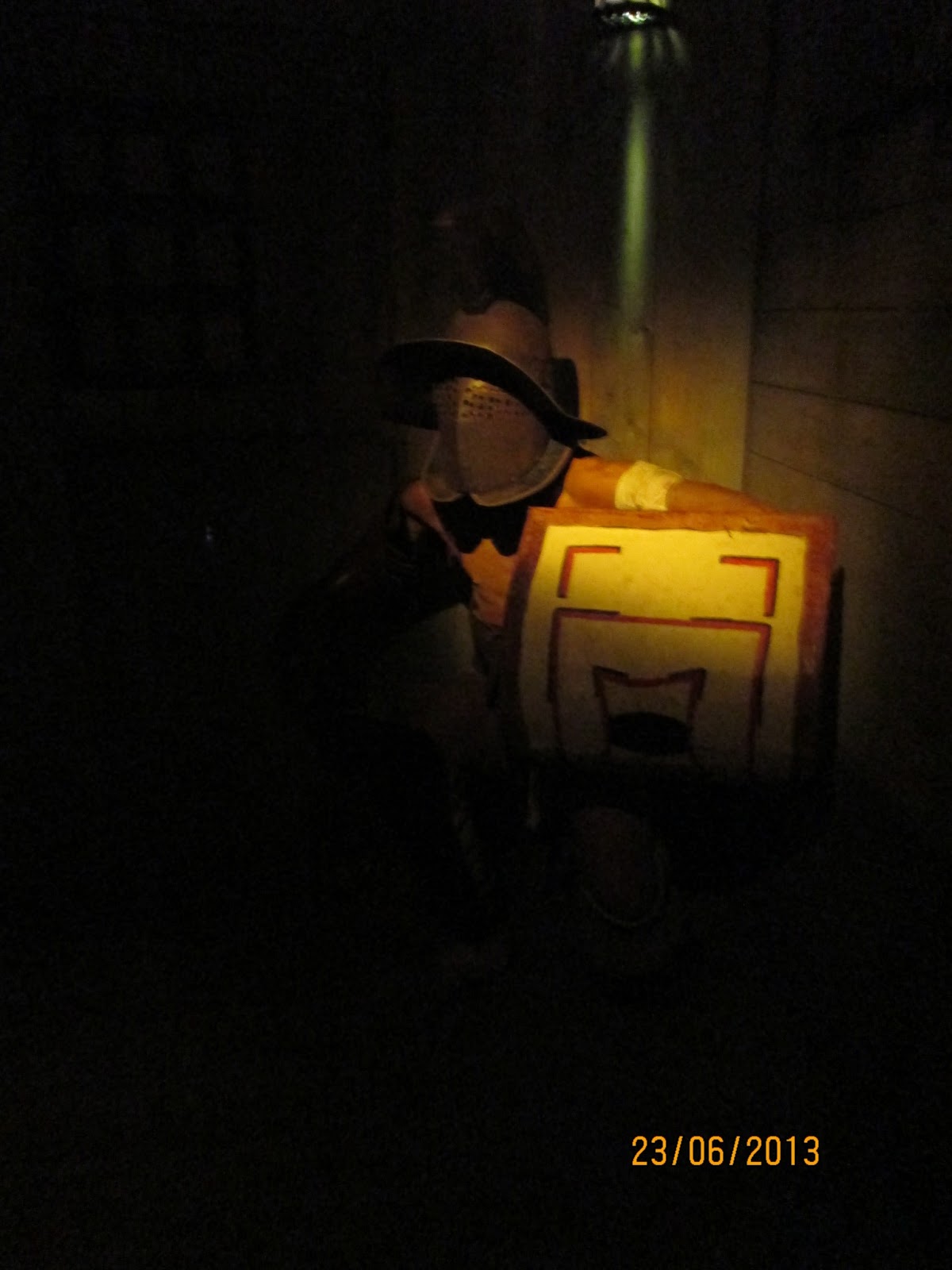
* An attempt at ´Gladiator experience´by transforming one room into a Gladitorial chamber


Weaknesses
* The whole theatre was full of staging equipment which probably funds the place being open but to the detriment of the visitor experience
* Lack of walking assistance particularly handrails - maybe I just need to grow a pair but the tiers were 1.5ft deep so I was clambering as opposed to walking up them. And once stood up the wind strength was high. Also they had very steep inclines in places.
* No safety bars either - nothing between you and a 4 storey drop  at times - lovely photos, scary implications especially for the lady taking a stroll along the top at 70 feet!


(Can you see the crazy lady?!)

This laid back attitude to health and safety was refreshing and yet also terrifying, especially with numerous kids running around and ladies considering stilletos fine discovery equipment! After this I became reaquainted with a Chinese/Canadian tourist and we swapped notes on the train. It felt really good to arrive in Avignon!

(Note swapping with China)


Thursday, 13 June 2013

Freiburg and Guildford: Twinned Cities


Freiburg: City of faces
I went to Freiburg because my friend May was going there. I have to say I didn't really know about its history but I sure did enjoy it. Think cobbled streets, with gentle inclines in the towns, mountains in the background. I enjoyed visiting the Gothic minster (we didn't climb the tower as the weather was bad), eating würste, buying curiosities in the Minster Market and drinking cocktails in the evening. Whilst exploring we came across numerous anthropomorphic faces from mermaids, to gargoyles and lions.

Cocktails always aid creativity - my fruit boats

The Augustiner Museum; a modern museum considering the art and culture of Freiburg from the Baroque through to the modern-day is a real treasure. Their stock is vast with tapestries, the most representations of Jesus I've ever seen as well as an organ, stained glass windows and gargoyles to boot! Although the content was really old, the layout was very modern and designed to purpose. The gargoyles were positioned so you could see them from a distance as they would be in situ but also close-up from the gallery.

Secondly, I wanted to tell you about a bookshop I visited. I don't know how you feel about bookshops.  For me, the smell of antique bookshop is like catnip (to a cat!). I cannot resist.
I looked in the window and knew I had to go in.

I asked May to restrain me.

We went in. They had loads of books on Anthropology and Material Culture and several travel books arranged according to locality. One book we found was a Baedecker of the Rhine Land from 1939. It was geographically relevant and was full of references to the Glory of Hitler - quite an unusual discovery! Unfortunately the price was also outside the usual range for my trip - aka all my euros. So I left the shop, but not before I bought this postcode from 1906!

From Freiburg with love - the message is written in pencil round the outside!


Guildford: Heritage, public and private
I visited my friend Bec and spent several hours exploring. There are lots of historical buildings in Guildford centre from the Tudor Rose Restaurant to the Alms Houses, Holy Trinity church, and Abbots Hospital. I found something to climb, this time a Norman Castle tower! I paid £3 to view an exhibition, watch a video (from 1995!) and then climb the tower - this seemed a reasonable fee for the upkeep of such ancient heritage. I don't really know when, or why this obsession with climbing high ancient things came about. I can't help but wonder whether it has something to do with being so small and always looking up at things. There's something quite novel about observing cities from above.

Next I walked out to Guildford Cathedral, passing the road where my grandparents used to live. There were a few subtle changes. The road sign now featured a subtitle 'no access to university' and at the bottom of the road a shisha bar had opened. I wondered what my Grandpa would have made of those changes.

Guildford Cathedral itself is not like many of the other places of worship I visit. It was originally designed in 1930 and was finally completed in the 1960's. The angels on the entrance to the nave were strangely reminiscent of the angels at Coventry, turns out they are both designed by John Hutton. Usually when I visit a Cathedral it is for its Medieval history, the sanctity of ancient places of worship and of course a decent church tower. This time my visit was incredibly personal; my grandfather was a Cathedral Guide and it was a really special place for him. Sat in the Lady Chapel I found myself transported back to my own experiences some 12 years ago at my grandmother's funeral. That too is a history and a heritage, but a much more personal one; it is mine I have both ownership and authorship over it. Not everyone gets a museum or exhibition in honour of their history.


Finally, sorry for disappearing on you all! My weekends have been manic. There has been much to discuss: I've read 4 great books, done lots of thinking on social action and exploitation, experimented with poetry at the seaside and taken 2 people on exciting tours of London over the last 6 weeks. I am not sure there will be time to write on all of these. Especially as I am off to France in just over a week!


Saturday, 11 May 2013

Going West

Hello!

Re-writing this post from Guildford I am really aware of just how much travelling I've done of late. I wrote the draft in the Black Forest, editing from Guildford and the content relates to Bristol and Oxford. Such is the life of the nomad I suppose.

My many recent trips have highlighted several heritage-y thoughts.

Arnos Vale Cemetery: A Place to Remember
One morning myself and some friends visited an Art exhibition, the Bristol Blue Glass Shop (where we hoped to witness some glass blowing but alas twas not to be) and a cemetery. But not just any cemetery, this was the Arnos Vale Cemetery, 'a place to remember'. At Arnos Vale they have decided to let nature reclaim a disused Victorian churchyard, an intriguing take on remembering. One of the other ways they 'remember' is to host themed events such as a halloween gig on site. Seeing as people have been buried in the cememtery into the 90's such events might seem a tad incongruous to the living memories of the not-long-gone deceased. The stones that remain are a veritable catalogue of Bristolian personalities from the famous to the unknown. Their stones, nationalities, and works of note all point towards Victorian Bristol's industrial past - one stone even had a watermill represented on it! There were several references to Bristol's connections with the open sea, with Indians buried in Bristol and memorials to Bristolians buried in India. Funny how somewhere so regional (think accents) can have such an international impact...


Memorial Reclaimed


Watermill Grave


St Mary's Tower: A Higher Perspective on Heritage
The next day I ventured to Oxford and was indulged with both Byron burgers and an old church tower. You all know how I love to climb things (this might jog your memory) and St Mary's Tower was no different. Standing at more than 120 steps tall (noone wants to tell me its actual height but it felt less than Canterbury's 100ft) its worth the climb - on a clear day the reward is an impressive 360 degree panorama. The views chart much of Oxford's history from rolling countryside through Medieval, Tudor, Victorian and of course 1960's architecture. Whilst considering the sheer range I was reminded of the limitations of preserving whole living, breathing cities. What would the impact of preservation have been on Oxford if organisations had prevented development along the way. Some 2400 miles away in Mali the whole town of Djenne is UNESCO protected. Part of the legislation dictates that any buildings must be built in the traditional style (faced with mud, occasional tiling) and that's a tad problematic if regular rainfall washes all the mud away. I wonder what Oxford would look like if the same rules had been applied to that historic city?

Preservation in Djenne, force for good?


Next time: Freiburg & Guildford - twinned cities.

Monday, 4 March 2013

People: Alan Bennet's Play


One of the first plays I saw at the National Theatre was an Alan Bennett play, The History Boys featuring the original cast; Corden, Cooper, Griffiths and in my opinion the best, Parker.  Having also performed in Talking Heads and seen other Bennett material staged, when People was announced I was excited. My well-worn Entry Pass got another airing for Bennett’s new play.

People, is the story of a country house and its destiny as lived by an elderly dowager, called Dorothy. It questions the immutability of time and the necessity of organisations like the National Trust. It was a particularly interesting play for someone with an interest in heritage because it always comes back to ‘what is worth preserving? And why?’.

The play opens with two old ladies in a big country house and the entrance of a young man wearing only a military jacket. From that point on Bennet both amuses and informs; especially when his play was furnished by such a stellar cast, De La Tour (who knows about timely delivery of a line), Jupp (playing a stereotypically dower and slightly slimy salesman) & Cadell as the Deacon of Huddersfield. He marries church and state, humour and a very serious agenda, porn and country houses.

People
(De La Tour & Linda Bassett in a light hearted moment)

National Trust as auctioneer & little England
In People Alan Bennet is evidently very critical of the mercenary attitude he considers the Trust to have taken on. As a reflection of changes in society, anything is for sale; Bevan claims his group even ‘bought Anglesey recently’. When asked about his evident objections in interview Bennet said, ‘‘Less and less are we a nation and more and more just a captive market to be exploited…That a Methodist church in Bournemouth has been bought and re-opened as a Tesco is hardly worth mentioning…My objections to this level of marketing are not to do with morals but to do with taste’. And this attitude comes out time and time again in his play. These objections often find their voice in the character of Dorothy who would rather have an ensuite bathroom and a porn film filmed in her lounge than leave her house to the National Trust. The reaction from the National Trust as voiced by Ivo Dawnay is as follows, ‘It’s sad that the world is very commercial but we need money to do our conservation work and if we are going to save beautiful places, we need to have the funds to do that.’

What is worth preserving?
The key question this play seeks to ask is, ‘What is worth preserving? And at what cost?’. Is the shell of a well-loved house in a state of disrepair really worth saving, when all Dorothy wants is a ‘non-arctic bathroom’, when the house is anything but unique, when it doesn’t really have a narrative to ‘sell’ it, when Dorothy must pay in order to donate her house to the Trust. As Dorothy notes ‘not caring is what has preserved them’. The young man representing the Trust raises a question even of what is worthy of saving, regarding Mazer prison he asks, ‘Do we…save them? Do we restore the patina? I think we do. I think we must’. It seems that for Bennet there is too much interference with the passage of time and decay which according to one character in the play ‘is a kind of progress’.

National Trust as church
During my Masters I was obsessed with the issue of how space becomes place. What imbues a location with meaning? What might be too sacred to touch or interfere with?

This is a question Bennet asks quite deliberately by staging a porn film in the house and running it up against the visit of a bishop and the more savoury clientèle of the Anglican church/ National Trust. The metaphor of church and National Trust is made explicit ‘The Trust is a church too and in the piety and devotion of its members one that would rival the Anglicans…the cars boast their pilgrim badge, the stickers the holy houses where they have paid homage and the sacrament they have received of coffee and walnut cake’. Not only is this hilarious, and true, it is also not a new metaphor, see Burch 

The sacred items in this secular church are also a little bit odd. He highlights the way in which National Trust properties land on anything that will create a story, even pot-pans used in the Billiard room by famous people in this case. Along with the servants quarters and the old croquet set, even Dorothy is coerced into being part of the visiting experience, she ruminates on the way people process museums now, ‘And not even looking. Snapping it. Ticking it off. I don’t want to be ticked off’. The National Trust man responds saying, ‘there is nowhere that is not visitable. That at least the Holocaust has taught us’. The horror implied in Bennet’s narrative of the fact that everything must be sacrificed to the mass consumer on the altar of ‘The Past as Experience becomes truly evident’.

Whilst Bennet is flippant and occasionally represents his subjects in a way that is truly farcical he has a point to make. What is really worth sacrificing for the good of ‘England’ if there really is such a thing? Is it worth the unhappiness of two women in their dying days, the sacrifice of ‘reality’ for some imported story, ‘Country houses are window dressing. They mitigate nothing’. His point is that they mean, nothing. Access to country houses for the masses changes very little. ‘The Trust wants to get people in, we want to keep them out. Either way the house is preserved.’

PST (people spoil things)
Early in the play Bevan, the auctioneer introduces us to his little saying, ‘PST: people spoil things’; he advocates not the democratisation of heritage but its siphoning off. Dorothy makes the point that whether people are included or excluded, ‘either way the house is preserved.’ The great irony of this play is the title, ‘People’ and the ostensible plot-focus, ‘a house’. Maybe the play isn’t about the house after all!

See this play at the NT, and if that’s too far to go see it in your local cinema, where its being streamed live on 21st March.