Wednesday, 4 March 2015

In Search of 'Identity': Grayson Perry.

Last month I went to see Grayson Perry’s ‘Who are you?’ at the National Portrait Gallery, not once, but twice – such is the joy of free museums in London! 

THIS EXHIBITION CLOSES IN 11 DAYS, SEE IT NOW!

Grayson Perry is a transvestite potter who has long been interested in innovative portraiture and the opportunity it provides to explore the disjuncture between the projected and real identity of individuals and groups. As with his work on class identity Perry has accompanied his exhibition with a TV series which you can catch on 4OD.

Perry’s first works to be encountered are a map of his own identity and a massive tapestry looking at British identity. It is in this context, of the individual and the corporate that the rest of the works should be considered.

I’m used to Perry being excellent, but he has really outdone himself this time. Perry uses a variety of mediums – tapestry, pottery, screen printing to explore what it means to be British, male, famous, disabled, a soldier, religious, even human. There is a strong undercurrent of gender discussion in his work, a family with 2 Dads are compared to a ‘conventional family’, the Huhne vase is stamped with penises and yet has been broken and pieced together to depict vulnerability, Alex is undergoing gender reassignment and is depicted in a bronze piece as a warrior.

(Huhne Vase)

One of the most fascinating elements of the exhibition was the way the pieces had been placed. Rylan was amongst the 18th century authors and gentry, the Irish loyalists were with the officers from WWI and Churchill, Alex depicted as a warrior blowing a shofar and the three soldiers returning from war found themselves keeping company with the old adventurers, and the gay family in the same room as the Royal Family resting at Windsor. Sometimes there’s a faint whiff of humour in the work, the Irish loyalists are created using garish pinks and yellows, riding a horse more akin to a unicorn than a mount! Perry’s use of material can be thought provoking: when depicting a white 20-something single-mum from Kent’s conversion to Islam, he prints it onto a hijab; an article so laden with meaning and emphasis.

(Hijab)

Perry’s work on class proved his aptitude as an ethnographer; but through his recent work on identity Perry has also proved himself an artist. I was thoroughly impressed by the work and the way placement of the exhibition encourages visitors to consider the wider range of works on offer at the National Portrait Gallery.


Who Am I?’ closes in just 11 days be sure to catch it before then. As previously mentioned, entry is free.

Tuesday, 3 February 2015

In Search of: Bambi

Some people go without alcohol for ‘Dry January’, I went without coffee, and blogging. One thing I did a lot of in January was searching. So herewith a series ‘In Search of’ beginning with Bambi.

Sundays are great feasts of leisure in my world. And one of the great benefits of living in Belsize Park is that nothing is that far away. So one Sunday afternoon my bike and I boarded a train and for the princely sum of £1 and a 40 minute train-ride made our way to Richmond Park.

On arrival I was relieved to have brought my bike, the park is a good 10 min uphill cycle, half an hour’s walk through suburbia would have seemed a waste of good energy en route to a park of epic proportions. That said, Richmond town is pretty enough, and they name places after food!


The park itself is a humongous 856 hectares (1427 football pitches) and is the largest of London’s parks, created in 1634 as a deer park for Charles I the park plays host to 630 deer, The Royal Ballet School and enough unique plants to be declared a Site of Specific Scientific Interest.  You can visit the park on foot, bike or in the car. The nice thing about riding the bike is you get wider access to the park (than in a car) but you can still cover large parts of the park fairly quickly.


I enjoyed looking for Bambi, his family and friends. I found his Dad and one of his sisters, but not Bambi himself. When you look at this majestic fellow you would never believe me that I nearly missed a whole herd of his antlered friends, but they really do camouflage very well. I also enjoyed this tree which looked a bit like a deer’s head complete with antlers.


It was a chilly crisp day so I didn’t sit around much. I did find a few snacks (what is an adventure without a good snack!) but was a bit disappointed that the tea rooms were shut. A pasty and a hot chocolate would have to do. Rejuvenated the return journey back to the station seemed terribly easy but then it was all down-hill. I was caught out (twice no less!) by last minute unannounced platform alterations at Richmond, do be aware.


As Sunday afternoons go, that was a good one. Long live Bambi!


Tuesday, 16 December 2014

Remembering and Representing: Germany Part II

Yes, I've been away, Christmas is coming and I have been crafting some beautiful things. Anyway...

Regular readers will know all about my obsession with Germany, today I even have Wir Sind Helden in the background. You will also know about my love for the British Museum. This Winter they made my dreams come true in producing Germany, Memories of a Nation.

https://www.youtube.com/watch?v=M0-VDKTY0ok
(Memories of a Nation Trailer. Click  here to watch video. Copyright: British Museum)


Different Germanys
The exhibition showcases 600 years of German history starting by illustrating the many different Germanys that have existed over time and the uniqueness of the regions. This section sort of works, it certainly gives good context for newcomers, with quality maps, but the coin display was a bit lifeless and more akin to a bronze age exhibition.

Vorsprung durch technik
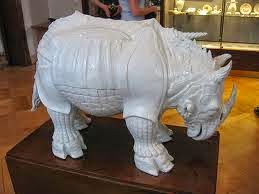
Germany's technical prowess is well documented from printing, to the Bauhaus movement, the incredible work in ceramics, the Meissen rhino really is quite impressively large. And its famous people are also well celebrated, both Hans Holbein's Erasmus and Tischbein's Goethe make an appearance, as does Napoleon's hat.

(Meissen Rhino)

New Learnings
Even for a massive Deutschophile there were things to learn. I learned that hidden in the Buchenwald Concentration camp gates was the hidden rebellion of a prisoner in the form of Art Deco script. I learnt the significance of Barlach's Hovering Angel, and the relevance of the face being modelled on the mourning mother and artist, Kathe Kollwitz.

(Buchenwald Gate)


One Nation?
One of the central events commemorated in the exhibition is the anniversary of the fall of the Berlin wall. There is a great chunk of the wall outside the main exhibition space but this its relevance is mainly lost in the grand surroundings of the hall; unlike its counterpart the VW Beetle which holds its own in the glass temple. The more effective image is the protest poster, 'Wir sind ein Volk', indicative of many Germanys coming under one banner. I remain, however, unconvinced of this idea as a reality on the ground.

(Wir Sind Ein Volk)

Come and see the exhibition in real life and tell me what you think! The exhibition is open until 25th January. Or listen to the insightful radio series by Museum Director, Neil MacGregor, taking one object at a time and discussing its role in German history for 15 mins.

Further Reading
I've been to a couple of panels at the British Museum and they have introduced me to Philip Olterman  (amongst others) who writes hilarious tweets and also wrote a great book in 2012, 'Keeping up with the Germans' - both informative and funny, I now finally understand why Germans love 'Dinner for One'; an English farce that I had never heard of!


Tuesday, 11 November 2014

Remembering and representing: World War I

Every museum worth its salt has a World War I exhibition this Autumn. I’ve almost lost count of the exhibitions I’ve visited.

Imperial War: through an imperial lens

The IWM have just reopened their First World War galleries, when I visited a mere fortnight ago the museum was rammed with grandparents and grandchildren making the most of this new, free, interactive exhibition. For an imperial war museum they’ve done a good job.  Technology has been used to good effect to create interactive games, and a reconstruction of a trench.  Subject wise there was plenty on the war as class conflict, a section dedicated to conscientious objectors, as well as an informative area on the world war beyond Europe particularly in the Middle East. There was some effort to represent the home front, but I felt women were under-represented in the exhibition particularly with reference to activity on the Front – but then I suppose I did buy the book which brought women to my attention at the IWM so maybe its not all bad!


('The Din', Imperial War Museum Gallery)

Upstairs at the IWM they have a collection of paintings from the First World War which cover the gender angle much better – featuring several paintings by women from the conflict as well as several paintings by the Nash brothers.

The Passing Bells

Another commemorative TV series on the BBC this Autumn – borrowing its title from Wilfred Owen’s ‘Anthem for Doomed Youth’. TPB jumps a major hurdle to remembrance from the first scene in genuinely representing 3 different nationalities experience; German, English and Polish. The producers have worked hard to show the shared experiences and get some comment on most of the major events –  1914 Christmas peace, the Somme etc. I felt the role of women in TPC was well covered and nothing was over romanticised. That said, unlike Our World War the show is designed to feel like a period piece. War is not glamorised, the character of Derek (Brian Fletcher) is used to mirror some of the questions we are asking today ‘in a hundred years’ time, I wonder what they will make of this?’. You can catch The Passing Bells on iPlayer til Dec 3rd.

(Enemies side by side. Photo credit: BBC Media Centre)

Burgh House: bringing the war home

To bring the conflict back to a very local scale I visited the free exhibition at Burgh House, Hampstead. Hampstead Heath played host to training troops during the conflict and artists famous from the era – including the Nash brothers and Richard Carline. The exhibition featured a copy of the Vorticist magazine, Blast and an original World War I nurses uniform as well as several photos of people using the hospital and the nearby heath during war-time. The curators had made good use of poetry on the walls to set the scene, and helped to set an international crisis into a local perspective – the personal drawn into stark relief through the smaller objects – a Princess Mary tin, a postcard home. The exhibition is open until 14th December. They also do great food!

(Troops work out on the Heath)

(The doorstep of Burgh House)

Monday, 3 November 2014

Madrid: a voyage into the unknown

Normally when I set out on adventures my friends have lots of recommendations. Not so with Madrid, only one friend had visited Madrid, most said by qualification, ‘I went to Barcelona’. If you are looking for a destination for a long-weekend I’d definitely include Madrid on your list; there was plenty to keep us busy across three days.

Apartementos Madrid Huertas

We found our lovely restored 18th-century apartment on booking.com. The bonus of an apartment and your own front door is being able to come back at any point for a cheeky coffee, a nap or a shower - we learnt this in Venice. We also had a balcony; I really enjoyed jotting down some lines, chorizo in one hand, coffee in the other watching the world go by of an afternoon.

Searching for cheese and chorizo

Our apartment was very near Calle León a street full of food and curiosities. So the first morning whilst my amiga was recovering from her jet-lag I escaped in search of bread and pastries, cheese and chorizo; and I was not disappointed. The bakery had baguettes the length of my arm and giant napolitanas (I bought 2). Buoyed by the experience I found what purported to be a wine deli, but when I asked to buy chorizo the gentleman behind the counter produced a foot-long sausage and asked how much I wanted! That was a serious breakfast!


(Breakfast at the apartment!)


We visited several churches whilst in Madrid but deliberately passed San Jeronimo on the way to the Parque del Retiro and it was the first of several churches we visited whilst in Madrid. Whilst the exterior is very impressive the inside features a lot of plastic and this was a bit disappointing. Somehow putting a euro into a slot which then turns on a battery operated tea-light wasn’t quite the same! That said there were several interesting depictions of Christ inside and I particularly liked this stained-glass window.


(Electronic candles :( )


(Christ on the cross)

Parque del Buen Retiro

The PdBR is 350 acres of beautiful public park complete with statues, cocktails, the Crystal Palace, a rose garden and a lake. Not just any lake, a lake you can hire a boat and row on - all the way past a monument to Alfonso XII. We spent a good 3 or 4 hours in the park, boating, pausing, smelling the roses. A top class park thoroughly reminiscent of San SouciBerlin and Jardin de Luxembourg, Paris.


(The monument, and the boating lake)
 
El Prado

Did you know the Prado is open for free between 6-8pm on some weekdays? We made the most of this free window to see numerous works by Rubens. I particularly enjoyed comparing the pictures of Adam and Eve painted by Titian and then copied by Rubens – it was like those games of spot the difference! I prefer Rubens version because it’s got a parrot!


(Titian and Rubens - Adam and Eve)

The time we bought biscuits from a closed order of nuns...

I had read online that there was a closed order of nuns in the city who sold biscuits. We decided this was an opportunity not to be missed and thus dedicated a morning to finding the spot where ‘sweets are for sale’. We found the church attached to the convent and after a brief tour of Hapsburg Madrid to allow the school group to disperse we returned to the door. A cyclist emerged and we asked him about the protocol for acquiring the sweet treasure. He said very little, ‘you’ll have to find out for yourselves. A gnarled beggar woman rang the bell for us to tell the nuns we were on our way. 

The door shut behind us with a clunk and there we were in a silent convent in the middle of a bustling city. We couldn’t believe it. With little to go on we followed the tin-plate signs round the nunnery til we got to this hatch with a wooden door in it. The door appeared to have taken on the voice of an octogenarian nun, ‘Aqui!aqui?' Having established that ‘yes’, we were there, and ‘yes’, we wanted to buy biscuits, the lady rattled off a long list of biscuits they had for sale. We were still making up our minds when a beautifully packaged pack of nevanditos emerged and a request for 'dinero' was made. We put our cash down, and our change re-emerged as a part of this rotating transaction. The American and I made our way back to the front door still silent in awe of the whole experience and remained silent for quite some time.


(The mysterious revolving door)


Calle Cava Baja

This is the road for all your tapas needs! We were in quite a particular mood so it took us a few goes before we found our ideal spot but we did find it, the ever kitsch, La Perejila. The pictures of Spanish senoritas on the walls, all the lace, even the octopus on toast (tentacles still very much on!). We experienced great kindness from the waitress who plied us with free sherry and sugared almonds.


(La Perejila)

Palacio Real

Official residence of the Spanish Royal family and the biggest palace in Europe. The palace in its current form has been there since the mid-18th century but built on the same site as 9th century fort mayrit (from where we get the name ‘Madrid’). 

There were several overlaps between the Palacio in Madrid and the Hofburg in Vienna. I guess that is not so surprising when the connections between Philip IV of Spain and Leopold I of Austria are considered. Margaret Theresa (immortalised below by Velázquez) was betrothed to her cousin and uncle as a child, and married at 15; producing 4 children only one of whom survived her, when she died aged 21.

The palace itself is very impressive, particularly the murals, the clocks and ceiling paintings. They also have an extensive royal armoury. Well worth the 10 euros entry fee in my mind. If you don’t want to part with cash, the Palacio Real also offers a free entry time later in the day.


(Margaret Theresa)


(The ceiling at Palacio Real)


Temple of Debod

For our last adventure before flying home we went to Parque del Oeste to visit the Temple of Debod – an ancient Egyptian temple given to Spain by the Egyptians as a thank-you present for their help in preserving Abu Simbel. It’s a surreal experience being surrounded by hieroglyphs in the middle of Madrid but definitely worth the hike up the hill. Free entry.

Honourable mentions go to:

 The Gran Via, Puerta del Sol (only tube stop I’ve known named after a phone network) Café Mallorquina, numerous churros venues and the Brazilian couple we met who were fab, Plaza Mayor.

Friday, 31 October 2014

Our Girl & Our World War, Brick Lane, The Riot Club, Mind and Soul podcasts

Hello!

I took a bit of a break, didn't I?! Whilst you've not heard from me in the online world, I have been up to an awful lot of things out there in that other world; a wedding, a baby dedication, several plays, many meals catching up with dear friends, making plans for new holidays, I even escaped to Madrid last week (more on that in subsequent posts). At one point I travelled some 493 miles in just 5 days without leaving the country.

I've had plenty to write about, but no time to process it. But here I am. Back at last. With a crisp that's even bigger than my mouth!


Our Girl & Our World War

I've still had time to keep up with some TV, particularly military dramas. Our Girl has just finished its second series starring Molly Dawes (Lacey Turner), a young army medic in Afghanistan.  Its quite unusual to present the active side of the military from a female perspective; unfortunately it does retain a fair amount of girl-fronted-TV-show traits, there's a strong focus on fashion and rom-com elements. I also think the fact that the show was brought back for a second series is interesting, indicative of the ways in which the British public have changed perspective on Afghanistan involvement over the last 5 years. In the final episode a mother who has lost both her sons to the conflict says 'I gave you my boys; and you gave me a flag'. Both sons chose to be soldiers, but the mother is left empty handed.

(Molly Dawes. Image Credit: Digital Spy)

By contrast Our World War is a drama series based on the first-hand accounts of soldiers in World War I. The series originally aired in August but I'm only just catching up with it now. Historic accounts can feel distant and difficult to engage with but the series' production team have really done their best to overcome this. Each episode begins with spy-series style mapping and info which means you don't have to know where Delville Wood is to understand the importance of location and action at that moment. A decision to film the series with a strong documentary flavour and a contemporary soundtrack also help to close the gap of a century and make the characters easy to relate to. Can't wait to finish episode 3!

(Image Credit: BBC)

Brick Lane: Monica Ali

Last Christmas I bought myself 5 fiction books about London including White Teeth (Zadie Smith), did we talk about that book? I can't remember. Anyway Brick Lane is in a similar vein but with a much tighter focus on one woman in one family. Nazneen is a Bengali woman who arrives in East London married to a much older man. The book addresses themes common to much of humanity; relationships, friendships, parenting, and employment, through the specific lens of a Bengali immigrant in East London.

I'll be honest, finishing Brick Lane has been difficult. I've been reading it for at least a month and I've still not finished it. I think it might be because it doesn't have that much drama, nothing drastic happens, its fairly run of the mill. That said, stylistically Ali is a pro, she captures the voice and grammar of Dhaka excellently, and the dialogue between characters is both distinct and believable. Ali clearly knows the locality of her book well, having spent some time in Tower Hamlets I recognised the roads and the shops mentioned. I'm determined to finish Brick Lane but she hasn't made it easy!

The Riot Club

TRC is a film based on the play POSH by Laura Wade, itself loosely based on the activity of Oxford society, The Bullingdon Club. The film focuses on one night, and 10 Riot Club members. Honestly, I'm a bit terrified that it will do Oxbridge a ton of disservice. The vast majority of people I met at Cambridge we're not like the cast of Made in Chelsea or The Riot Club - with more money than sense. The things I liked about the film were: the panoramas of Oxford, that scene on the roof top, the eccentric supervisions, the lunch where Tom Hollander plays a successful MP.

That said, I think the film failed to adapt the play enough to its medium. Plays are restricted by physical space so it makes sense to set 90% of the play in 1 room. On film multiple locations become more viable and hosting the majority of a film in the same 4 walls can lose pace and the film did feel like it was dragging sometimes.

(Image Credit: IMDB)

Mind and Soul Podcasts

My congratulations to you if you are still with me! Its been a lengthy one this week as I had so much to say. I just wanted to conclude by saying I've been listening to a series of talks by Christian Mental Health resource, Mind and Soul. They've recently released a couple of talks on Perfectionism, Worry and Guilt. I've found them all helpful. Give them a listen.

Next Time: Madrid! I had an incredible time, I'm still processing the experience.

Friday, 26 September 2014

James III: National Theatre Scotland

This week I had an extra special theatre experience at the National, watching the National Theatre of Scotland's James III - from the stage.

Jamie Sives (Game of Thrones) and Sofie Gråbøl (The Killing). 
King James III and Queen Margaret of Denmark.
Photo Credit: National Theatre.

Click here to see trailer.


Theatre in the round

James III is one of a trio of plays by Rona Munro charting the history of the first 3 James kings of Scotland. It was originally performed at Edinburgh International Festival in the round and they've copied this format for the performance in the Olivier Theatre. This meant I got to go back stage. It was so magical to see the engine rooms of the National Theatre, the backstage props and the perspective of performers looking out on an audience from the stage.

The play itself is a contemporary rendering of the history of James III of Scotland by Rona Munro. Both acts commence with a ceilidh band playing 'Born this way' and other modern classics which subtly allude to the plot. The characters wear modern dress with the odd nod to the fifteenth century (a la Robin Hood circa 2006).

Jester King

James' court is portrayed rather like that of King Henry VIII's in The Other Boleyn Girl, pretty poor girls, poor economic decisions and banishment of the privy council. I particularly enjoyed the moment where James III sacrifices the funds for a pilgrimage to Avignon to instead employ a choir to follow him round at all times to make life more 'beautiful'.

This play is all about the girls; the mistresses, the mothers and the formidable Danish queen, Margaret, who might be a bit past her best but has one hell of a head on her shoulders. Beyond the privy council, the nobles, Lord John and sibling rivalries the real power is held by the girls. There was a particularly strong performance from Sofie Gråbøl showing depth of character and progression.

Poignancy of timing

I watched this play one week after Scotland's referendum. There are plenty of references to the relationship between England and Scotland as James III constantly suffered the threat of English invasion and coercion. Munro illustrates the links between the historical political circumstance and that of today very well, so  little has changed in 500 years. A contemporary play, James III gave me an insight into how Shakespeare's history plays must have been received by the audience of the day; the parallels to their modern day circumstances must have been clear.


The show was a sensation, taught me loads of Scottish history and provided a unique backstage tour as part of the bargain. I'm really looking forward to seeing the first of the trio, James I, in a few weeks time.

King James is played by Game of Thrones star, Jamie Sives, and Margaret of Denmark by Sofie Gråbøl from The Killing. James III features full nudity and is not appropriate for those under 14 years old. The three James plays run daily in rotation, you can still get tickets for £15 until 29th October.