Showing posts with label Germany. Show all posts

Friday, 6 January 2017

Hamburg: Aug 15

As you know, I have been to Hamburg a couple of times with my Dad (see here) and then for a sex trafficking conference (see here). This time I was visiting a childhood friend who moved to Hamburg, and some pretty sweet Viking sites.

The trip began very adventurously with an hour and a half delay on picking up my hire car from the airport. It was my first time hiring a car abroad and I was nervous. The first thing I did was drive the car the wrong way down a dual carriageway. It was a super stressful experience, but I did eventually complete the trip from Bremen to Hamburg. I remain unconvinced that German motorways are all they are cracked up to be for speed; at no point on the holiday did I escape the Summer 'Staue' (queues)!

City Centre Fun
Hamburg being a harbour city there are many opportunities to discover the watery-environs. We hired a row-boat to explore the Alster and did plenty of messing about on the river, or should I say lake. For entertainment there is a great riverside bar on a re-purposed light-ship; we enjoyed a night of jazz music on board the Feuerschiff - at least there was a legitimate reason for the horizon to be moving!

Who left me in charge of an oar?!
Feuerschiff


Beyond Hamburg: Lübeck and Hedeby
One of the advantages of hiring a car is how much easier it is to explore the wider world beyond your immediate town; so I took day-trips from Hamburg to two other places: Lübeck and Hedeby.
Lübeck is a pretty Medieval town which really shone in the summer light. Big city gates, beautiful warehouses, and old winding streets. Lübeck is also famous for marzipan; they have been producing marzipan there since 1806 and there are several shops dedicated to the stuff in the town centre. On the way home the radio played David Gray's Babylon for the nth time!

Salt-store
Old school high street


The Viking trading settlement of Hedeby was founded in the 770's. It was the first town I ever studied whilst at Cambridge. And only 1 and a half hours from Hamburg. I had more driving stress on this journey, this time associated with parking. There were very few places to park; when I did find somewhere to park turned out it was for coaches only - I was driving a Fiat 500!

When I eventually parked safely Haithabu Re-enactment village it did not disappoint. Neither did the boar sausage and mash I had for lunch, very Viking! On the way home I stopped via Gottorf Castle and saw the Nydam clinker-boat in real life. This is something akin to being able to touch the shroud of Tutankhamen in my world!

Hedeby village
Wildboar and veg. Viking diet.

Clinker boat at Hedeby


Bremen
And so on the last morning, I drove my car back to Bremen with plenty of time, and prayed they wouldn't charge me for the wing-mirror paint scratches. Trying to find somewhere to fuel up was quite a challenge in the unknown city; and I felt like Bremen and I already had car-related beef. Having dropped the car off I explored the city in the afternoon. I came across this group of street performers chanting 'eat.work.sleep.repeat' and wearing all black. I was fairly sure these were Christians. I was trying to take a photo and the man in the photo engaged me in conversation. When I told him I was waiting for a flight he said 'perhaps you are waiting for Jesus!' and I prayed he wasn't prophetic!


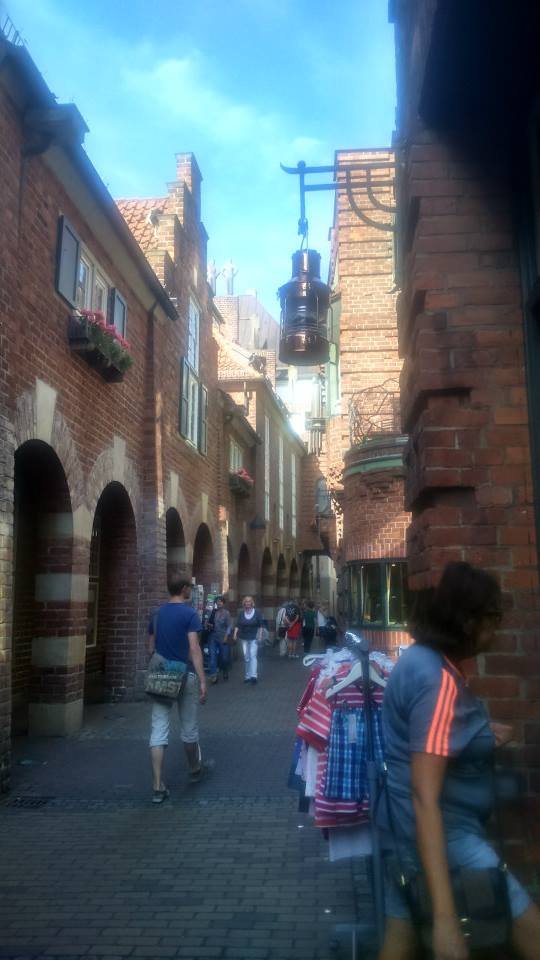
Bremen town
Waiting for Jesus?


Tuesday, 16 December 2014

Remembering and Representing: Germany Part II

Yes, I've been away, Christmas is coming and I have been crafting some beautiful things. Anyway...

Regular readers will know all about my obsession with Germany, today I even have Wir Sind Helden in the background. You will also know about my love for the British Museum. This Winter they made my dreams come true in producing Germany, Memories of a Nation.

https://www.youtube.com/watch?v=M0-VDKTY0ok
(Memories of a Nation Trailer. Click  here to watch video. Copyright: British Museum)


Different Germanys
The exhibition showcases 600 years of German history starting by illustrating the many different Germanys that have existed over time and the uniqueness of the regions. This section sort of works, it certainly gives good context for newcomers, with quality maps, but the coin display was a bit lifeless and more akin to a bronze age exhibition.

Vorsprung durch technik
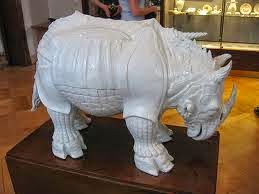
Germany's technical prowess is well documented from printing, to the Bauhaus movement, the incredible work in ceramics, the Meissen rhino really is quite impressively large. And its famous people are also well celebrated, both Hans Holbein's Erasmus and Tischbein's Goethe make an appearance, as does Napoleon's hat.

(Meissen Rhino)

New Learnings
Even for a massive Deutschophile there were things to learn. I learned that hidden in the Buchenwald Concentration camp gates was the hidden rebellion of a prisoner in the form of Art Deco script. I learnt the significance of Barlach's Hovering Angel, and the relevance of the face being modelled on the mourning mother and artist, Kathe Kollwitz.

(Buchenwald Gate)


One Nation?
One of the central events commemorated in the exhibition is the anniversary of the fall of the Berlin wall. There is a great chunk of the wall outside the main exhibition space but this its relevance is mainly lost in the grand surroundings of the hall; unlike its counterpart the VW Beetle which holds its own in the glass temple. The more effective image is the protest poster, 'Wir sind ein Volk', indicative of many Germanys coming under one banner. I remain, however, unconvinced of this idea as a reality on the ground.

(Wir Sind Ein Volk)

Come and see the exhibition in real life and tell me what you think! The exhibition is open until 25th January. Or listen to the insightful radio series by Museum Director, Neil MacGregor, taking one object at a time and discussing its role in German history for 15 mins.

Further Reading
I've been to a couple of panels at the British Museum and they have introduced me to Philip Olterman  (amongst others) who writes hilarious tweets and also wrote a great book in 2012, 'Keeping up with the Germans' - both informative and funny, I now finally understand why Germans love 'Dinner for One'; an English farce that I had never heard of!


Friday, 19 September 2014

The big 100!

Today is a momentous day.

We discovered that Scotland as a whole wants to stay in the UK but with a substantial minority expressing discontent. The rhetoric is that everything will change, I've yet to be convinced...

This is also my 100th blog post.


Shankhill Road (Jan 2013)

It all began 3 and a bit years ago, during my MA when the interesting things I was discovering and thinking about wouldn't fit inside essays, so I wrote about them here. My first ever post here, was all about car gears and families. Perhaps I was an eccentric child.


Camino (June 2011)

Since then I'm on job number three, and living a mere 51.5 miles from where this story began. I've lived up to my adventurous moniker having visited 8 different countries and more than 14 cities across Europe - always returning to London with all that it has to offer.


St Paul's (Jan 2014)

I've mused on whether Santa is racist, if social media is bad for us, the masterful work of Luke Leighfield and Susan Abulhawa, and if we really need vision to experience the world around us.


Llanthony Castle (Sept 2012)

My most popular post to date is My Berlin Diaries II, with Offa's Dyke and a review of Skyfall coming in a close 2nd and 3rd illustrating that my travel diaries are your favourites.


Berlin (Sept 2013)

Predictably most of you are from the UK, but then the US and Russia follow next. Whilst I knew I had German readers I was surprised to find many page views from Eastern Europe, Ukraine, Latvia etc. So 'hi' if you are from those places, I hope you enjoy what you find here.

It turns out that 2014 has been a prolific year for me, completing a third of the content for this blog. I really am surprised by that fact. At least perhaps it has kept me in the habit of writing if nothing else!

I've no plans to stop just yet, the adventure is only just beginning!

Yours,

Adventurous Wilkinson


Venice, August 2014

Thursday, 4 September 2014

Munich: TGT Episode 3

Population: 1.378 million

Highlights: Unironic lederhosen, the Third Reich tour, Sausage at Bratwurst Glöcklein (The Sausage Bell), a rail service named Bob.

Accommodation: Air b’n’b room.

(Milkmaid vogue)

Munich itself epitomises all the stereotypes I used to hold about Germany; lederhosen, milk maid outfits, lots of sausage and pork knuckle delicacies, beer halls and beer –I drank one from a 14th century brewery) and architecture reminiscent of Christmas toy-towns.


Munich has a long association with toys and toy making, so we were excited to see the Toy Museum one gloomy morning, but were a bit disappointed. It wasn’t very big and the displays weren’t that imaginative. But I think I am forever scarred by the teddy skeleton and Barbie in her original butter-milk hue.

(1960's Barbie with bob)

One of the best things we did during our time in Munich was a 3-hour walking tour covering the history of the Third Reich in Munich. That sounds like a strange sentiment, let me explain. Munich was the birthplace of Hitler’s Germany, the site of the Beer Hall Putsch, his failed revolution, and several communist uprisings that would shape the future of the Nazi party. All the events on the GCSE History syllabus (1918-39) were happening in Munich – and unlike in Berlin where history is blatant, you really need a guide to point out the clues. The reality that Munich was the breeding ground for so much hatred is very quietly brushed under the carpet such that this gold stream through the pavement counts as one of the only memorials in the city. I also learned on this tour that Germany was created in France, how contrary.
(Hofbräuhaus München - mid-tour)

(Memorial. Source: Around the world in 5 months)


Had we had better weather or more time we’d both have liked to go to Chiemsee, me for the Benedictine nunnery (founded 782) and Dad for the trains. Also in for a penny, in for a pound to continue the black tourism, perhaps a guided trip round Dachau would have been sobering and interesting.

As we were leaving Munich we realised they have a regional train called Bob – we were so tickled we took a photo.

(BOB and BOB)

So Munich, you were a bit wet when we visited, I never realised that this sort of Germany really existed outside of story-books. Your commitment to beer is impressive. But outside of Oktoberfest you are consigned with Frankfurt to my ‘been there, done that’ bin.

Tuesday, 25 February 2014

The Book Thief: a magical homage to the power of books

The weekend before last I made the pilgrimage to Leicester Square cinema. I was on a quest, a quest to watch The Book Thief nearly 2 weeks before it hit cinemas in the UK. My quest was not unrewarded, The Book Thief is an amazing film. But I must admit early on, in an ironic move, I haven't read the book.

The Book Thief tells the story of Liesel Meminger; a little girl growing up with her adoptive parents in the fictitious south-western German town of Molching. Liesel hates Hitler because she believes he took her communist mother away. Liesel loves; her adoptive father, the jewish boy Max they are hiding in their basement, and her friend Rudy who spends the whole film oscillating between love for Liesel and wanting to belong in the Hitler Youth. That and books, Liesel has a lot of time for books.


The film is book-ended (ha!) by narration from a third party and the whole film has a sort-of unreal, ethereal feel. Shrouded in cloud, kept distant by time. The town of Molching has fairytale architecture despite the goings-on being decidedly more nightmare. The Book Thief has come under criticism for being too soft on the Nazi regime and the realities of war; Abele calls it 'a convenient backdrop for a wishful narrative rather than the springboard for an honest one.' I think the problem here is partly stylistic; in reflection of a book which I've heard is highly descriptive, the film's vignette style might not be to everyone's taste. Similarly there is limited reference to the suffering of the Jews on a daily basis. But, I would argue it very much does engage with the real problems facing teenagers and young people during the Second World War. Liesel and Rudi join the Hitler Youth but still feel conflicted. There is a great moment where Rudi paints himself to look like Jesse Owens, his favourite, black, athlete. The pain of his father in trying to explain why this is not an OK thing to do in public in Nazi Germany was realistic and credits the German people with more grace than perhaps other films have done.

Abele also claims that The Book Thief will leave audiences unmoved. I don't think that's fair, it is highly emotive. During a sequence portraying Kristallnacht in all its barbaric cruelty; Liesel and Rudi are part of a children's choir singing the Deutschlandlied. The contrast of childhood innocence and the reign of terror is stark and really effective at portraying the level of brainwashing imposed on young people in Germany. 

(Source: www.hypable.com)

Credit is definitely due to the actors, in their teens, who play Liesel (Sophie Nélisse) and Rudi (Nico Liersch). Neither of them speak English as a first language, coming from French Canada and Germany respectively, and neither have been cast as major roles in films before. The beauty of picking novices is that there is no fakery. Nélisse and Liersch show genuine emotion, it doesn't look staged when Liesel cries or laughs. Their acting is alive and believable, such a rarity in child-actors. Honourable mentions must also go to Geoffrey Rush, him off of the King's Speech, for playing his now almost type-cast quasi-magician, kind natured, adoptive father. And similarly Emily Watson playing Liesel's severe-yet-soft adopted mother. Final mention must go to John Williams who wrote the score for the film, the first time he's written for anyone but Spielburg in nearly a decade! The music is haunting yet magical and reminiscent of some of his other soundtracks, particularly Schindlers List, Harry Potter and E.T. I bought it when I got home from the cinema in the hope that my life will seem more magical to Williams' soundtrack.


(Source: www.pagetopremiere.com/2013/08/first-six-stills-from-the-book-thief-starring-sophie-nelisse/)

Written by an Australian (Petroni) and directed by the director of Downton Abbey (Percival), I can see why The Book Thief has come under criticism for being distant from the subject matter but this film is pure escapism to a simpler world. Its a coming of age movie, through a fairytale lens. Definitely worth watching when it comes out in UK cinemas on 27th February.

Thursday, 13 June 2013

Freiburg and Guildford: Twinned Cities


Freiburg: City of faces
I went to Freiburg because my friend May was going there. I have to say I didn't really know about its history but I sure did enjoy it. Think cobbled streets, with gentle inclines in the towns, mountains in the background. I enjoyed visiting the Gothic minster (we didn't climb the tower as the weather was bad), eating würste, buying curiosities in the Minster Market and drinking cocktails in the evening. Whilst exploring we came across numerous anthropomorphic faces from mermaids, to gargoyles and lions.

Cocktails always aid creativity - my fruit boats

The Augustiner Museum; a modern museum considering the art and culture of Freiburg from the Baroque through to the modern-day is a real treasure. Their stock is vast with tapestries, the most representations of Jesus I've ever seen as well as an organ, stained glass windows and gargoyles to boot! Although the content was really old, the layout was very modern and designed to purpose. The gargoyles were positioned so you could see them from a distance as they would be in situ but also close-up from the gallery.

Secondly, I wanted to tell you about a bookshop I visited. I don't know how you feel about bookshops.  For me, the smell of antique bookshop is like catnip (to a cat!). I cannot resist.
I looked in the window and knew I had to go in.

I asked May to restrain me.

We went in. They had loads of books on Anthropology and Material Culture and several travel books arranged according to locality. One book we found was a Baedecker of the Rhine Land from 1939. It was geographically relevant and was full of references to the Glory of Hitler - quite an unusual discovery! Unfortunately the price was also outside the usual range for my trip - aka all my euros. So I left the shop, but not before I bought this postcode from 1906!

From Freiburg with love - the message is written in pencil round the outside!


Guildford: Heritage, public and private
I visited my friend Bec and spent several hours exploring. There are lots of historical buildings in Guildford centre from the Tudor Rose Restaurant to the Alms Houses, Holy Trinity church, and Abbots Hospital. I found something to climb, this time a Norman Castle tower! I paid £3 to view an exhibition, watch a video (from 1995!) and then climb the tower - this seemed a reasonable fee for the upkeep of such ancient heritage. I don't really know when, or why this obsession with climbing high ancient things came about. I can't help but wonder whether it has something to do with being so small and always looking up at things. There's something quite novel about observing cities from above.

Next I walked out to Guildford Cathedral, passing the road where my grandparents used to live. There were a few subtle changes. The road sign now featured a subtitle 'no access to university' and at the bottom of the road a shisha bar had opened. I wondered what my Grandpa would have made of those changes.

Guildford Cathedral itself is not like many of the other places of worship I visit. It was originally designed in 1930 and was finally completed in the 1960's. The angels on the entrance to the nave were strangely reminiscent of the angels at Coventry, turns out they are both designed by John Hutton. Usually when I visit a Cathedral it is for its Medieval history, the sanctity of ancient places of worship and of course a decent church tower. This time my visit was incredibly personal; my grandfather was a Cathedral Guide and it was a really special place for him. Sat in the Lady Chapel I found myself transported back to my own experiences some 12 years ago at my grandmother's funeral. That too is a history and a heritage, but a much more personal one; it is mine I have both ownership and authorship over it. Not everyone gets a museum or exhibition in honour of their history.


Finally, sorry for disappearing on you all! My weekends have been manic. There has been much to discuss: I've read 4 great books, done lots of thinking on social action and exploitation, experimented with poetry at the seaside and taken 2 people on exciting tours of London over the last 6 weeks. I am not sure there will be time to write on all of these. Especially as I am off to France in just over a week!


Monday, 3 September 2012

Adventures in Europe 2 - Berlin

Part II of III of my inter-railing adventure with my Dad.

Entering Berlin with a spring in my step I quickly found our hotel the wonderfully welcoming Industrie Palast right near Westkreuz Station. Housed in a recently converted warehouse the Palace is vibrant and high-tec, serving both hostel and hotel budgets and featuring lots of high ceilings. I dropped my stuff and headed off on adventure. 

I saw the East Side Gallery which uttered yet more truth and made me think of Marika Rose’s theory of Joy, ‘In the beginning there was freedom’, noted the shrapnel damage on the Berlin Library (and thought of Gabe Moshenska), rode the U6 and marvelled at how the Berliners could convince the playmobil to fix their trains, ate my first Currywurst in Charlottesburg and wrote some postcards with my back to the Berlin Wall, watching the setting sun. 
It was a good day and a great introduction to the Garden City.
(Berlin Underground Playmobil Pixies! & Berlin from the Oberbaum Bridge)


 Waiting for my now half deaf dear little daddy to return, on the other hand, was a bit nerve-wracking and I was glad for such distractions. Shortly after 11, having made passing references to Waiting for Godot to my sister and having just ordered a latte, dear little Daddy arrived.

After an in-house breakfast Dad and I hit Berlin in the blazing sunshine. We walked the round about way to Checkpoint Charlie having checked out some little harbours on the way. And once again ruminated on how Dad’s current affairs is my history lesson. After a little snack we walked past the site of Hitler’s bunker, passed the British Embassy, and along Unter den Linden, laughing at all the little boys having their photos taken near posh cars, by the same token dodging the Turkish ladies ‘raising money for the disabled’.

We stopped for lunch at the Hackescher Markt, where I sat in a funky 70’s hanging seat and ate my second currywurst of the trip, and persuaded Dad to do the ‘Berlin Beer Bear’ pose for a photo. We were surrounded by all kinds of artisan goods are available for the right price, which was slightly out our price range. 

After the market we headed back to Untern to eat icecream and then do the Reichstag Tour. The Reichstag Tour was recommended to me and is genuinely one of the best things in Berlin. You do have to book in advance, but its free to book online, and you will be subjected to an airline style security check. Once inside and carefully herded in your group of 20 you climb the height of the Reichstag in a futuristic silent lift. Armed with your in-ear headpiece you are then free to climb the elegantly designed Reichstag Dome. The audio-guide keeps movement round the dome regulated, the information was relevant and detailed to just the right level. Joan would be chuffed at all the ways they tried to make it eco-friendly and it offers great views of Berlin on a sunny day like ours was. Although you cannot escape history in Berlin, the Reichstag Tour celebrated significance in a way that was really thoughtful. Also its free!

(Reichstag Tour - note cloudless sky, awesome walkways, German flag)

After the tour I wanted to visit the Holocaust Memorial because I learned lots about it last year on my MA and was interested to see the way people interacted with the space. From what I saw I imagine the purists would be angry along similar lines to Diana’s park. I visited the Holocaust Museum at the park anxious to find out more about the history of the memorial.
 I didn’t find out anything. 
But the exhibition is very moving; as with everything in Berlin its on a mammoth scale, and makes the most of multiple media to make its point. I really didn’t like the dark reflective rooms. But they have done well to create room for reflection and also for people to come together for positive change.

(Brandenburg Gate on a summer's evening)

On Sunday we discovered more of Berlin, we had a go at Museum-Island, but having booked little in advance the queues just seemed too long. Appreciative of the pretty architecture instead we plumped for Berlin Dom. Being built in the early 20th century might put people off visiting the Dom but having an interest in German Cathedrals (from last year) it seemed like an obvious choice. There was an audio visual guide which seemed to be a programme built on Nintendo handsets – an interesting choice when I was thinking about PR at Aachen Cathedral. Dad discovered the iPad whilst seeing people taking photos on them. I remembered what it was I liked about both Luther and Christians. And we had yet another opportunity to get up high on the Cathedral Tour. This time there was nothing between us and the sky on yet another glorious Berlin summer day. I enjoyed seeing all the green spaces but my feet hurt and it was really hot so we quickly made for the cafe at the bottom, complete with ‘Heaven Cake’ which was heavenly!

Tune in on Wednesday for Part 3 - Hamburg then home!

Wednesday, 23 May 2012

North Rhine Westmania!

Wrote this piece for Doppelpunkt. Thought I'd share it with you guys.


I had some holiday to use at work so I decided to spend a week and a half in North Rhine Westphalia. Although I made brief forays into other countries; namely Holland and Belgium the main focus of the trip were three German cities, Düsseldorf, Aachen and Cologne.

I flew into Düsseldorf from London on a warm Monday evening. The airport felt really big but I think this was mainly because I couldn’t find my host. Once reunited with my friend the first exciting thing about my return to Germany was my first ride on a double-decker train. I imagine, if you live in Continental Europe, the thought of a train on two levels is not that unusual but in England they don’t exist; between that and the Sky Train I was quite enamoured of the German rail system.

Düsseldorf, like the airport, was bigger than I expected. I particularly enjoyed the old town, complete with Schneider Wibbel immortalised in music and metal, little town squares and gorgeous waterfronts. Their rich heritage in Persil and other soaps is celebrated in the town museum which boasts a large collection of artefacts and trilingual signs. The other wonderful part of Düsseldorf to visit is the harbour. Like much of the rest of Europe, the old industrial parts of the country have been salvaged through architectural innovation. The arty office blocks make for an interesting view but if nature is more your thing there is also a really nice Rhine walk in this area complete with little beaches. Like many German cities Düsseldorf’s public transport is comprehensive...but one word of warning, don’t trust the station names. Getting off the train at Düsseldorf Zoo Station will not lead you to Düsseldorf Zoo but an ice-rink, the zoo was destroyed in the Second World War.

Stroking Schneider’s Nose. Düsseldorf.

For the majority of my trip I was based in Aachen, staying at a backpackers hostel. I was taking a bit of a leap because usually I only stay in HI hostels; but I found the backpackers hostel to be much friendlier, more homely and, importantly for a girl on foot, more central than its competitor. Aachen is a great German city to visit; it has got impressive regional, national and international transport links. The old town has some lovely places to visit; Charlemagne’s Cathedral, a UNESCO site with an impressive treasury, the Town Hall, again Carolingian in origin and now featuring an impressive multi-sensory museum, and lots of pretty little streets with a surprising amount of remaining architecture for a city that was 80% blitzed. It is hard to verbalise my love for this city but one of the things I really like is how truly international it is; the last big city before the border with both Holland and Belgium it is not unusual to hear at least three different languages at once. Several of my shopping experiences have started in German and ended in English via French! This attitude is echoed in everything from the architecture to the food and the music that I’ve heard in Aachen. That and the ice cream from a little parlour called Del Negro is the best I’ve tasted outside of Italy; they’ve got loads of flavours, the portions are huge, the prices are small and they even let you do half and half!

Amazing Aachener Eis!

Finally I wanted to write a little about Cologne. It took me a while to visit Cologne because of the loyalty I felt to other parts of Westphalia. The rivalry runs so deep that to ask for Kölsch in an Altbier region is really quite offensive! But Cologne was lovely. The riverside at Cologne is much photographed and with good cause. A similar size to Düsseldorf but very aware of its historic context, where Aachen is built in circles, Düsseldorf builds in squares and lines. Nowhere is this more evident than in comparing the Cathedrals of both towns. Aachen circular and Carolingian, Cologne is tall, gothic and towered. The city museum showcased just how aware the people of Cologne were of their cities relevance. The town had, for a long time, been able to harness all the local resources, and become a powerful independent city. That power had been seized on occasion for good and for very bad uses but I felt the museum dealt with this subject gracefully. There was lots to do in Cologne even on a national holiday; I reckon I could have spent more days there and still not have been bored.

In sum then, I really enjoyed my return to West Germany; the challenge of communicating in foreign languages, walking through foreign climes and discovering new cities. I hope you will consider visiting North Rhine Westphalia and discover its charms for yourself.

Thursday, 22 December 2011

Merry Christmas! Fröhliche Weihnachten!¡Feliz Navidad!


 Its been a while hasn’t it?! I’ve been learning Bengali and knitting, watching Tolstoy performed live above pubs and meeting many friends for festive meals. I thought given the season I might share a little festive anthropology with you on Christmas Traditions.

The nights are closing in and its so cold you’re losing touch with your toes! It must be nearly time for a winter celebration; for a Merry Christmas! Ever since I first travelled to Europe as a teenager I have been fascinated by our shared European heritage and the way it is expressed in such different ways. Never was this truer than with our divergent celebrations of Christmas. So I decided to explore three different expressions of Christmas; from English, German and Spanish perspectives.

Disclaimer: Every family is different and doesn’t necessarily do the things listed below. In no way is this supposed to be an exhaustive description.

England

Christmas is quite a contracted celebration in England. Although children mark advent with Advent Calendars most of the focus in on 24th-26th December. The Christmas Trees are put up in family homes from the start of December. On Christmas Eve traditional families might go to Midnight Mass but most families start preparations for Christmas Day. Christmas Eve (24th December) is the time when Father Christmas visits overnight leaving presents for good children in stockings (large socks). He and his reindeer are often made welcome through the provision of food items laid out for them such as mince pies and a carrot for the reindeer. Both Christmas Day and the day that follows (Boxing Day) are national holidays in England. The 25th December is the central event and the day on which presents are given and received. Christmas Day is also the day when the large Christmas meal is eaten, typically including; Turkey with stuffing and cranberry sauce, ‘pigs in blankets’ (chipolatas wrapped in bacon) and Brussels Sprouts. These are followed by mince pies, a Christmas pudding (a fruit dessert) which is often set alight with warm brandy as part of the ceremony, and sometimes Christmas cake. Modern English Christmas Days are also accompanied by lots of seasonal television such as The Snowman.

Germany

The way other countries celebrate has always interested me and having a few friends with connections across Germany I asked them what made Christmas. One of the most popular activities was going to the Christmas Fair and drinking warm spiced drinks with friends. This activity has not been missed by the opportunistic tourism boards in England who advertise flights to German markets; where you can apparently buy authentic wooden toys and eat mountains of wurst, Stollen and gingerbread.  The Christmas Tree is an important tradition introduced by the Germans to European Christmas accompanied by its companion, mulled wine. Christmas extends out as far as St Nicholas Day, a day unrecognised in England. In some areas, the gifts from St Nicholas arrive on St Nicholas Eve. If presents have not been given on St Nicholas Eve, then it is on Christmas Eve, the focus of the Christmas time, when gifts are shared. Christmas also stretches out to Epiphany in January; when people, particularly children, join parades and other activities around the town dressed as the Three Kings. German Christmases seem much longer than English ones.

Spain
Spanish Christmases begin with the celebration of their patron saint, Mary on December 8th, the day of the immaculate birth. As a thoroughly Catholic country the celebration of Christmas follows the church calendar quite tightly. On Christmas Eve (Nochebuena) the main Christmas meal is eaten often featuring lamb or seafood; quite separate from the American influenced Turkey. On the subject of Christmas food, Spain is famous for its turron or nougat. Most homes will feature a beléne or nativity scene and in some areas the scene also features the El Caganer, or defecating shepherd. The origins of this unusual onlooker to the nativity are cloaked in the mists of time. The Spanish never miss out on a chance to dance and so unsurprisingly have a Christmas dance, called the Jota. The modern world has had its impact on the Spanish too with the El Gordo Christmas Lottery. The 28th December is also a celebratory day on Santos Inocentes which acts a bit like ‘April Fools’; often a child is made mayor for the day and his/her wishes are honoured as if they were the real mayor. This is just as well as children have to wait until the feast of Epiphany for their gifts in Spain. The night before there are processions of children dressed as the kings. The reindeer and St Nic are replaced by tired camels and kings who are the present givers. The camels are placated with straw left in shoes; a little reminiscent of the German tradition of food left in shoes. The 6th of January is also a national holiday celebrated with hams and seafood.

The contrasting traditions of the three nations are neatly summed up in one little tradition; the Christmas Cracker. In Spain they appear not to exist. The first Christmas Crackers probably contained sweets and the ‘cracking’ feature was decidedly secondary. In England they are contextualised by their season, ‘Christmas’ and have lost all reference to sweets. An archetypal cracker would include; a Christmas hat, a tacky toy and a cheesy joke – the joke is meant to be bad, that’s the point! German Christmas Crackers are called ‘Knallbonbon’ a name which reflects both the ‘cracker’ and sweet components of the tradition. Although I have to admit I’ve never seen a German Christmas Cracker!

So, that’s my little walk around Christmas traditions in Europe; there are some interesting similarities and peculiarities I think you’ll agree! What do you do in your home that’s unique to your family, or country? Do you know where those traditions come from? Why not ask a family member or a friend about their traditions?
Have a very Merry Christmas and see you in 2012!

Friday, 15 July 2011

Aachen (Kultur + Kaffee) Part 2

If you are looking for tourist info my 'top 5 places to visit in Aachen' is at the bottom of the page.

And this blog is unusually lengthy today, sorry.

As I’ve previously mentioned, in May this year I worked for a Cathedral in Germany. It was my first prolonged stay in the country (previous visits amounting to 2 hours in total!) and as such the people I met were very interested in my first reactions to what ‘Germans were really like’. Its strange how we often feel outsiders can categorise our own nation groups isn’t it?! Of course I came to Germany with all the standard stereotypes, that Germans would be intensely scientific and down-right Prussian in attitudes of the heart or displaying emotions; actually I found quite the opposite, warm-hearted, caring people who weren’t all engineers – although I did meet several scientists.

Aachen is in North-Rhine-Westphalia, the last town in Germany before Belgium. It calls itself ‘the heart of Europe’ and one can see why; its a true fusion of Franco-Germanic culture with a good dose of Flemish (from the Dutch and Belgian) thrown in for good measure! It is a place where many worlds meet.

What follows are some musings I had whilst thinking about ‘Aachen Culture’ which wouldn’t fit into my 3,000 words on ‘German Cathedral Culture’.

Kaffee
Being a student in a foreign city there was plenty of time for coffee, most of which, mercifully, I drank with German friends who guided me through the process. In the cafes and bars of Aachen paying for coffee is quite different to England; there is none of the theatrics around leaving the bill on your table and paying whilst the waitress pretends to look away. Instead, the fact that one is paying for a service is made quite explicit; the waiter comes to the table, presents you with the bill and then you pay him directly, even negotiating the tip, ‘that will be 12 euro 50 cents’, ‘oh call it 13 euro’, ‘thank you’. This sort of procedure is fairly unheard of in England.

It amused me watching the process the other way round when a friend from Aachen visited England and we went for coffee. She was most baffled by our ‘complicated’ system for paying and leaving tips. This whole charade reminded me of Kate Fox’s hypothesis in her book ‘Watching the English’ (which I highly recommend) where she suggests the English will go to great lengths to avoid the discussion of money. Maybe our receive bill, walk away, now I pay system is just an elaborate ruse to do the same thing? Avoiding the uncomfortable reality that we are paying for a service. And that’s not even to start on the fact that bars serving coffee and hot chocolate are open til 2 am, even on a school night, what a brilliant idea!

(Maibaum in Aachen)

Maibaum
Now to move on to something totally different. The photo above is of a slightly dilapidated Maibaum. A Maibaum is a birch tree felled close to the 1st of May; they are erected across the city on the eve of the month of May by men seeking to impress their current or future loves. They decorate their birch tress with colourful crepe paper and as you might expect the imagery is all decidedly phallic, how big’s your tree? Not all men fell trees, creating a small hand-crafted gift is also acceptable; and with the growing eco-agenda there is increasingly upset with the felling of all these trees for such a silly tradition.

As some of you may have already guessed this maibaum tradition is not so far from the pan-European tradition of the Maypole. In fact when I searched ‘maibaum’ on Wikipedia, Google translated the page as ‘Maypole’. But there are also differences. In England the Maypole is the sole preserve of young children and old Morris Dancers, who are encouraged to dance round the poles. It is also an almost exclusively rural pursuit, there are few Maypoles erected in the centre of towns. In Aachen it is a very different process; owned by the young as a courting game of the 20-something. It is a highly devolved process every man for himself; there is little to no state involvement and there are as many Maibaum in cities as the countryside. In Aachen, Maibaum is not a quaint tradition maintained to lengthen the tourist season in sleepy villages; it is a living tradition that has evolved over the centuries to suit its new market. Caviat: You will notice I don’t refer to ‘German’ tradition here as my experience was only in reference to Aachen. But for the record, I like the tradition.

Dreilanderpunkt
Within an hour’s walk of the city centre is the ‘Dreilanderpunkt’ the place where Belgium, Germany and Holland all meet. Over the past century these borders have at times felt very solid; with passport check points throughout the Cold War period and the use of three separate currencies until the arrival of the Euro in 2002. The three nations still speak separate languages but physically crossing the boundaries is easy. On a cycle ride to the north of the city we passed down one road where the row of houses to the left were Dutch and the houses on the right were German; although their architecture was different it seemed almost ridiculous that you would have needed two currencies to shop on one road less than ten years ago! The Dreilanderpunkt is a physical place where you can go and have your photo taken, but in some ways I also think its a metaphor for Aachen as a whole! Bringing the efficiency of German transport, Dutch artistic flair and the joys of Belgian food (yes I mean chocolate and beer).


Unmissable Aachen – top 5 must-sees.

1. Aachen Cathedral – Everything about this part of Europe boils down to one key man, Charlemagne, Emperor of Europe in the eighth century. And you can’t get more Carolingian than Charlemagne’s own royal chapel (and coronation church for more than 30 German kings!) If you like shiny, golden Cathedrals with impressive treasuries and tall Gothic architecture (without buttresses), you’ll like Aachen Cathedral. If you have been to San Vitale or Sainte-Chapelle you might get a strange sense of déjà-vu.

2. Ok, so you’ve got to eat somewhere! Here are two great, contrasting eateries, to ensure you don’t go hungry. The people of Aachen are great fans of icecream but arguably the best place to eat icecream is Del Negro. Huge portions, low prices, and quality ice cream; there are always queues outside this kiosk and after you’ve tried one of their ice creams you’ll understand why. They also let you go half and half with flavours, see nice too!

The other place is a funky bar which sells both the warming bedtime drinks, and beers and wine into the early hours; the Egmont. I was taken to the cafe several times by different people and its proved popular across generations and interests. Particularly good if you are looking for European philosophers and artists, or somewhere quiet to read a paper in the afternoon.

3. The Elisenbrunnen on a Sunday night – In the summer, Sunday night is salsa night at the Elisenbrunnen. For the smallest of fees you can dance the night away, outdoors yet undercover at the picturesque Elisenbrunnen park. With thermal springs in the background and a pina colada in your hand – you could be forgiven for thinking you weren’t in Germany.

4. The Dreilanderpunkt. I already mentioned this place in the blog but its the border-land of three European nations. Set in large quantities of woodland its also great for a day’s walking with pretty panoramas that stretch for miles. They also hold events at the Dreilanderpunkt itself; I saw a medieval joust on an epic scale, complete with re-enactment village and honey beer stall.

5. My friend Simone’s House – OK so this one’s cheeky and you’d have to ask me for her details but I’ve got a great German pal called Simone. When I was complaining at work that I hadn’t tasted German food because it looked decidedly dodgy she invited me to her house and cooked all the German classics from Sauerkraut to Schnitzel; and all in the beauty of the very nearly, almost Dutch, countryside.